
Last updated November 2026. This program is built from published research on muscle growth, and most training principles link to the study behind them. General information, not medical advice.
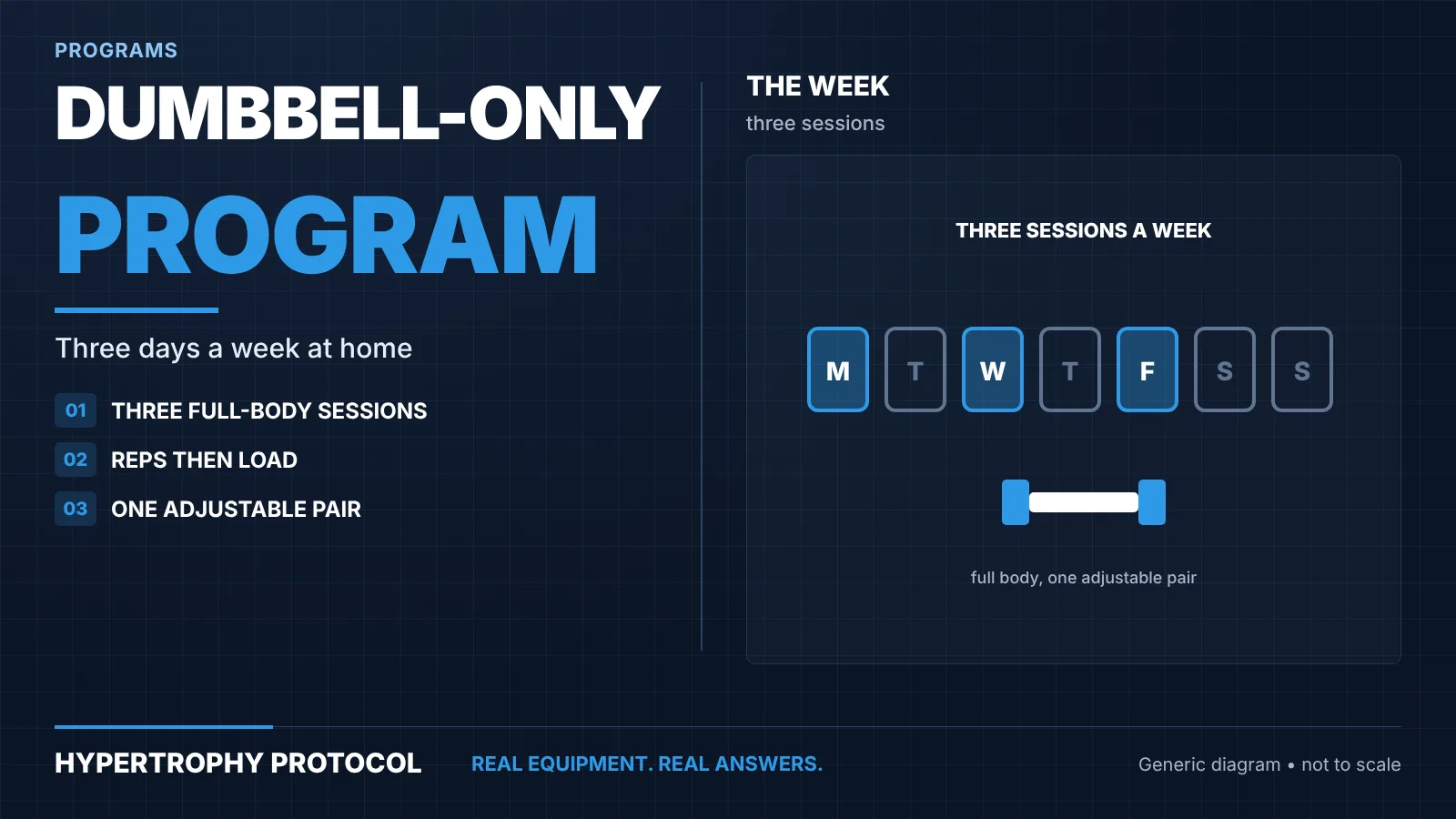
If all you have is a set of dumbbells and an adjustable bench, you can still run a science-based hypertrophy program. The research that matters most doesn’t care what the weight is attached to: take sets close to failure, do enough hard sets for each muscle every week, use a full range of motion, and keep adding reps or load. This 3-day full-body program does that with nothing else.
The one real limit of dumbbells is load. Once the heaviest pair gets easy for your legs, you need more reps, slower lowering or harder exercise versions. Research shows lighter loads still build muscle when sets go to failure, and the other methods help you get there with the weights you have.
At a glance
| Verdict | Dumbbells and a bench are enough to train every major muscle hard. Lower-body load is the limit to plan around. |
|---|---|
| Key numbers | Light and heavy loads grew muscle similarly when sets went to failure (21 studies). Each extra weekly set was linked to about 0.37% more growth. |
| Evidence strength | Strong for the principles (meta-analyses). The exact program is an example built from them, not a tested protocol. |
| What to do | Train 3 full-body days a week, 2 to 3 hard sets per exercise, 1 to 3 reps short of failure, and add reps before weight. |
| Main caveat | Hamstring curls are awkward with dumbbells; a cheap Nordic anchor or a cable fills that gap. |
General information, not medical advice. See the study table below for sources.
What makes a dumbbell program science-based?
- Load range is flexible. In a meta-analysis of 21 studies where every set went to failure, light loads (60% of max or less) and heavy loads built similar muscle, though heavy loads built more maximal strength (Schoenfeld et al., 2017). That is why a 30-rep set of goblet squats can still grow your legs when your dumbbells top out.
- Effort matters for growth. A 2024 series of meta-regressions found muscle growth improved as sets ended closer to failure, while strength gains were similar across a wide range (Robinson et al., 2024). The authors called it exploratory, so treat it as a direction, not an exact number.
- Weekly sets add up. A meta-analysis of 15 studies found a graded dose response: each extra weekly set was linked to about 0.37% more growth (an effect size of 0.023 per set). The highest category studied was 10 or more sets per muscle per week, but that three-group comparison only reached a trend (P = 0.074), so it isn’t a proven ceiling or minimum (Schoenfeld et al., 2017).
- Stretch under load. Exercises that load a muscle when it’s long, like incline curls, overhead triceps extensions and Romanian deadlifts, look especially good for growth. See training at long muscle lengths.
What equipment do you need?
- Dumbbells that go heavy enough for rows and Romanian deadlifts. Adjustable dumbbells save space.
- An adjustable bench for incline pressing, chest-supported rows and incline curls.
- A step or sturdy plate for calf raises and heel-elevated goblet squats.
- Optional: a door or bench anchor for Nordic curls, or a pull-up bar.
The 3-day full-body program
Train on three non-consecutive days, for example Monday, Wednesday and Friday. Rest 1 to 3 minutes between sets: longer for squats and presses, shorter for raises and curls. How long to rest between sets covers why.
Day A
| Exercise | Sets x reps | Main muscles |
|---|---|---|
| Goblet squat, heels elevated | 3 x 10 to 20 | Quads, glutes |
| Dumbbell Romanian deadlift | 3 x 8 to 15 | Hamstrings, glutes |
| Incline dumbbell press | 3 x 8 to 12 | Upper chest, front delts, triceps |
| One-arm dumbbell row | 3 x 8 to 15 each side | Lats, mid back, biceps |
| Lateral raise | 3 x 12 to 25 | Side delts |
| Incline curl | 2 x 10 to 15 | Biceps (long length) |
| Overhead triceps extension | 2 x 10 to 15 | Triceps (long length) |
| Calf raise off a step, one leg | 3 x 10 to 20 each leg | Calves |
Day B
| Exercise | Sets x reps | Main muscles |
|---|---|---|
| Bulgarian split squat | 3 x 8 to 15 each leg | Quads, glutes |
| Single-leg Romanian deadlift or dumbbell hip thrust | 3 x 10 to 15 | Glutes, hamstrings |
| Flat dumbbell press | 3 x 8 to 12 | Chest, triceps |
| Chest-supported row on the incline bench | 3 x 10 to 15 | Mid back, rear delts |
| Dumbbell pullover | 2 x 10 to 15 | Lats, chest |
| Calf raise off a step, one leg | 3 x 10 to 20 each leg | Calves |
| Hammer curl | 2 x 10 to 15 | Biceps, forearms |
| Lateral raise | 3 x 12 to 25 | Side delts |
Day C
| Exercise | Sets x reps | Main muscles |
|---|---|---|
| Dumbbell reverse lunge or step-up | 3 x 10 to 15 each leg | Quads, glutes |
| Dumbbell Romanian deadlift | 3 x 8 to 15 | Hamstrings, glutes |
| Dumbbell fly | 2 x 10 to 15 | Chest (long length) |
| Seated dumbbell shoulder press | 3 x 8 to 12 | Front delts, triceps |
| One-arm dumbbell row | 3 x 8 to 15 each side | Lats, mid back |
| Rear delt raise | 3 x 12 to 20 | Rear delts |
| Dumbbell skull crusher | 2 x 10 to 15 | Triceps |
| Incline curl | 2 x 10 to 15 | Biceps (long length) |
Counting every set once for each muscle listed next to it, every major muscle gets at least 6 hard sets a week, and most get 9 or more. The delts and calves sit at 6, and the front delts get theirs from pressing. If you recover well after the first month, add a set to the exercises for the muscles you most want to grow.
How hard should each set be?
Finish most sets with 1 to 3 reps left in the tank, and take the last set of each isolation exercise (raises, curls, extensions) close to failure. Use the rep ranges as a guide: if you can do more than the top of the range with good form, the weight is too light.
How do you progress when your dumbbells run out?
Use double progression. Stay at one weight until you hit the top of the rep range on every set, then go up. When you reach your heaviest dumbbells, keep progressing with:
- More reps. In the load meta-analysis above, light loads built as much muscle as heavy ones when sets were taken to failure, so push high-rep sets very close to failure.
- One side at a time. Split squats and single-leg Romanian deadlifts put close to your full dumbbell load on one leg at a time. The unilateral training guide covers the evidence.
- Slower lowering and a pause in the stretched position.
- A harder version: heels-elevated goblet squats instead of regular ones, deficit split squats, or a longer range.
When even that runs out, it’s time to add equipment. Progressive overload in a small home gym covers the options, and a rack and barbell is usually the next big step.
What does a dumbbell-only gym miss?
- Hamstring curls. A dumbbell leg curl lying face down is awkward. A Nordic curl with an anchor, or a cable or leg curl attachment later, fills this gap.
- Heavy leg loading. Strong lifters outgrow dumbbell squats. Single-leg work and high reps buy a lot of time.
- Vertical pulling. Rows and pullovers cover the lats, but a pull-up bar is a cheap addition that adds a lot.
How strong is the evidence, study by study?
| Study | What it covered | Type | Main finding |
|---|---|---|---|
| Schoenfeld 2017 (J Strength Cond Res) | 21 studies, all sets to failure | Meta-analysis | Light and heavy loads built similar muscle; heavy loads built more 1RM strength |
| Robinson 2024 | Studies estimating reps in reserve | Meta-regressions | Muscle growth improved as sets ended closer to failure; strength similar across a wide range |
| Schoenfeld 2017 (J Sports Sci) | 15 studies, 34 groups | Meta-analysis | Each extra weekly set linked to about 0.37% more growth |
Who should check with a doctor first?
If you have heart disease, uncontrolled blood pressure, a recent injury or surgery, or you’re starting after years of inactivity, check with your doctor before training hard. Start with lighter weights and fewer sets for the first two weeks either way.
Your next step: pick your three training days, run the program for 8 to 12 weeks, and log every set. When you add a rack and barbell, move on to the 12-week hypertrophy training program, and use the weekly sets planner to keep your volume on track.