
Last reviewed October 20, 2026. This program is built from published research, and every number below comes from the study linked beside it. This is general training information, not medical advice.
This hypertrophy training program runs 12 weeks on a power rack, barbell, plates, an adjustable bench and adjustable dumbbells. It trains every muscle two or three times a week, starts the big muscles at about 8 to 12 hard sets per week and adds one or two in the second block, keeps most sets 1 to 3 reps short of failure, and adds reps before it adds weight. Run the 4-day upper/lower split if you can train four days a week, and the 3-day full-body version if you can’t.
Each design choice traces back to meta-analyses on weekly sets, frequency, effort and load, and the sections below say where that evidence is thin. Whether you’re starting in January or on any other Monday, the tables are the program. Print them, write in your weights, and start.
What does the 12-week program look like?
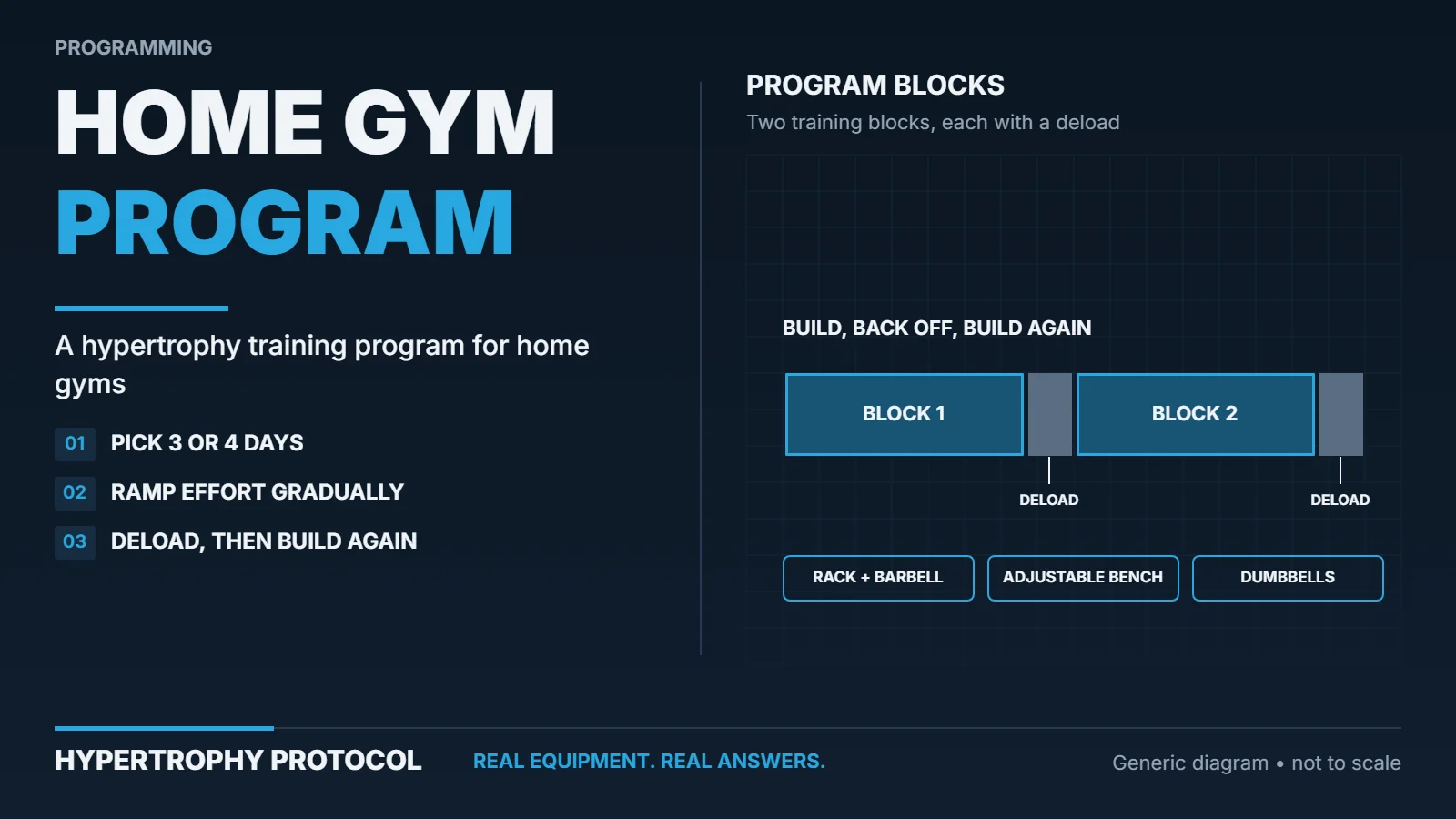
The 12 weeks split into two 5-week training blocks, each followed by an easier week. Block 2 repeats Block 1 with one extra set on the exercises marked with an asterisk (*) in the day tables, and effort climbs within each block.
| Weeks | Phase | Sets | Compound lifts (reps in reserve) | Isolation lifts (reps in reserve) |
|---|---|---|---|---|
| 1 | Ramp-in | Block 1 sets | 3 | 3 |
| 2 | Block 1 | Block 1 sets | 2 | 2 |
| 3 | Block 1 | Block 1 sets | 2 | 1 |
| 4 | Block 1 | Block 1 sets | 1 | 1 |
| 5 | Block 1 | Block 1 sets | 1 | 0 to 1 (last set to failure) |
| 6 | Deload | Half the sets, same weights | 4 or more | 4 or more |
| 7 | Block 2 | Block 2 sets (+1 on * exercises) | 2 | 2 |
| 8 | Block 2 | Block 2 sets | 2 | 1 |
| 9 | Block 2 | Block 2 sets | 1 | 1 |
| 10 | Block 2 | Block 2 sets | 1 | 0 to 1 (last set to failure) |
| 11 | Block 2 | Block 2 sets | 1 | 0 to 1 (last set to failure) |
| 12 | Deload | Half the sets, same weights | 4 or more | 4 or more |
Reps in reserve (RIR) is how many more clean reps you could have done when you stopped the set. Two in reserve means you racked the bar knowing two more were there. Barbell compound lifts never drop below 1 in reserve in this plan, because a failed squat or bench rep alone in a garage is a safety problem, not a growth tool.
Should you run the 3-day or the 4-day version?
Run whichever schedule you will keep for 12 weeks. Both versions train each muscle two or three times a week, and when total sets are matched, how you spread them across the week makes little difference to growth (the frequency research is below).
| Day | 4-day upper/lower | 3-day full body |
|---|---|---|
| Monday | Upper A | Full Body A |
| Tuesday | Lower A | Off |
| Wednesday | Off | Full Body B |
| Thursday | Upper B | Off |
| Friday | Lower B | Full Body C |
| Saturday | Off | Off |
| Sunday | Off | Off |
The 4-day version fits more weekly sets into sessions of a similar length. The 3-day version lands nearer the low end of the volume range for most muscles, which is a fair trade if it’s the schedule you’ll stick to. If a fixed weekday doesn’t work, keep the sessions in order and get all of them done within the week.
What is the 4-day upper/lower hypertrophy program?
Each table lists Block 1 sets first and Block 2 sets second. Rest is the time between sets of the same exercise. The cable column is optional; every exercise works without one.
Upper A (Monday)
| # | Exercise | Sets (Block 1 / 2) | Reps | Rest | Cable option |
|---|---|---|---|---|---|
| 1 | Barbell bench press | 3 / 3 | 6–10 | 2–3 min | Not needed |
| 2 | Pull-up or chin-up | 3 / 3 | 6–12 | 2–3 min | Lat pulldown |
| 3 | Incline dumbbell press, 30–45° * | 3 / 4 | 8–12 | 2 min | Not needed |
| 4 | Chest-supported dumbbell row * | 3 / 4 | 8–12 | 2 min | Seated cable row |
| 5 | Dumbbell lateral raise * | 3 / 4 | 12–20 | 1.5 min | Cable lateral raise |
| 6 | Overhead dumbbell triceps extension | 2 / 2 | 10–15 | 1.5 min | Overhead cable triceps extension |
| 7 | Incline dumbbell curl | 2 / 2 | 10–15 | 1.5 min | Cable curl, facing away from the pulley |
Lower A (Tuesday)
| # | Exercise | Sets (Block 1 / 2) | Reps | Rest | Cable option |
|---|---|---|---|---|---|
| 1 | Barbell back squat | 3 / 3 | 6–10 | 3 min | Belt squat, if you have one |
| 2 | Barbell Romanian deadlift | 3 / 3 | 8–12 | 2–3 min | Not needed |
| 3 | Dumbbell Bulgarian split squat * | 2 / 3 | 8–12 each leg | 2 min | Not needed |
| 4 | Leg curl (Nordic or slider curl) | 3 / 3 | 6–12 | 2 min | Seated or standing cable leg curl |
| 5 | Standing calf raise, dumbbell in hand * | 3 / 4 | 10–15 | 1.5 min | Not needed |
Upper B (Thursday)
| # | Exercise | Sets (Block 1 / 2) | Reps | Rest | Cable option |
|---|---|---|---|---|---|
| 1 | Incline barbell press, 30–45° | 3 / 3 | 6–10 | 2–3 min | Not needed |
| 2 | One-arm dumbbell row | 3 / 3 | 8–12 each side | 2 min | One-arm cable row |
| 3 | Chin-up or neutral-grip pull-up * | 3 / 4 | 6–12 | 2–3 min | Lat pulldown |
| 4 | Flat dumbbell fly * | 2 / 3 | 10–15 | 1.5 min | Cable fly |
| 5 | Chest-supported rear-delt fly | 2 / 2 | 12–20 | 1.5 min | Cable reverse fly |
| 6 | Barbell or dumbbell curl | 2 / 2 | 8–12 | 1.5 min | Cable curl |
| 7 | Lying dumbbell triceps extension | 2 / 2 | 10–15 | 1.5 min | Overhead cable triceps extension |
Lower B (Friday)
| # | Exercise | Sets (Block 1 / 2) | Reps | Rest | Cable option |
|---|---|---|---|---|---|
| 1 | Front squat or high-bar back squat | 3 / 3 | 8–12 | 3 min | Belt squat, if you have one |
| 2 | Barbell hip thrust * | 3 / 4 | 8–12 | 2 min | Not needed |
| 3 | Dumbbell reverse lunge * | 2 / 3 | 10–12 each leg | 2 min | Not needed |
| 4 | Leg curl (Nordic or slider curl) * | 3 / 4 | 6–12 | 2 min | Seated or standing cable leg curl |
| 5 | Single-leg calf raise, dumbbell in hand | 3 / 3 | 10–15 each leg | 1.5 min | Not needed |
| 6 | Dumbbell lateral raise | 2 / 2 | 12–20 | 1.5 min | Cable lateral raise |
Upper days run 17 to 22 working sets and lower days 14 to 19. To save time, pair the last two exercises of an upper day as a superset: a set of curls, then a set of triceps work, then rest. Keep the heavy barbell lifts as straight sets.
Warm up with two to four lighter ramp-up sets on the first lift of each day, and one on the first exercise for each new muscle after that. Warm-up sets don’t count toward the sets in the tables. The guide to building a hypertrophy workout covers ramp-up sets, exercise order and supersets in more detail.
What is the 3-day full-body version?
Same rules, same progression, three sessions. Each one opens with a squat or hinge and a press, then fills in back, legs and smaller muscles.
Full Body A (Monday)
| # | Exercise | Sets (Block 1 / 2) | Reps | Rest | Cable option |
|---|---|---|---|---|---|
| 1 | Barbell back squat | 3 / 3 | 6–10 | 3 min | Belt squat, if you have one |
| 2 | Barbell bench press | 3 / 3 | 6–10 | 2–3 min | Not needed |
| 3 | Chest-supported dumbbell row * | 3 / 4 | 8–12 | 2 min | Seated cable row |
| 4 | Leg curl (Nordic or slider curl) | 3 / 3 | 6–12 | 2 min | Seated or standing cable leg curl |
| 5 | Dumbbell lateral raise * | 3 / 4 | 12–20 | 1.5 min | Cable lateral raise |
| 6 | Overhead dumbbell triceps extension | 2 / 2 | 10–15 | 1.5 min | Overhead cable triceps extension |
Full Body B (Wednesday)
| # | Exercise | Sets (Block 1 / 2) | Reps | Rest | Cable option |
|---|---|---|---|---|---|
| 1 | Barbell Romanian deadlift | 3 / 3 | 8–12 | 2–3 min | Not needed |
| 2 | Incline dumbbell press, 30–45° * | 3 / 4 | 8–12 | 2 min | Not needed |
| 3 | Pull-up or chin-up | 3 / 3 | 6–12 | 2–3 min | Lat pulldown |
| 4 | Dumbbell Bulgarian split squat * | 2 / 3 | 8–12 each leg | 2 min | Not needed |
| 5 | Standing calf raise, dumbbell in hand | 3 / 3 | 10–15 | 1.5 min | Not needed |
| 6 | Incline dumbbell curl | 2 / 2 | 10–15 | 1.5 min | Cable curl, facing away from the pulley |
Full Body C (Friday)
| # | Exercise | Sets (Block 1 / 2) | Reps | Rest | Cable option |
|---|---|---|---|---|---|
| 1 | Front squat or high-bar back squat | 3 / 3 | 8–12 | 3 min | Belt squat, if you have one |
| 2 | Incline barbell press, 30–45° | 3 / 3 | 6–10 | 2–3 min | Not needed |
| 3 | One-arm dumbbell row * | 3 / 4 | 8–12 each side | 2 min | One-arm cable row |
| 4 | Leg curl (Nordic or slider curl) * | 2 / 3 | 6–12 | 2 min | Seated or standing cable leg curl |
| 5 | Flat dumbbell fly | 2 / 2 | 10–15 | 1.5 min | Cable fly |
| 6 | Dumbbell lateral raise, paired with 7 | 3 / 3 | 12–20 | 1.5 min after each pair | Cable lateral raise |
| 7 | Standing calf raise, dumbbell in hand | 3 / 3 | 10–15 | 1.5 min after each pair | Not needed |
The 3-day version gives arms the least direct work. If arms are a priority, add 2 sets of curls and 2 sets of lying triceps extensions to Full Body C as a superset at the end.
How many sets per muscle does each version give you?
These are hard working sets per muscle per week, counting only exercises that train the muscle directly. The notes column shows the indirect work that also counts, at half value (the reason is in the next section).
| Muscle | 4-day, Block 1 / 2 | 3-day, Block 1 / 2 | Notes |
|---|---|---|---|
| Chest | 11 / 13 | 11 / 12 | Flat and incline presses, flys |
| Lats and upper back | 12 / 14 | 9 / 11 | Pull-ups, chin-ups, rows |
| Quads | 10 / 12 | 8 / 9 | Squats, split squats, lunges |
| Hamstrings | 9 / 10 | 8 / 9 | Romanian deadlifts, leg curls |
| Glutes | 3 / 4 | 0 / 0 | Plus every squat, lunge, split squat and Romanian deadlift |
| Side delts | 5 / 6 | 6 / 7 | Plus pressing |
| Rear delts | 2 / 2 | 0 / 0 | Plus every row |
| Biceps | 4 / 4 | 2 / 2 | Plus 9 to 14 sets of rows and pull-ups |
| Triceps | 4 / 4 | 2 / 2 | Plus 9 or 10 sets of pressing |
| Calves | 6 / 7 | 6 / 6 | Standing and single-leg raises |
Why does the program use about 8 to 14 sets per muscle per week?
In both of the main dose-response meta-analyses, more weekly sets meant more growth, and the newer one shows each added set is worth a little less. A 2017 meta-analysis of 15 studies found that each additional weekly set was associated with a 0.37% larger gain in muscle size, and higher-volume conditions beat lower-volume ones by 3.9% in percentage gain (Schoenfeld et al., 2017). Its comparison of fewer than 5, 5 to 9, and 10 or more sets per muscle per week only trended toward 10 or more (p = 0.074), so 10 sets is a guideline, not a proven threshold.
A meta-regression published online in December 2025 pooled 67 studies and 2,058 participants (Pelland et al., 2026). Growth kept rising as weekly sets rose, with diminishing returns. The authors also found that counting an indirect set, such as a row for the biceps, as half a set predicted results better than counting it fully or not at all. That is why the table above lists rows under biceps and presses under triceps.
This program starts the big muscles at 8 to 12 direct sets and adds one or two in Block 2. That is enough to grow on, it leaves room to push each set hard, and it fits a home session. You can add sets in a later block if recovery and time allow. Within the range these studies covered, the returns shrink but don’t disappear.
Why train each muscle at least twice a week?
Twice a week is the easiest way to fit 10 or more sets without stacking them all in one session. A 2016 meta-analysis of 10 studies found that training a muscle more often produced a larger effect size than training it less often (0.49 vs 0.30), and its authors concluded that major muscles should be trained at least twice a week (Schoenfeld et al., 2016).
A larger 2019 update of 25 studies softened that. When total sets were matched, frequency made no significant difference, including in trained lifters and for upper and lower body separately (Schoenfeld et al., 2019). Pelland’s analysis agreed: frequency’s effect on growth was compatible with a negligible one, though strength gains rose with more frequent training.
Taken together, frequency is a way to spread your sets, not a growth lever on its own. That is why the 3-day and 4-day versions are equally valid, and why the 4-day version’s real advantage is room for more sets.
Why these effort targets, rep ranges and exercises?
Each of these choices comes from research covered in detail in the guide to building a hypertrophy workout. Here is the short version, and how this program applies it.
- Effort. Muscle growth improves as sets end closer to failure, but true failure adds little over stopping just short of it (Refalo et al., 2023; Robinson et al., 2024). Barbell lifts stay 1 to 3 reps short, which keeps them safe and repeatable. Isolation lifts go to 0 or 1 in reserve late in each block.
- Rep ranges. Light and heavy loads build similar muscle when sets are hard (Schoenfeld et al., 2017). Compound lifts sit at 6 to 12 reps, because long sets of squats tend to end from breathing before the legs are near failure. Isolation lifts sit at 10 to 20, because heavy, low-rep lateral raises and curls are hard to do with clean form.
- Exercises. Several picks load the muscle while it is stretched: overhead and lying triceps extensions, incline curls, Romanian deadlifts, deep split squats and flys. Single small trials favored that position for the triceps and hamstrings (Maeo et al., 2023; Maeo et al., 2021), so treat it as a tie-breaker between otherwise similar exercises. The guide to training at long muscle lengths covers the full evidence and its limits.
Hamstrings are the weak spot in most home gyms. A Nordic or slider curl bends the knee with the hip straight, like a lying leg curl, which grew the hamstrings less than a seated curl in that trial. If your hamstrings lag, a cable you can do seated leg curls on is the upgrade worth making.
Split squats, reverse lunges and one-arm rows train one side at a time, which needs less weight for the same effort. The guide to unilateral training for muscle growth covers what single-side work does and doesn’t add.
How do you progress from week to week?
Use double progression: add reps inside the range first, then add weight. Every set should land on that week’s reps-in-reserve target.
- Start each exercise at a weight that lets you reach the bottom of its rep range at the week’s target.
- Each session, try to add a rep to at least one set at the same reps in reserve.
- When every set reaches the top of the range at the target, add the smallest weight jump you have and drop back toward the bottom of the range.
- Write down the weight and reps of every set. Progress you don’t record is a guess.
Say you bench 185 lb for 8, 8 and 7 in week 2, each with 2 reps left. Next session, aim for 9, 8 and 8. Once all three sets reach 10 at the target, add the smallest jump your plates allow, such as 5 lb with a pair of 2.5s, and start again near 7. Because the target tightens toward 1 in reserve across each block, some weekly gains will come from effort alone. That is expected, and week 1 is your baseline.
Adjustable dumbbells move in fixed steps, and a 5 lb jump is a big share of a light lateral raise. When the next step is too big, stay at the weight and stretch the rep range upward first. Progressive overload in a small home gym lays out that ladder step by step. For barbell lifts, the Barbell Plate Capacity Calculator shows the plates per side for any target weight.
How does the deload work?
In weeks 6 and 12, do half the sets of every exercise, rounding up, keep the same weights, and stop each set with 4 or more reps in reserve. The point is to shed fatigue so the next block starts fresh.
The evidence on deloads and muscle growth is thin. In one trial of 39 trained lifters, a full week off at the midpoint of a 9-week program didn’t change lower-body muscle growth compared with training straight through, though the group that kept training gained more strength (Coleman et al., 2024). That suggests an easier week costs little muscle. The half-sets format used here is a common practical choice that no study has compared head to head.
How do you set up a home gym to run it?
- Set your safeties. Set the rack’s safety arms just below the bottom of your squat, and just below where the bar touches your chest for bench and incline press.
- Find your incline notch. Most adjustable benches don’t label their angles. Check each notch with a phone level and pick the one closest to 30 to 45 degrees. The guide to incline bench angle for upper chest explains why that range.
- Plan for the dumbbell ceiling. I use NÜOBELL 80 lb adjustable dumbbells, and with a set that size, split squats and one-arm rows are the lifts most likely to outgrow them. When a dumbbell exercise does, switch to the barbell version: a barbell split squat in the rack or a barbell row.
- Scale your pull-ups. If you can’t do 6 yet, use a band for assistance or do slow lowering reps from the top, and count those as your sets.
- Pick a leg curl you can do. For Nordic curls, anchor your heels under something solid and padded, and lower yourself as slowly as you can; most people need a band or a push-off from the floor at first. Slider curls need a smooth floor and won’t glide on rubber mats.
- Swap squats for belt squats if your back needs it. I moved from barbell squats to belt squats to reduce spinal loading as I get older, and I belt squat with a Beyond Power VOLTRA I while standing on plyo boxes. Any squat slot in these tables can take a belt squat at the same sets, reps and effort.
What changes if you add a cable or pulley?
Nothing about sets, reps or effort. The cable column swaps in exercises that fill the gaps free weights leave, mainly lat pulldowns for anyone who can’t do enough pull-ups yet and seated leg curls for the hamstrings. Machines and free weights build similar muscle in the research, as covered in machines vs free weights for muscle growth.
My own cable work runs on an Innodigym P1 Max with two Rogue solo pulleys and a Rogue TRD pulldown. If your pulley runs a 2:1 ratio, the handle carries about half the load you put on, so weights won’t match a 1:1 machine or a dumbbell. The Cable Pulley Ratio Calculator works out the resistance at the handle, and cable attachments for hypertrophy matches handles to each swap.
Is this the best hypertrophy program?
No study has crowned a best hypertrophy program, and none could, because the research tests ingredients rather than whole plans. What it does support is enough weekly sets, each muscle trained twice a week or the same sets spread another way, sets taken close to failure, steady progression, and enough food and sleep to recover. Any program built from those will work. The best one for you is the one you run for all 12 weeks.
Change exercises freely within the same movement pattern if one hurts or your equipment differs, and keep the sets, reps and effort targets. Set your protein with the Protein Calculator, since training without enough of it leaves growth on the table.
What should you do after week 12?
Run it again with new variations. Change the squat variant, the row, the incline angle or the curl, and start a little above your week 1 weights. Your logbook from the first 12 weeks tells you which lifts moved and which stalled, and the stalled ones are the first to swap.
FAQ
Can you run this program with only dumbbells?
Mostly. Swap the barbell presses for dumbbell presses and the Romanian deadlift for a dumbbell version. Legs are where dumbbells run out first, so lean on split squats and reverse lunges, and add reps and range before you need heavier weights.
Is this program right for a beginner?
Yes. Start week 1 at 3 reps in reserve, spend the first sessions learning the lifts, and keep the Block 1 sets through Block 2 if you’re still sore going into each session. Beginners tend to progress quickly on any reasonable plan, so the logbook matters more than the exact numbers.
What if you miss a session?
Do the next session in the order and carry on. Don’t double up two sessions in one day. If you miss a full week, repeat the last week you completed.
How much muscle will you gain in 12 weeks?
It varies with training history, diet and genetics. In Maeo’s two 12-week trials, whole-muscle gains ran from 9% to about 20%, depending on the muscle and the exercise. Treat those as examples from small studies, not a forecast.
Related guides
- Hypertrophy workout: how to build a session that grows muscle
- Progressive overload in a small home gym
- Training at long muscle lengths
- Mechanical tension and muscle growth
- Machines vs free weights for muscle growth
- Unilateral training for muscle growth
- Incline bench angle for upper chest
- Barbell Plate Capacity Calculator
- Protein Calculator
- All free tools
1 thought on “Hypertrophy Training Program for a Home Gym”
Comments are closed.