
Prices, specs and energy costs were checked on manufacturer, retailer and EIA pages on October 13, 2026. This page contains no affiliate links.
For a typical attached two-car garage gym with no insulation, you need about 17,000–21,000 BTU/hr to hold 55°F on a 20°F morning. That’s a 5,000–7,500 W, 240 V electric garage heater, which costs about $1.45 a workout to run at the US average electricity price. Insulate the same garage and the heat loss drops by about two-thirds. A plug-in 1,500 W space heater only keeps up in a small, well-insulated room. Use the calculator below with your own garage and prices; it also shows which part of the building is losing the most heat.
At a glance
| Heater type | Example (Oct 2026 price) | Running cost* | Best for | Main catch |
|---|---|---|---|---|
| 240 V electric heater | NewAir G56, 5,600 W, $199.99 | $25/month | Most garage gyms | Needs its own 240 V circuit; have an electrician check it |
| Mini-split heat pump | MRCOOL DIY 12K Hyper Heat, $2,557 sale | $10/month | Year-round use; it also cools | Highest up-front cost; may fall short in an uninsulated two-car garage |
| Vented gas unit heater | Mr. Heater Big Maxx 50,000 BTU, $913.87 | $8/month | Big or detached garages with gas | Gas line, vent, gas fitter and permit |
| Portable propane heater | Mr. Heater Big Buddy, $240.26 | $121/month on 1 lb cylinders | Occasional backup only | Cylinder rules, condensation and carbon monoxide risk |
*For the article’s example: a 20 x 20 ft uninsulated attached garage, four 60-minute workouts a week with 30 minutes of warm-up, at 18.3 cents/kWh, $1.44/therm and $5.56/lb propane. Insulating cut that garage’s heat loss by 67%. Prices and specs checked October 13, 2026. Confirm before ordering.
1. Your garage
2. Insulation and drafts
3. Temperatures and use
4. Energy prices
| Where the heat goes | BTU/hr | Share |
|---|
Featured image: AI-generated concept illustration, not a photograph of a specific product or an actual installation.
How to size a garage gym heater
Rules of thumb like “10 watts per square foot” ignore the things that decide how much heat a garage actually loses: the garage door, the ceiling, drafts and how cold it is outside. The calculator works it out surface by surface instead. Heat escapes through each surface at its area divided by its R-value, multiplied by the gap between inside and outside temperature. On top of that, warm air leaks out and cold air comes in, and the slab edge pulls heat into the ground.
Here’s what that looks like for a 20 x 20 ft attached garage with 9 ft ceilings, a double steel door, drywall but no insulation, and average drafts, warming from 20°F to 55°F:
| Where the heat goes | BTU/hr | Share |
|---|---|---|
| Ceiling (uninsulated attic above) | 4,667 | 28% |
| Walls (three exterior walls) | 4,280 | 26% |
| Uninsulated garage door | 3,920 | 24% |
| Air leaks | 2,268 | 14% |
| Slab edge | 1,533 | 9% |
| Total | 16,668 | 100% |
A 5,000 W heater puts out 17,065 BTU/hr, so it would only just keep up, with nothing left to warm the room quickly. That’s why the calculator adds a 25% margin and recommends 7,500 W here. A garage gym is heated for an hour at a time, not all day, so warm-up speed matters more than it does for a house.
One thing the numbers don’t show: the air warms in minutes, but the slab, walls and iron stay cold much longer. Turn the heater on 30–45 minutes before you train, and expect bars and plates to feel cold for the first sets.
The four ways to heat a garage gym
| Type | Example (Oct 2026 price) | Up front | Running cost* | Best for |
|---|---|---|---|---|
| 240 V electric heater | NewAir G56, 5,600 W, $199.99 | Low, plus a 240 V circuit | $25/month | Most garage gyms |
| Mini-split heat pump | MRCOOL DIY 12K Hyper Heat, $2,557 sale | High | $10/month | Year-round use; it also cools |
| Vented gas unit heater | Mr. Heater Big Maxx 50,000 BTU, $913.87 | High, plus gas line and vent | $8/month | Big or detached garages with gas |
| Portable propane heater | Mr. Heater Big Buddy, $240.26 | Low | $121/month on 1 lb cylinders | Occasional backup only |
*Running cost is for the example garage above: four 60-minute workouts a week with the heater on 30 minutes beforehand, at 18.3¢/kWh, $1.44/therm and $5.56/lb for 1 lb propane cylinders. Your numbers will differ; the calculator uses yours.
Electric garage heaters: the default choice
A fan-forced 240 V heater is cheap to buy, needs no venting, makes no fumes and has a built-in thermostat. Popular options in October 2026:
| Heater | Power | Draw | Hookup | Price |
|---|---|---|---|---|
| NewAir G56 | 5,600 W | 23.4 A | Plugs into a 240 V NEMA 6-30 outlet | $199.99 (NewAir) |
| Dr. Infrared DR-966 | 3,000/6,000 W | 25 A on high (6,000 ÷ 240) | Hardwired | $249.99 (Tractor Supply) |
| Heat Storm HS6000GC | 6,000 W, Wi-Fi | 25 A (6,000 ÷ 240) | Hardwired (confirm in the manual) | $299.95 (Sylvane) |
| Fahrenheat FUH54 | 2,500–5,000 W | 20.9 A at 240 V | Hardwired, mount at 6 ft | Varies by seller |
The circuit matters as much as the heater. The calculator estimates heating capacity; it does not specify a breaker or wire size. Have an electrician check the exact heater nameplate, installation manual, supply voltage, wiring method and applicable local code before choosing a circuit. For example, the Fahrenheat FUH54C manual specifies copper conductors rated at least 75°C and gives model-specific wiring and mounting requirements. A new 240 V circuit can be a substantial part of the installed cost; our garage sauna wiring calculator provides editable cost examples for wire, breaker, labor and permit.
Don’t run any of these from an extension cord or a dryer outlet adapter, and keep the heater on its own circuit.
Mini-split heat pumps: cheapest to run, best if you train year-round
A heat pump moves heat rather than making it, so it delivers more heat per kWh than a resistance heater. MRCOOL’s DIY 12K Hyper Heat lists heating down to -22°F and an HSPF2 rating of 10 (climate region IV), which works out to a seasonal average of roughly 2.9 units of heat per unit of electricity. Real efficiency drops on the coldest mornings, so the calculator defaults to 2.5. The catch is price: $2,557 on sale, plus a dedicated 230 V circuit (15 A maximum breaker). MRCOOL rates it for up to 550 sq ft, but in an uninsulated two-car garage the heat loss can exceed a 12,000 BTU unit’s output.
The reason a mini-split can still win is summer. It’s the only option here that also cools, which matters as much as heat in a lot of garage gyms.
Vented gas heaters: lowest fuel cost, highest install cost
If your garage already has a gas line nearby, a vented unit heater gives the cheapest heat per hour at winter gas prices. Mr. Heater’s Big Maxx 50,000 BTU natural gas heater is $913.87 direct; it vents through a flue, needs 115 V power for its fan, and has to hang with at least 8 ft between the floor and the base of the heater. Mr. Heater lists it as not indoor-safe, which means it must be vented as the manual specifies.
Budget for a gas fitter and permit on top of the heater. Residential code also requires the ignition source of gas appliances in a garage to sit at least 18 inches above the floor, and wants them protected from vehicle impact unless they’re mounted 6 ft or higher (IRC G2408.2 and G2408.3, as summarized by Knox County, Tennessee).
Portable propane heaters: why they’re a backup, not a plan
Indoor-safe radiant heaters like the Mr. Heater Big Buddy ($240.26, 4,000/9,000/18,000 BTU) are tempting because they need no wiring. Three problems make them a poor main heater for a garage gym:
- Cylinder rules. Fire codes based on NFPA 58 don’t allow propane cylinders larger than 1 lb to be stored or used inside a home, and Minnesota’s State Fire Marshal says that includes attached and detached garages. Check your local fire code, but in many places that rules out a 20 lb tank on a hose indoors.
- Cost. One-pound cylinders cost about $5.56 per pound of propane ($11.12 for a Coleman two-pack at Walmart). That’s why propane comes out at $121 a month in our example, versus $25 for electric.
- Moisture and fumes. Burning propane makes water. By our calculation, a gallon of propane burned produces about 0.8 gallons of water vapor, and in a closed, cold garage that ends up as condensation on bars, plates and rack uprights. The Big Buddy also needs an 18 sq in vent opening near the ceiling and another near the floor, and its manual warns about carbon monoxide.
Never use an outdoor-only propane “torpedo” or forced-air heater in a closed garage.
Insulate before you buy a bigger heater
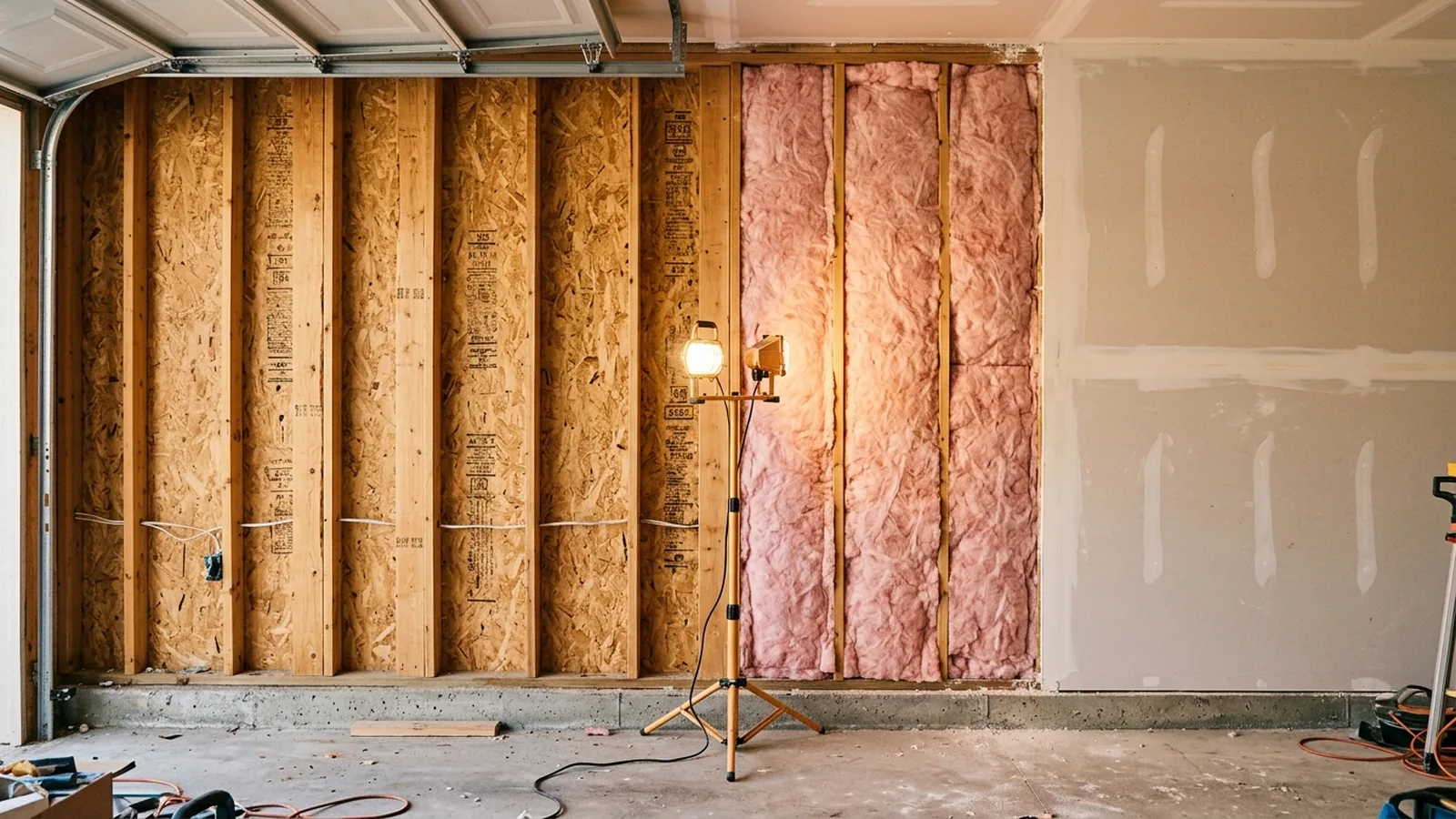
Run the calculator twice: once as your garage is, and once with insulation. In our example, adding R-13 walls, R-30 in the attic, a polystyrene-insulated door and new weatherstripping cuts the heat loss from 16,668 to about 5,500 BTU/hr. That’s a 67% cut, so a 5,000 W heater runs on low and running costs drop by roughly two-thirds.
The calculator’s “largest modeled loss” result tells you where to look first; compare upgrade prices before you decide. In attached garages it’s usually the ceiling or the door. A garage door bottom seal and weatherstripping are the cheapest fixes. Rubber flooring makes the floor feel warmer underfoot, but it doesn’t stop much heat leaving through the slab edge; see our home gym flooring guide for thickness and cost.
Safety checklist
- Fit a carbon monoxide alarm in any garage with a fuel-burning heater, and a smoke alarm regardless.
- Keep the clearances in the manual. The Big Buddy, for example, needs 30 in above and 24 in in front of it.
- Hardwired electric heaters and gas heaters should be installed by a licensed electrician or gas fitter, usually with a permit.
- Keep heaters away from where a bar or plate could hit them, and away from chalk, cleaning products and anything flammable.
The short version
- Most garage gyms: a 5,000–7,500 W, 240 V electric heater on its own circuit. Cheap to buy, simple, about $1–$1.50 a workout uninsulated.
- Train year-round or want cooling too: a mini-split. Costs the most up front and the least to run.
- Big or detached garage with gas available: a vented gas unit heater, professionally installed.
- Avoid as your main heat: portable propane on 1 lb cylinders.
- Before any of it: insulate and seal. It can cut the heater you need by two-thirds.
Frequently asked questions
Can a 1,500 watt space heater heat a garage gym?
A plug-in 1,500 W space heater only keeps up in a small, well-insulated room.
Can I plug a 240V garage heater into a dryer outlet or extension cord?
No. Don’t run a 240 V garage heater from an extension cord or a dryer outlet adapter, and keep the heater on its own circuit. Have an electrician check the exact heater and circuit before you choose.
Can I use a 20 lb propane tank to heat my garage gym?
In many places, no. Fire codes based on NFPA 58 don’t allow propane cylinders larger than 1 lb to be stored or used inside a home, and Minnesota’s State Fire Marshal says that includes attached and detached garages. Check your local fire code.
Do propane heaters cause condensation on gym equipment?
Yes, burning propane makes water. By our calculation, a gallon of propane burned produces about 0.8 gallons of water vapor, and in a closed, cold garage that ends up as condensation on bars, plates and rack uprights.
Sources
- EIA, Electric Power Monthly (average residential electricity price)
- EIA, US residential natural gas price (February 2026: $14.95 per 1,000 cu ft)
- EIA, British thermal units (91,452 Btu per gallon of propane; 1,036 Btu per cu ft of natural gas; 3,412 Btu per kWh)
- EC&M, NEC Article 424: Fixed Electric Space Heating
- Fahrenheat FUH54C / FUH724A installation manual
- NewAir G56 product page
- Dr. Infrared DR-966 at Tractor Supply
- Heat Storm HS6000GC at Sylvane
- MRCOOL DIY 12K Hyper Heat
- Mr. Heater Big Maxx 50,000 BTU natural gas heater
- Mr. Heater Big Buddy and its manual
- Minnesota State Fire Marshal, LP gas inside buildings
- Knox County, TN, garage requirements (IRC G2408.2 and G2408.3)
- Coleman 16 oz propane cylinder 2-pack at Walmart
- ASHRAE Standard 90.1, Appendix A (F-factor for uninsulated slab on grade)
1 thought on “Garage Gym Heater: What Size You Need and What It Costs to Run”
Comments are closed.