
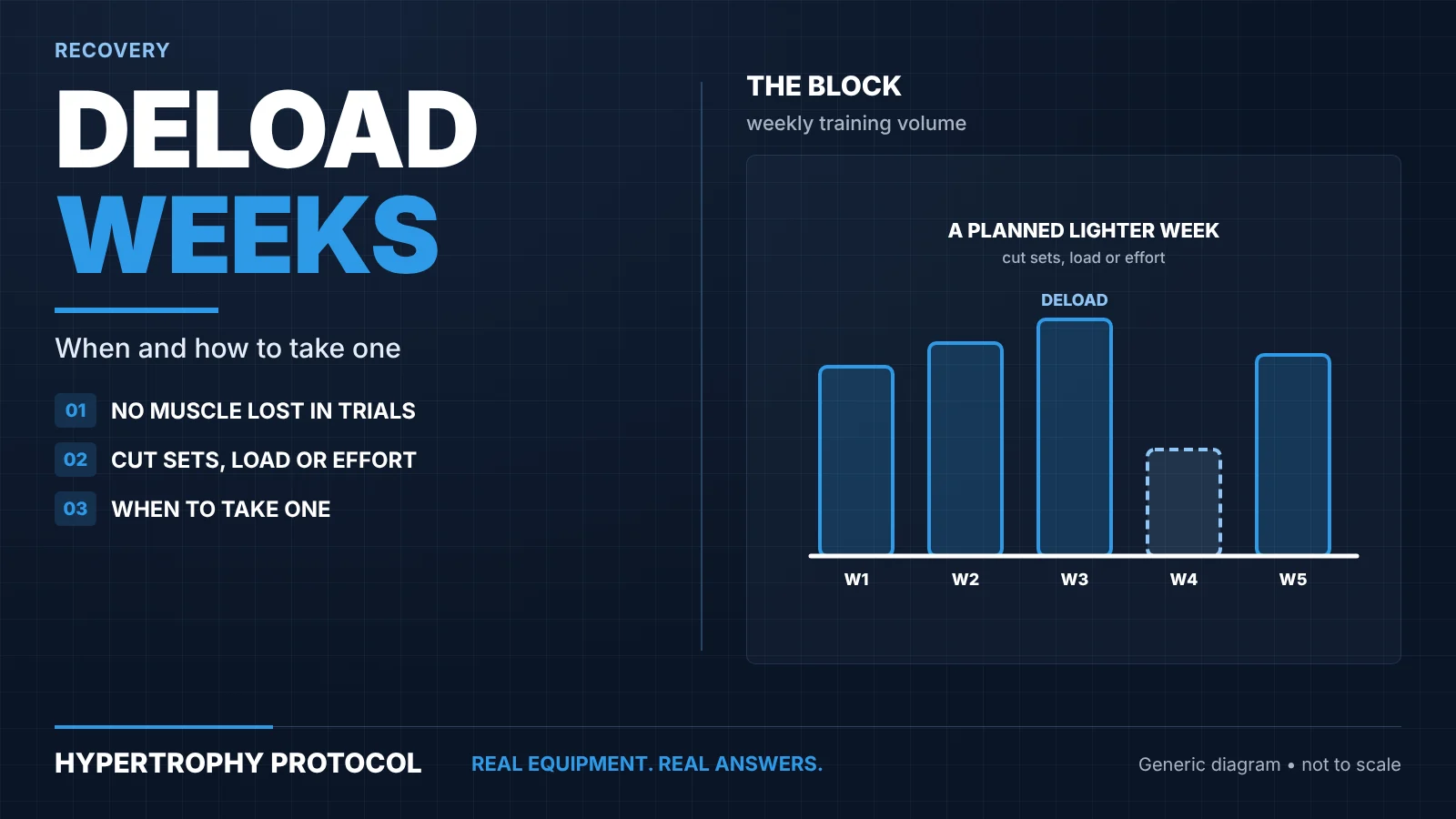
How long should a deload week be? Athletes and coaches who have been asked typically report about 5 to 7 days, with wide variation. In a 2024 survey of 246 competitive strength and physique athletes, the typical deload lasted 6.4 days, and in earlier interviews 18 experienced coaches typically used 5 to 7 days.
You have trained hard for five or six weeks, the weights have stopped moving, and every program you read tells you it is time for a deload week. For muscle growth, the controlled trials point one way: a short planned deload neither costs you size nor adds any. The one real trade-off shows up in strength, where a full week off in trained lifters led to slightly smaller gains than training straight through.
That leaves the choice between scheduled and as-needed deloads mostly up to you, because no trial has compared them. Most advice on sets, load and effort during a deload comes from coaches and athletes, so the tables below mark what was tested and what is practitioner consensus. Every study cited here was checked on PubMed on September 28, 2026.
At a glance
| Verdict | A short planned deload neither costs muscle nor adds any; a full week off slightly slowed strength gains. |
|---|---|
| Effect size / key numbers | Coleman 2024: mid-thigh thickness −0.63 mm (95% CrI −2.8 to 1.5); squat 1RM +13.0 vs +16.4 kg continuous. |
| Evidence strength | Limited: 2 direct deload trials (39 trained adults; 19 untrained men). Most deload advice is coach consensus. |
| What to do | Cut sets by about two-thirds, keep your exercises and sessions, and stop further from failure. |
| Main caveat | No trial has compared scheduled vs as-needed deloads, or tested one after a long, hard block in trained lifters. |
Studies checked on PubMed, September 28, 2026.
What counts as a deload week?
That gap between experiment and experience starts with the definition. In a 2023 Delphi study, strength and physique coaches voted over three rounds and settled on this wording: “Deloading is a period of reduced training stress designed to mitigate physiological and psychological fatigue, promote recovery, and enhance preparedness for subsequent training.” The panel began with 34 coaches and finished with 21.
The definition leaves room on purpose. The coaches agreed that volume comes down, while load can drop, hold steady or even rise. They also agreed that deloading practice rests mainly on coaching experience, because so little research exists.
A deload is also different from a taper. A taper comes right before a competition to peak performance, while a deload can sit anywhere in a program and aims to leave you ready for the next block of hard training.
Does a deload week cost you muscle?
If a deload means doing less work, the natural worry is losing what the work built. Only a few trials test deloads directly, so the table adds detraining studies, where people stopped lifting completely for a set period and then resumed.
| Study | Who and how long | Deload or break | Result |
|---|---|---|---|
| Coleman 2024 (RCT) | 39 trained men and women completed, 9 wk, lower body supervised | No lifting in week 5 vs continuous training | Ultrasound muscle thickness similar at every site (mid-thigh 50%: −0.63 mm, 95% CrI −2.8 to 1.5). Smith machine squat 1RM +13.0 vs +16.4 kg; probability that continuous training was better: 0.851 for 1RM, 0.924 for isometric strength |
| Pancar 2026 (within-subject) | 19 untrained men, 8 wk, leg extension and curl | Weeks 4 and 8 cut to 1 session and 2 sets per exercise, down from 2 sessions and 6 to 8 sets | Muscle thickness and 10RM similar; between-condition effects small (ηp² 0.001 to 0.076), all confidence intervals included zero; 18% fewer total sets |
| Vann 2021 | 30 trained men, 6 wk high-volume block | 1 wk at about 15% of peak-week volume vs no training | Marginal molecular differences, largely similar responses; no training block afterward |
| Ogasawara 2011 | 15 untrained men, 15 wk bench press | 3 wk off after week 6 | No significant drop in MRI muscle size or 1RM during the break; final gains similar |
| Ogasawara 2013 | 14 untrained men, 24 wk bench press | Three 6-wk blocks with 3 wk off between them (18 of 24 weeks trained) | Overall muscle size and strength gains similar to continuous training |
| Halonen 2024 (RCT) | 42 untrained adults completed (45% women), 30 wk | 10 wk training, 10 wk off, 10 wk training | Size and strength fell during the break, came back quickly, and ended similar to continuous training |
| Hwang 2017 | 20 trained men, 10 wk | 4 wk training, 2 wk off, 4 wk training | Leg press strength did not drop after 2 wk off; lean mass held |
| McMahon 2019 | 16 young adults trained, 8 wk | 2 and 4 wk off afterward | Quad size fell from its peak at both points but stayed above baseline |
| Bickel 2011 | 70 adults, 16 wk training then 32 wk | Dose cut to one-third or one-ninth, or stopped | Both reduced doses kept the muscle gained in young adults (20 to 35), not in older adults |
Across these trials, muscle size held up. The two direct deload trials, one with a full week off in trained lifters and one with reduced sets in beginners, ended with muscle thickness matching continuous training. The detraining breaks were far longer than any deload, and people still caught up once they resumed.
Strength is where the Coleman trial leaned the other way. Both groups got stronger, but the continuous group gained a little more on the squat and more on isometric knee extension. Participants often felt lethargic and out of practice after the week off rather than refreshed, and the researchers suspected a reduced-volume week might avoid that.
The limits matter. Most samples were under 40 people, only three trials used trained lifters, and most measured growth in only one or two muscles. Nobody has tested a deload after a long, hard block in trained lifters, which is the situation most people deload for.
Should you schedule a deload week or take one when you need it?
Because muscle size seems safe either way, the scheduling question comes down to how you like to train. In a 2024 survey of 246 competitive strength and physique athletes, the typical deload lasted 6.4 days and came every 5.6 weeks. The athletes split on planning like this.
How 246 strength and physique athletes decide when to deload
Those same athletes were not sure they needed deloads at all, since 65% believed they could keep progressing without them. The most common triggers were the program itself, feeling beaten up, and stalled performance, and about a quarter timed deloads around vacations or trips. In earlier interviews, 18 experienced coaches typically used deloads of 5 to 7 days every 4 to 6 weeks, with wide variation.
The Delphi panel accepted both routes: planned around your life, or triggered when you feel physically or mentally fatigued. No study has compared them for growth. The Coleman team did raise one caution from their strength data, suggesting that a deload taken when you do not feel the need may do more harm than good, and almost none of their participants felt they needed a break after nine hard weeks.
How do you deload for hypertrophy without losing muscle?
Whichever timing you pick, the week itself follows one logic: cut the amount of hard work and keep the movements familiar. The table separates what a trial has tested from what comes from coach and athlete data.
| Variable | What to do in a deload week | Evidence |
|---|---|---|
| Weekly sets | Cut by roughly two-thirds or more | Tested: Pancar cut 6 to 8 sets to 2 with no loss in beginners; Vann used about 15% of peak-week volume. Consensus: 78.9% of surveyed athletes cut sets; the Delphi panel agreed volume comes down. |
| Reps per set | Same or fewer | Consensus only: 52.8% of athletes cut reps, 30.9% kept them. |
| Load on the bar | Same or somewhat lighter | Consensus only: 83.7% of athletes lighten multi-joint lifts; for single-joint lifts, 60.2% lighten and 33.3% keep the load. The Delphi panel accepted an unchanged load only when volume drops. No tested reduction for hypertrophy. |
| Effort (reps in reserve) | Stop further from failure than usual | Consensus only: 84.9% of athletes ease off on multi-joint lifts. No study has tested a specific RIR target. |
| Sessions per week | Keep them, or drop one | Consensus: 63.0% of athletes keep the same number. Tested: Pancar halved frequency with no loss. |
| Exercises | Keep your usual ones | Consensus only: 70.3% keep the same number of multi-joint lifts; the Delphi coaches linked new exercises to extra soreness. |
| Full week off | A fallback, not the default | Tested: Coleman kept muscle size but saw slightly smaller strength gains. |
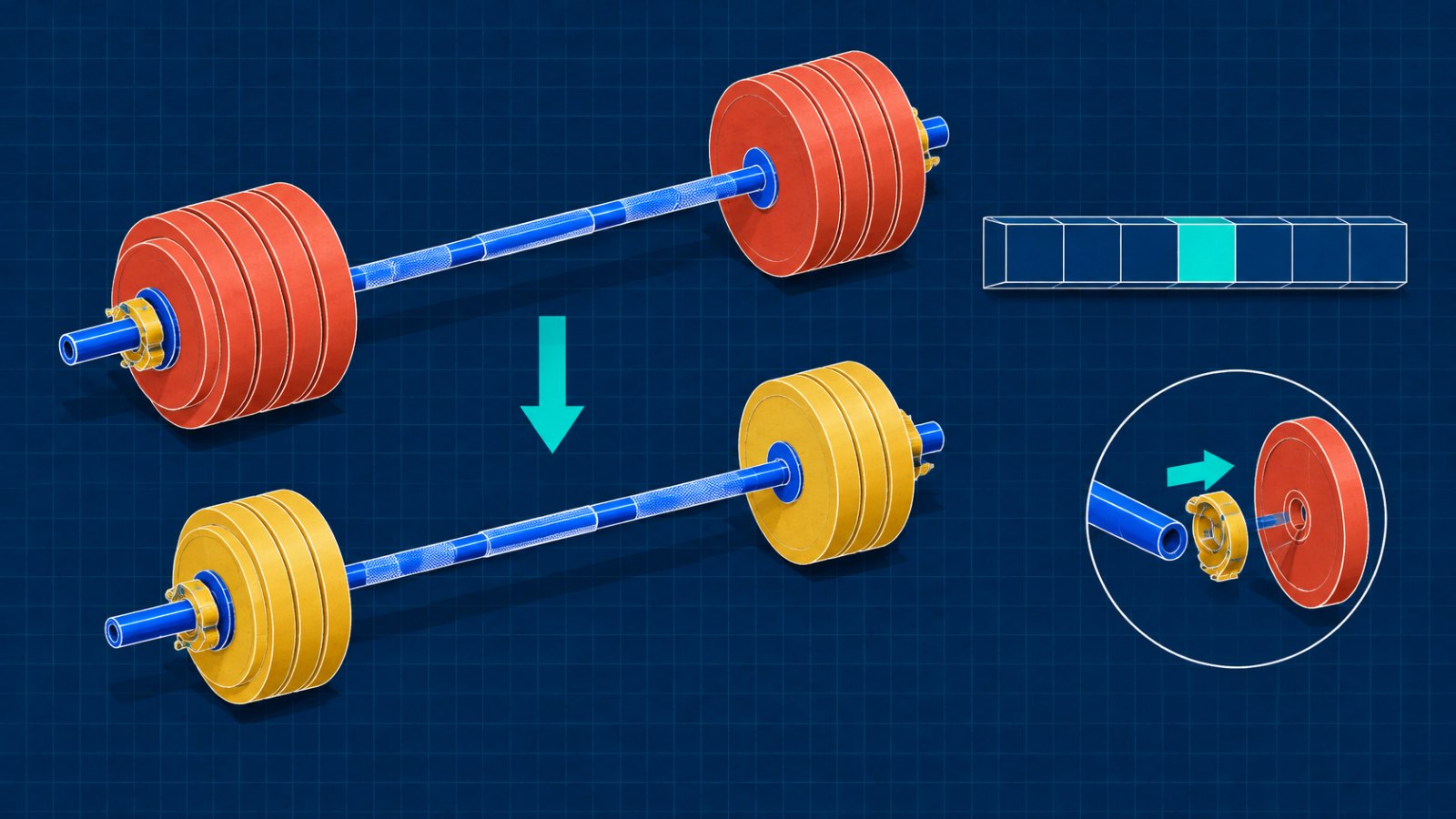
A worked example makes the volume row concrete. Say your normal week has 12 quad sets over two sessions, each taken to 1 or 2 reps in reserve. A deload week keeps both sessions and the same exercises but drops to 4 sets in total, with the same or a slightly lighter load, stopping every set well short of failure.
That is a two-thirds cut in sets, in line with the roughly 66% to 75% set cut the Pancar authors report, though their deload weeks also dropped to one session. No trial has tested a reps-in-reserve target for a deload, so stop each set clearly short of your usual effort and judge the exact margin by feel.
Sessions get shorter because there are fewer sets, so keep your usual rest periods. The Delphi coaches agreed session length could fall or stay the same, and the rest between sets guide covers how long those rests should be for growth.
When does an unplanned deload make sense?
A reduced week like that is also your tool when fatigue arrives off schedule. In the athlete survey, 54.1% deloaded when performance stalled or dropped and 30.5% did so during heavy stress outside the gym, such as work or family demands.
Check whether the problem is one session or the whole week first. If only your heavy leg day keeps leaving you flat, more time between hard sessions may fix it without cutting everything; the leg day recovery guide walks through that window.
Judge the deload by what the athletes used as their test. The most common signs of a deload that worked were fatigue fading (87.8%) and motivation returning (69.5%). If neither happens after a week, the surveyed athletes most often blamed training too heavy or keeping volume too high.
Which deload approach fits your training?
With the evidence this thin, the right choice depends on what you train for and how you like to plan. Find the line that matches you.
- You train mainly for size and progress is steady: a scheduled deload is optional. When you take one, cut sets by about two-thirds rather than stopping, since muscle size held in both direct deload trials.
- You like structure or have predictable busy weeks: plan a reduced week every five or six weeks, close to what surveyed athletes use, and move it to line up with travel.
- You care about strength as much as size: skip full weeks off. Keep the load near normal and cut sets instead, an approach the Delphi coaches accepted. The strength dip in the Coleman trial followed a full stop, and whether a reduced week avoids it is still untested.
- You are in your first months of lifting: the only deload trial in beginners showed a reduced week cost nothing, so take one when life requires it without worrying about lost progress.
Your next step: plan how you will build back after the deload with the progressive overload guide, so the week off heavy work leads into a block with clear targets. Most athletes in the survey started a new block and ramped the difficulty back up, while only 7.3% went straight for a personal record.
Frequently asked questions
How long should a deload last?
Most deload advice comes from coaches and athletes. In a 2024 survey of 246 competitive strength and physique athletes, the typical deload lasted 6.4 days. In earlier interviews, 18 experienced coaches typically used 5 to 7 days, with wide variation.
How often should you deload?
The surveyed athletes deloaded about every 5.6 weeks, and the coaches typically every 4 to 6 weeks, with wide variation. No trial has compared scheduled and as-needed deloads for muscle growth.
Should you lift lighter weights during a deload week?
Many do. In the survey, 83.7% of athletes lighten multi-joint lifts, and for single-joint lifts 60.2% lighten while 33.3% keep the load. That is practice, not a tested rule for hypertrophy. The coaches agreed that volume comes down, while load can drop, hold steady or even rise. The Delphi panel accepted an unchanged load only when volume drops.
Is a full week off as good as a reduced week?
That is still untested. In Coleman 2024, a trial of 39 trained men and women, a full week off in week 5 left muscle thickness similar to continuous training, but strength gains were slightly smaller. Whether a reduced week avoids that strength dip has not been tested. Treat a full week off as a fallback, not the default.
Sources
- Bell L, Strafford BW, Coleman M, Androulakis Korakakis P, Nolan D. Integrating deloading into strength and physique sports training programmes: an international Delphi consensus approach. Sports Med Open. 2023. doi:10.1186/s40798-023-00633-0
- Rogerson D, Nolan D, Androulakis Korakakis P, Immonen V, Wolf M, Bell L. Deloading practices in strength and physique sports: a cross-sectional survey. Sports Med Open. 2024. doi:10.1186/s40798-024-00691-y
- Bell L, et al. “You can’t shoot another bullet until you’ve reloaded the gun”: coaches’ perceptions, practices and experiences of deloading in strength and physique sports. Front Sports Act Living. 2022. doi:10.3389/fspor.2022.1073223
- Coleman M, et al. Gaining more from doing less? The effects of a one-week deload period during supervised resistance training on muscular adaptations. PeerJ. 2024. doi:10.7717/peerj.16777
- Pancar Z, et al. Effects of deload periods in resistance training on muscle hypertrophy and strength endurance in untrained young men using a randomized within subject design. Sci Rep. 2026. doi:10.1038/s41598-026-40612-5
- Vann CG, et al. Molecular differences in skeletal muscle after 1 week of active vs. passive recovery from high-volume resistance training. J Strength Cond Res. 2021. doi:10.1519/JSC.0000000000004071
- Ogasawara R, et al. Effects of periodic and continued resistance training on muscle CSA and strength in previously untrained men. Clin Physiol Funct Imaging. 2011. doi:10.1111/j.1475-097X.2011.01031.x
- Ogasawara R, et al. Comparison of muscle hypertrophy following 6-month of continuous and periodic strength training. Eur J Appl Physiol. 2013. doi:10.1007/s00421-012-2511-9
- Halonen EJ, et al. Does taking a break matter? Adaptations in muscle strength and size between continuous and periodic resistance training. Scand J Med Sci Sports. 2024. doi:10.1111/sms.14739
- Hwang PS, et al. Resistance training-induced elevations in muscular strength in trained men are maintained after 2 weeks of detraining and not differentially affected by whey protein supplementation. J Strength Cond Res. 2017. doi:10.1519/JSC.0000000000001807
- McMahon G, et al. Circulating tumor necrosis factor alpha may modulate the short-term detraining induced muscle mass loss following prolonged resistance training. Front Physiol. 2019. doi:10.3389/fphys.2019.00527
- Bickel CS, Cross JM, Bamman MM. Exercise dosing to retain resistance training adaptations in young and older adults. Med Sci Sports Exerc. 2011. doi:10.1249/MSS.0b013e318207c15d
Sources checked September 28, 2026. Research summaries describe the cited studies; individual results vary.