
Disclosure: As an Amazon Associate, Hypertrophy Protocol earns from qualifying purchases made through Amazon links on this page, which are marked affiliate.
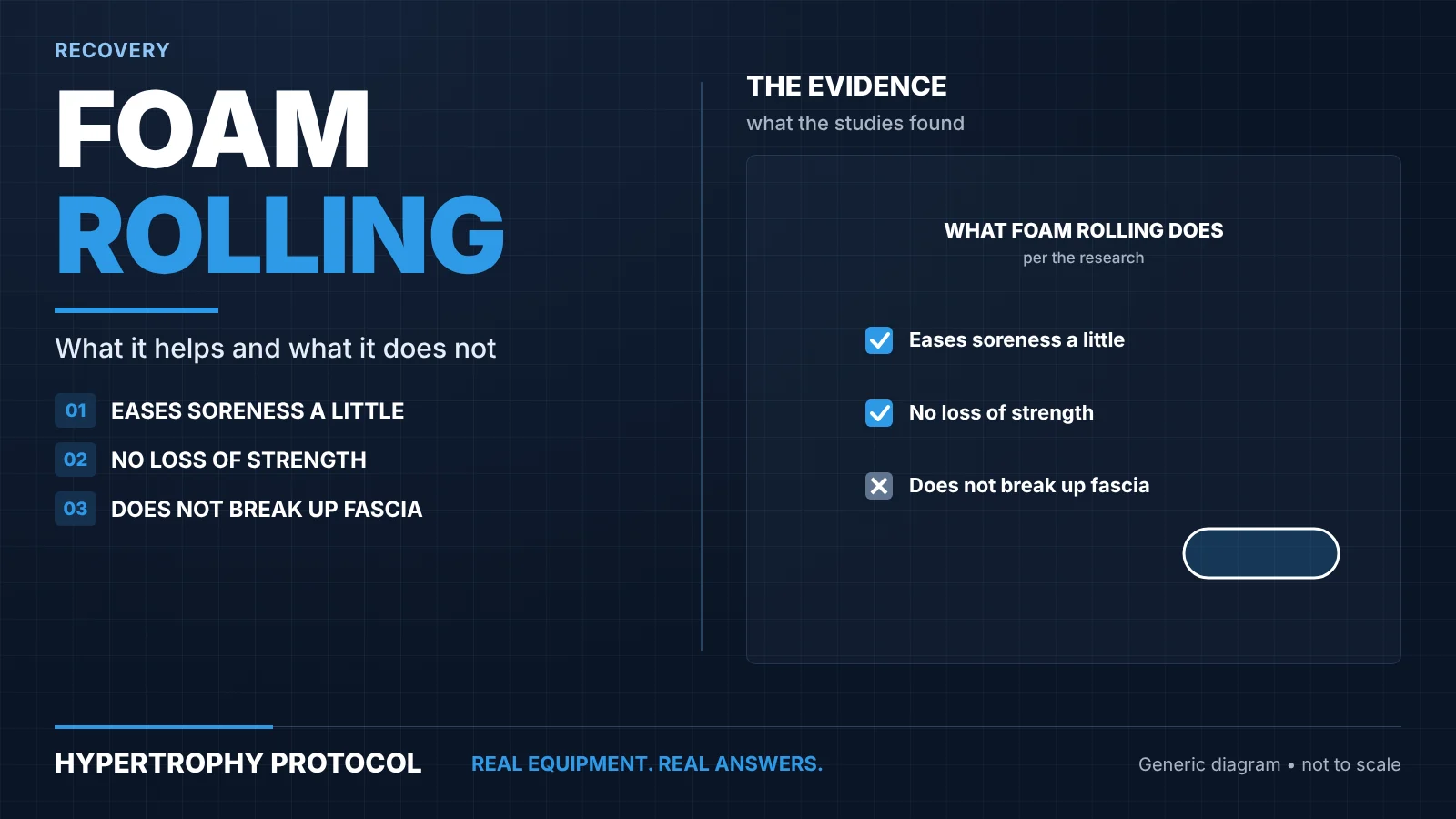
Foam rolling can take the edge off sore muscles, but the effect is small and short-lived. It doesn’t break up fascia, it doesn’t speed up muscle repair in any proven way, and it isn’t better than an ordinary warm-up for loosening you up before you lift. What it does well is cheap, quick relief that won’t cost you strength. This guide covers what the research shows, how to use a roller around your training, and which kind of roller is worth buying.
Short answer
- Soreness: rolling after exercise reduced how sore people felt by about 6% on average in a pooled analysis. That’s a small effect.
- Before lifting: it doesn’t sap strength, and it gives a small, short-term boost in flexibility. A general warm-up does about the same.
- Fascia: a foam roller is very unlikely to stretch or “release” thick fascia. The effects you feel most likely come from your nervous system.
- Flexibility over time: rolling several times a week for more than four weeks improved range of motion about as much as stretching.
- What to buy: a plain high-density foam roller for about $15 to $25 does the job. Vibrating rollers cost about ten times as much, and there’s no roller-specific evidence that they’re worth it.
At a glance
| Verdict | Small, short-lived soreness relief with no strength cost. It doesn’t break up fascia. |
|---|---|
| Effect size / key numbers | Soreness down 6.0% after exercise (ES 0.47; 21 studies). Long-term range of motion ES 0.82 vs no rolling. |
| Evidence strength | Moderate: several meta-analyses agree; certainty for strength effects is low. |
| What to do | Roll about a minute per muscle if you like it, but keep your warm-up sets. A plain high-density roller is enough. |
| Main caveat | A general warm-up loosens you up about as well, and effects on muscle growth haven’t been studied. |
See the full sections below for sources.
Does foam rolling help sore muscles?
A little. The most-cited meta-analysis on the topic (Wiewelhove and colleagues, 2019) pooled 21 studies. Rolling after exercise reduced perceived muscle pain by 6.0% on average (effect size 0.47, a small-to-moderate effect). It also slightly reduced the drop in sprint performance (+3.1%) and strength (+3.9%) in the days after a hard session. The authors’ overall verdict was that the effects of foam rolling on performance and recovery are “rather minor and partly negligible,” and that the evidence supports it more as a warm-up than as a recovery tool.
A 2026 systematic review of delayed onset muscle soreness (DOMS) treatments by Jemni and colleagues found the same order of magnitude: foam rolling reduced soreness with a standardised effect of about −0.34, slightly smaller than compression garments (−0.44). Most of the studies it screened didn’t report usable effect sizes, so treat those figures as rough.
For comparison, a larger 2018 meta-analysis of 99 studies (Dupuy and colleagues) ranked massage as the most effective option for reducing soreness and perceived fatigue. Foam rolling is self-massage, so it’s reasonable to expect a similar but weaker effect, which is roughly what the trials show.
Will rolling before you lift hurt your strength?
No. In the same 2019 analysis, rolling before exercise had a negligible effect on strength (+1.8%) and jump height (−1.9%), and small benefits for sprinting (+0.7%) and flexibility (+4.0%). A 2023 meta-analysis focused on strength (Glänzel and colleagues) found no effect of rolling on isometric strength, eccentric torque or rate of force development, and a small increase in knee extensor concentric torque. The certainty of that evidence was low, but nothing suggests a few minutes of rolling will weaken your working sets.
The catch is that rolling isn’t special as a warm-up. A 2024 meta-analysis (Warneke and colleagues) compared stretching and foam rolling with other warm-up activities and found no difference in short-term range of motion or muscle stiffness. Other warm-up activities, including general exercise that raises muscle temperature, produced similar short-term gains. A few light sets of the lift you’re about to do will likely loosen you up about as well. Roll if you like how it feels, but don’t skip your ramp-up sets for it.
Can foam rolling improve flexibility over time?
Yes, if you keep at it. A 2022 meta-analysis of foam rolling programmes (Konrad and colleagues) found a moderate increase in range of motion compared with no rolling (effect size 0.82). Programmes longer than four weeks worked better than shorter ones. Gains showed up for the hamstrings and quadriceps, but rolling the calves didn’t improve ankle range of motion in those studies.
A 2024 follow-up by the same group compared rolling with static stretching. Over the long run both increased range of motion by a similar amount, but over four weeks or less, stretching worked better. A 2026 network meta-analysis focused on ankle mobility (Park and colleagues) did rank foam rolling among the most effective options for ankle dorsiflexion, so the calf result isn’t settled.
A 2022 multi-week analysis found no change in performance measures such as jumping or strength from foam rolling training. Rolling can make you more mobile, but don’t expect it to make you stronger.
Does foam rolling break up fascia or “knots”?
Almost certainly not. A modelling study of human fascia (Chaudhry and colleagues, 2008) found that very large forces, outside the normal physiological range, would be needed to compress or shear the fascia lata, the thick sheet on the outside of your thigh, by even 1%. Your bodyweight on a roller isn’t close to that. The 2023 strength meta-analysis also found no measurable change in myofascial tissue stiffness after rolling.
The more likely explanation is that rolling changes how your nervous system senses stretch and pressure, so the area feels looser and you tolerate more range of motion. That’s still useful. It just means you don’t need to grind on a sore spot until it hurts, and you can ignore packaging claims about “aerating” tissue or flushing blood and oxygen into your muscles.
Does foam rolling affect muscle growth?
There’s no evidence either way from studies that measured muscle size, and no clear mechanism by which a few minutes of rolling would help or hurt growth. That sets it apart from cold water immersion after lifting, which can blunt hypertrophy when used regularly. If you enjoy rolling, it may take the edge off soreness, but its long-term effect on muscle growth hasn’t been studied directly.
How to use a foam roller around your training
These are practical suggestions rather than tested protocols. The studies used a wide range of durations and techniques, and none clearly beat the others.
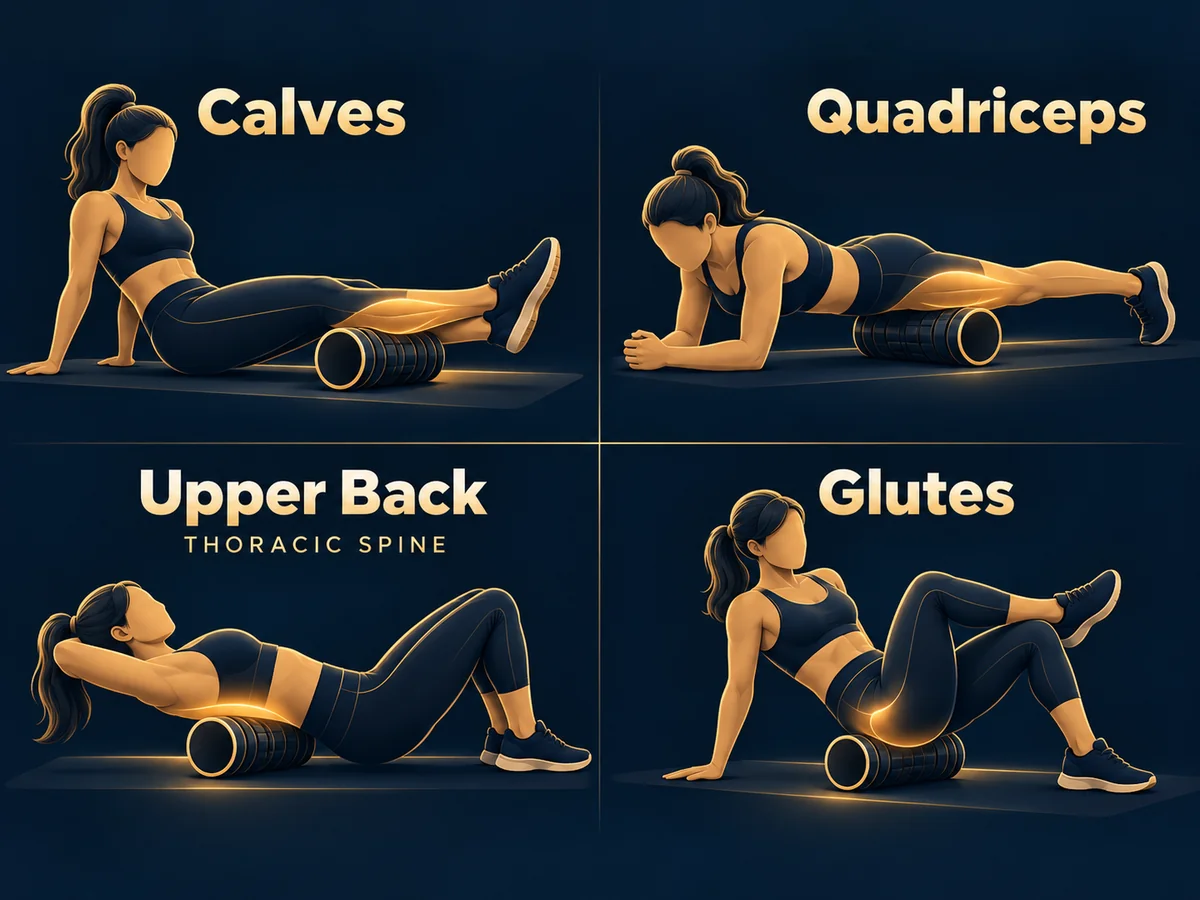
- Before training: roll the muscles you’re about to work for a minute or so each, then go straight into your warm-up sets. If you’re short on time, skip the roller and keep the warm-up sets.
- After a hard session or on sore days: roll the sore areas slowly with moderate pressure. Uncomfortable is fine; sharp or wincing pain isn’t the goal and doesn’t make it work better.
- For long-term mobility: roll the tight area several times a week and stick with it for more than a month. Static stretching works as well and is faster over the first few weeks.
- Where not to roll: avoid rolling directly over bones and joints, the front of the neck, or an area you think is injured. If you have a medical condition that affects your blood vessels, bones or skin, check with your clinician first.
For the bigger picture on soreness, including what helps most and when soreness is a warning sign, see our guide to DOMS and what actually helps sore muscles.
Which foam roller should you buy?
Price differences between rollers are mostly about texture, firmness and features, not results. In the 2019 meta-analysis, full foam rollers tended to do better than handheld roller sticks for recovering strength (+5.6% versus −0.1%), although the difference wasn’t conclusive. A 2025 meta-analysis on vibration (Jochum and colleagues) found that, in a single session, adding vibration improved flexibility only slightly more than the same treatment without it (effect size 0.20). Over several weeks the extra gain was larger (0.65). Those studies covered many kinds of vibration devices, though, so they don’t show that a vibrating foam roller in particular adds a reliable benefit.
Prices below were checked on Amazon on October 20, 2026, and change often.
| Roller | Type | Price | Best for |
|---|---|---|---|
| Amazon Basics High-Density Foam Roller, 36 in (affiliate) | Smooth, high-density | About $22 | Most people. Long enough to roll your upper back and both legs at once. |
| Amazon Basics High-Density Foam Roller, 18 in (affiliate) | Smooth, high-density | About $15 | Small gyms and gym bags. |
| TriggerPoint GRID 1.0, 13 in (affiliate) | Textured foam over a hollow core | About $29 | Lifters who want a firmer, textured roller that won’t flatten. |
| Tiger Tail 18 in massage stick (affiliate) | Handheld roller stick | About $40 | Calves and quads when you can’t get on the floor. Less pressure than bodyweight on a roller. |
| Therabody WaveRoller (affiliate) | Vibrating, 12 x 5 in, five intensity settings | About $180 | Only if you’ll use the vibration often and the price doesn’t matter. There’s no roller-specific evidence of extra benefit. |
If you only buy one, get a plain high-density roller. Firmness is personal: if a hard roller is too painful to relax on, you’ll get more out of a softer one that you actually use.
The bottom line
Foam rolling is a cheap, low-risk way to feel a bit less sore and a bit looser. The effects are small, the fascia claims don’t hold up, and it won’t replace sleep, sensible training volume or a proper warm-up. If you enjoy it, keep doing it. If you don’t, you aren’t missing much.
Frequently asked questions
How long should you foam roll each muscle?
We suggest rolling about a minute per muscle if you like it, while keeping your warm-up sets. These are practical suggestions rather than tested protocols, because the studies used a wide range of durations and none clearly beat the others.
Is foam rolling as good as stretching for flexibility?
In a 2024 meta-analysis comparing the two, both increased range of motion by a similar amount over the long run. Over four weeks or less, stretching worked better.
Is a vibrating foam roller worth the extra money?
Vibrating rollers cost about ten times as much as a plain high-density roller, and there is no roller-specific evidence that they are worth it. The vibration studies cited above covered many kinds of devices, so they do not show that a vibrating foam roller in particular adds a reliable benefit.
Where should you not use a foam roller?
Avoid rolling directly over bones and joints, the front of the neck, or an area you think is injured. If you have a medical condition that affects your blood vessels, bones or skin, check with your clinician first.
Related guides
- Ice or Heat for Sore Muscles? What the Research Says After Lifting
- Deload Weeks: When and How to Take One
- Overtraining: Signs, Recovery Time and Whether Lifters Really Get It
Sources
- Wiewelhove T, Döweling A, Schneider C, et al. A meta-analysis of the effects of foam rolling on performance and recovery. Front Physiol. 2019;10:376. doi:10.3389/fphys.2019.00376
- Jemni M, Quodling N, Hammami N, et al. Rethinking neurophysiology of delayed onset muscle soreness: updated concepts and mechanisms for mitigation across endurance, resistance, and plyometric exercise. Front Sports Act Living. 2026;8:1709704. doi:10.3389/fspor.2026.1709704
- Dupuy O, Douzi W, Theurot D, Bosquet L, Dugué B. An evidence-based approach for choosing post-exercise recovery techniques to reduce markers of muscle damage, soreness, fatigue, and inflammation: a systematic review with meta-analysis. Front Physiol. 2018;9:403. doi:10.3389/fphys.2018.00403
- Glänzel MH, Rodrigues DR, Petter GN, et al. Foam rolling acute effects on myofascial tissue stiffness and muscle strength: a systematic review and meta-analysis. J Strength Cond Res. 2023;37(4):951-968. doi:10.1519/JSC.0000000000004385
- Warneke K, Plöschberger G, Lohmann LH, et al. Foam rolling and stretching do not provide superior acute flexibility and stiffness improvements compared to any other warm-up intervention: a systematic review with meta-analysis. J Sport Health Sci. 2024;13(4):509-520. doi:10.1016/j.jshs.2024.01.006
- Konrad A, Nakamura M, Tilp M, Donti O, Behm DG. Foam rolling training effects on range of motion: a systematic review and meta-analysis. Sports Med. 2022;52(10):2523-2535. doi:10.1007/s40279-022-01699-8
- Konrad A, Alizadeh S, Anvar SH, et al. Static stretch training versus foam rolling training effects on range of motion: a systematic review and meta-analysis. Sports Med. 2024;54(9):2311-2326. doi:10.1007/s40279-024-02041-0
- Park JM, Lee KW, Yoon SY, Kim YW, Lee SC. Flexibility-enhancing interventions for ankle range of motion: a network meta-analysis. Int J Sports Med. 2026;47(11):843-853. doi:10.1055/a-2876-9237
- Konrad A, Nakamura M, Behm DG. The effects of foam rolling training on performance parameters: a systematic review and meta-analysis including controlled and randomized controlled trials. Int J Environ Res Public Health. 2022;19(18):11638. doi:10.3390/ijerph191811638
- Chaudhry H, Schleip R, Ji Z, et al. Three-dimensional mathematical model for deformation of human fasciae in manual therapy. J Am Osteopath Assoc. 2008;108(8):379-390. doi:10.7556/jaoa.2008.108.8.379
- Jochum D, Konrad A, Lohmann LH, et al. The merit of superimposed vibration for flexibility and passive stiffness: a systematic review with multilevel meta-analysis. J Sport Health Sci. 2025;14:101033. doi:10.1016/j.jshs.2025.101033