
Last updated November 2026. This guide is based on published research, and each claim links to the study behind it. General information, not medical advice.
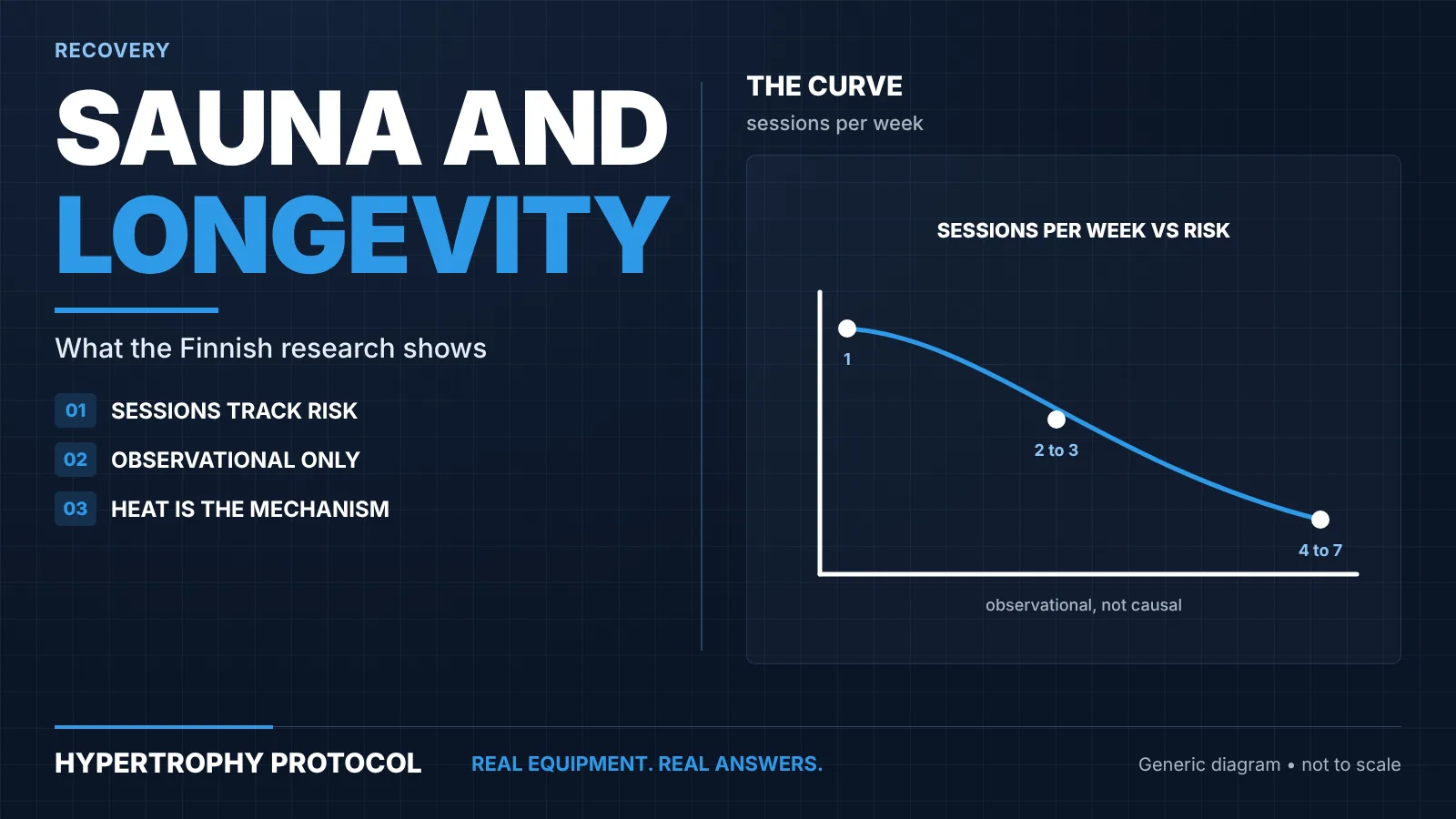
If you’re wondering whether a sauna can help you live longer, the best evidence is a long-running Finnish study: men who used a sauna 4 to 7 times a week had much lower rates of sudden cardiac death, and fewer died from any cause, than men who went once a week. That is a strong link, but it comes almost entirely from one group of Finnish adults, and no trial has tested whether sauna use itself adds years.
For a lifter, the more useful finding is in the same data: high aerobic fitness was linked to lower risk than frequent sauna use, and the combination did best. A sauna is a reasonable extra if you enjoy it and will use it often. It isn’t a substitute for training.
At a glance
| Verdict | Frequent sauna use is linked to lower cardiovascular and all-cause death in Finnish cohorts. Aerobic fitness was linked to bigger risk reductions. |
|---|---|
| Key numbers | 4 to 7 sessions a week vs 1: sudden cardiac death HR 0.37. All-cause deaths over about 21 years: 49% (1 a week) vs 31% (4 to 7 a week). |
| Evidence strength | Moderate: large, long cohorts, but nearly all from one Finnish study and no randomized trials of hard outcomes. |
| What to do | If you buy one, use it often (the cohort’s strongest links were at 4 to 7 sessions a week, and sessions over 19 minutes were linked to lower cardiac death), skip alcohol and stay hydrated. |
| Main caveat | Mostly middle-aged men using traditional Finnish saunas. There are no long-term outcome data for infrared saunas. |
General information, not medical advice. See the study table below for sources.

What did the Finnish sauna study find?
The Kuopio Ischemic Heart Disease study followed 2,315 men aged 42 to 60 in eastern Finland for a median of 20.7 years. Compared with men who used a sauna once a week, men who used it 4 to 7 times a week had a 63% lower risk of sudden cardiac death after adjustment (hazard ratio 0.37), and the authors reported similar links for fatal heart disease, fatal cardiovascular disease and death from any cause (Laukkanen et al., 2015).
The raw numbers show the size of the gap. Over the follow-up, 49% of the once-a-week men died, against 38% of the 2 to 3 times a week group and 31% of the 4 to 7 times a week group. Longer sessions were also linked to lower risk: more than 19 minutes was linked to about half the sudden cardiac death risk of under 11 minutes, though session length wasn’t linked to all-cause death.
Two cautions. Only 201 men were in the most frequent group, so that estimate is imprecise. And men who were healthy enough to sit in a hot room most days may have been healthier in ways the study couldn’t fully measure.
Does it apply to women?
Probably, but the data are thinner. A later analysis of the same Finnish study included 1,688 people aged 53 to 74, 51.4% of them women. Using a sauna 4 to 7 times a week was linked to lower cardiovascular death than once a week (fully adjusted hazard ratio 0.23), and risk fell steadily with each extra weekly session (Laukkanen et al., 2018). In 1,628 men and women from the same study, 4 to 7 sessions a week was linked to lower stroke risk (hazard ratio 0.38), with no difference by sex (Kunutsor et al., 2018).
What else has been linked to sauna use?
- Dementia: in the original 2,315 men, 4 to 7 sessions a week was linked to lower dementia risk (hazard ratio 0.34) and Alzheimer’s risk (0.35) than once a week (Laukkanen et al., 2017).
- High blood pressure: in 1,621 men who didn’t have high blood pressure at the start, 4 to 7 sessions a week was linked to lower risk of developing it (hazard ratio 0.53) over about 25 years (Zaccardi et al., 2017).
All of these come from the same cohort and largely the same research team. That doesn’t make them wrong, but independent studies from outside Finland would make the case much stronger.
Sauna or fitness: which is linked to bigger benefits?
Aerobic fitness. In 2,277 men from the same study, followed for about 26 years, high aerobic fitness (measured with a lab exercise test) was linked to half the risk of cardiovascular death of low fitness with infrequent sauna use (hazard ratio 0.50). Using a sauna 3 to 7 times a week was linked to a smaller drop (0.72), and men with both did best (0.42) (Kunutsor et al., 2018).
This study measured aerobic fitness, not strength, so keep your cardio as well as your lifting. Strength training for longevity covers the lifting side. A sauna sits on top of training, not in place of it.
What does a sauna do to your heart and blood pressure?
In the short term, blood pressure drops. In 102 adults with at least one heart risk factor, one 30-minute session at 73°C lowered systolic pressure from 137 to 130 mmHg and reduced arterial stiffness, and pressure was still lower 30 minutes later (Laukkanen et al., 2018, J Hum Hypertens). That study had no comparison group.
Whether regular heat lowers resting blood pressure over weeks is less clear. A 2021 meta-analysis of heat therapy studies found systolic pressure about 3.9 mmHg lower than control, pooled from 10 studies (Pizzey et al., 2021). A 2025 meta-analysis limited to 20 randomized trials found no significant overall effect, with a benefit only for whole-body heating (about 4.1 mmHg) and in people with heart risk factors (Hamaya et al., 2025). A sauna isn’t a treatment for high blood pressure.
Infrared or traditional sauna?
All the long-term findings above come from traditional Finnish saunas, which typically run at 80 to 100°C. Infrared saunas run cooler and have no long-term outcome data. In a direct comparison in 20 healthy adults, a traditional sauna (3 rounds of 10 minutes at 80°C) raised core temperature by 0.4°C, while 45 minutes of far-infrared at 45 to 65°C didn’t raise it at all; a hot bath raised it most (Atencio et al., 2025). Run hot enough, though, infrared can heat you: 45 minutes at 65°C raised core temperature by 1.4°C in a small 2026 study (Jenkins et al., 2026).
If you want the setup closest to the research, choose a traditional sauna that reaches Finnish temperatures. If you choose infrared, run it at the hot end of its range and treat the longevity data as not applying directly.
How often, how hot and how long?
No trial has tested a best dose, so the honest answer is what the Finnish cohort did. The biggest differences showed up at 4 to 7 sessions a week, and sessions of more than 19 minutes were linked to lower cardiac death than sessions under 11 minutes. Build up to that gradually, get out if you feel dizzy or unwell, and cool down before your next round.
Is a sauna safe?
For most healthy people, yes, with sensible habits. In Finland, with about 2 million saunas for 5.2 million people, deaths in a sauna occurred at a rate of under 2 per 100,000 people a year, and half of those who died had been drinking (Kenttämies et al., 2008). In Swedish sauna deaths, 71% of those tested had alcohol in their blood, and almost all who were found dead in a sauna were alone (Rodhe et al., 2008).
- Don’t drink alcohol before or during a session.
- Drink water. In one study people sweated about 1.4 liters an hour in a hot infrared sauna (Jenkins et al., 2026).
- Trying for a baby? In 10 men, two sessions a week for 3 months sharply cut sperm count and motility; it fully recovered 6 months after stopping (Garolla et al., 2013).
- Talk to a doctor first if you have heart disease, chest pain, uncontrolled blood pressure, are pregnant, or have fainted from heat before.
How strong is the evidence, study by study?
| Study | Who | Type | Main finding |
|---|---|---|---|
| Laukkanen 2015 | 2,315 Finnish men aged 42 to 60, about 21 years | Cohort | 4 to 7 sessions a week vs 1: sudden cardiac death HR 0.37; all-cause deaths 31% vs 49% |
| Laukkanen 2018 | 1,688 adults aged 53 to 74, 51.4% women | Cohort | 4 to 7 sessions a week vs 1: cardiovascular death HR 0.23 |
| Kunutsor 2018 (Neurology) | 1,628 men and women aged 53 to 74 | Cohort | 4 to 7 sessions a week vs 1: stroke HR 0.38 |
| Laukkanen 2017 | 2,315 Finnish men | Cohort | 4 to 7 sessions a week vs 1: dementia HR 0.34 |
| Zaccardi 2017 | 1,621 men without high blood pressure | Cohort | 4 to 7 sessions a week vs 1: new high blood pressure HR 0.53 |
| Kunutsor 2018 (Ann Med) | 2,277 Finnish men, about 26 years | Cohort | Cardiovascular death: high fitness HR 0.50, frequent sauna 0.72, both 0.42 |
| Pizzey 2021 | 15 heat therapy studies (10 for systolic pressure) | Meta-analysis | Systolic pressure about 3.9 mmHg lower than control |
| Hamaya 2025 | 20 randomized trials of passive heating | Meta-analysis | No significant overall blood pressure effect; whole-body heating about 4.1 mmHg lower |
| Atencio 2025 | 20 healthy adults | Crossover trial | Core temperature: hot bath +1.1°C, traditional sauna +0.4°C, far-infrared +0.0°C |
Should you buy a home sauna?
If you already train and would use it most days, it’s a reasonable addition. The research links frequent use, not occasional use, with lower risk.
If money or space is limited, put it into training first. Aerobic fitness was linked to bigger risk reductions than sauna use in the same cohort.
If you’re planning one, putting a sauna in a garage covers space, wiring and running costs, and the garage sauna cost calculator works out install and running costs for your setup. Wondering whether to use it right after lifting? See sauna after a workout.
Your next step: decide how many sessions a week you would really do. The research links each extra weekly session with lower risk, and the clearest differences were at 4 to 7 a week. If you’d only manage one or two, the case for buying one is weak.
Frequently asked questions
Is it proven that saunas make you live longer?
No. Frequent sauna use has a strong link with lower death rates, but it comes almost entirely from one group of Finnish adults, and no trial has tested whether sauna use itself adds years.
Is sauna use linked to a lower risk of dementia?
In the Finnish cohort of 2,315 men, using a sauna 4 to 7 times a week was linked to lower dementia risk (hazard ratio 0.34) and Alzheimer’s risk (0.35) than once a week. These findings come from the same cohort and largely the same research team.
Is it safe to drink alcohol in a sauna?
Do not drink alcohol before or during a session. In the Finnish data cited above, half of those who died in a sauna had been drinking, and in Swedish sauna deaths 71% of those tested had alcohol in their blood.
Does sauna use lower sperm count?
In one study of 10 men, two sauna sessions a week for 3 months sharply cut sperm count and motility. It fully recovered 6 months after stopping.