
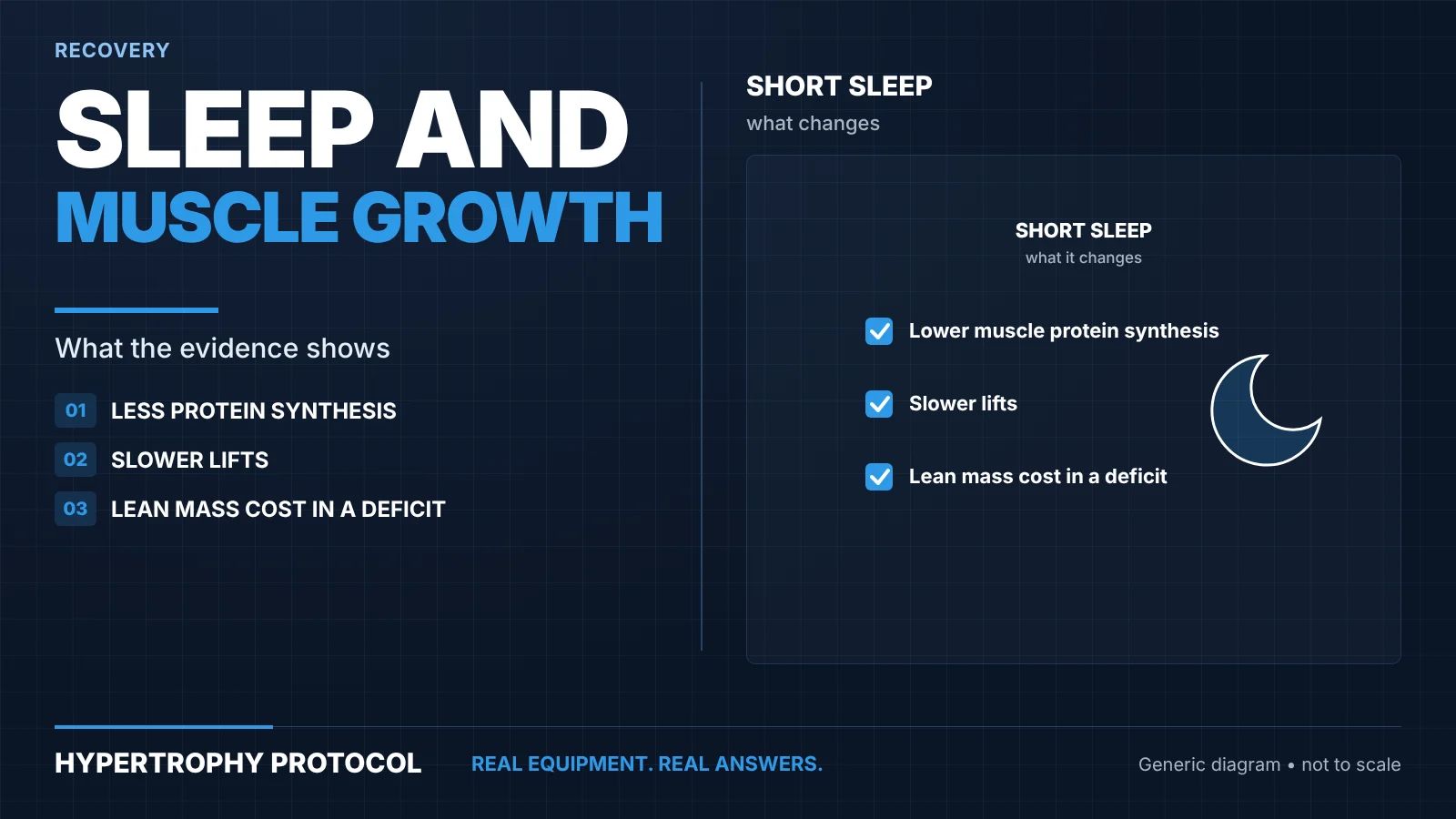
You train hard and eat enough protein, but your sleep gets cut short most weeknights, and you keep hearing that muscle is built while you sleep. The research on sleep and muscle growth supports a narrower conclusion. Short sleep lowers muscle protein synthesis and makes hard sessions feel harder, yet no controlled trial has shown how much muscle a lifter actually gives up.
The clearest cost shows up when short sleep is combined with a calorie deficit: in the best-known trial, more of the weight lost came from fat-free mass. Outside a diet, the evidence is thin and mostly short-term. Every study below was checked on PubMed on September 28, 2026.
At a glance
| Verdict | Sleep supports growth but isn’t when muscle is built. The clearest cost is during a calorie deficit. |
|---|---|
| Effect size / key numbers | Five nights of 4 h in bed: synthesis about 19% lower. Dieting on 5.5 h in bed: 2.4 vs 1.5 kg fat-free mass lost. |
| Evidence strength | Low: short-term proxies and small diet studies; no randomized trial has measured muscle size in lifters. |
| What to do | Protect time in bed most when dieting. After one bad night, train as planned. |
| Main caveat | Fat-free mass is mostly water, and nobody in the diet studies lifted weights. |
See the full sections below for sources.
Does muscle really grow while you sleep?
That thin evidence base is the first problem with the myth. Muscle protein synthesis runs around the clock and rises after meals and training, so growth is the net result of many hours, with no single nightly event. A 2019 review from the Maastricht group pointed out that overnight synthesis rates tend to be lower than the rates seen the next morning after an overnight fast.
So the night is not a special building window. Sleep matters for a different reason: losing it seems to blunt the response to meals and training during the day, and it changes how the body handles a calorie deficit. Those two ideas are worth testing.
What does a short night do to muscle protein synthesis?
The daytime response is where the most direct data sit, all of it from short experiments. In Lamon 2021, young men and women spent one night fully awake and one night sleeping normally, in random order. After the sleepless night, synthesis following a meal was lower, alongside a hormone shift toward higher cortisol and lower testosterone.
Partial sleep loss over several nights points the same way. In Saner 2020, young men on a controlled diet spent five nights with 4 hours in bed, and their myofibrillar synthesis dropped below a normal-sleep group. A third group did hard interval cycling during the same short-sleep week and kept synthesis at normal-sleep levels. The numbers for both studies are in the table in the next section.
These are proxies, and the Saner authors acknowledged that five nights was probably too short to detect meaningful changes in muscle mass. The hormone story is also weaker than it sounds. A 2021 meta-analysis showed that a full night or more without sleep lowered testosterone in men, while short-term partial sleep loss had no significant effect, and partial loss is what most lifters actually live with.
Is there long-term evidence on sleep and muscle growth?
Moving from hours to weeks, the evidence gets sparse fast. A PubMed search on September 28, 2026 turned up no randomized trial that assigned lifters to short or normal sleep and then measured muscle size with MRI or ultrasound. What exists are two diet studies without lifting and one small non-randomized training study. The table groups them with the shorter studies covered in the rest of this guide.
| Study | Who and how long | Comparison | What was measured | Result |
|---|---|---|---|---|
| Short-term proxies | ||||
| Lamon 2021 | 13 young adults (7 men, 6 women), one night, crossover, no training | Total sleep deprivation vs normal sleep | Muscle protein synthesis after a meal (proxy) | 18% lower (0.072 vs 0.059 %/h); cortisol +21%, testosterone −24% |
| Saner 2020 | 24 young men, five nights, controlled diet | 8 h vs 4 h in bed vs 4 h plus three interval cycling sessions | Myofibrillar synthesis over the week (proxy) | 1.53 vs 1.24 vs 1.61 %/day; short sleep about 19% lower, exercise group unaffected |
| Knowles 2024 | 10 resistance-trained women, nine nights, crossover | 5 h vs at least 7 h in bed, with lifting sessions | Muscle gene expression (proxy) | Short sleep alone had no effect; it altered the gene response to lifting |
| Su 2021 (meta-analysis) | 18 studies, 252 healthy men | Partial or total sleep deprivation vs normal sleep | Serum testosterone | Partial: SMD −0.22 (95% CI −0.5 to 0.06), not significant. Total: SMD −0.64 (95% CI −0.87 to −0.42) |
| Lean mass over weeks | ||||
| Nedeltcheva 2010 | 10 sedentary adults with overweight, 14 days per condition, crossover, no training | 8.5 vs 5.5 h in bed during a calorie deficit | Fat and fat-free mass lost (DXA plus scale) | Similar weight lost (about 3 kg); fat-free mass loss 1.5 vs 2.4 kg (P = 0.002) |
| Wang 2018 | 36 adults with overweight or obesity, 8 weeks, no training | Calorie deficit alone vs deficit plus about 1 h less sleep on five nights a week | Weight, lean mass, fat mass | Similar lean and fat loss in kg; smaller share of weight lost as fat with short sleep |
| Borba 2024 | 24 untrained men in two training groups (plus 12 non-training controls), grouped by habitual sleep, not randomized; 16 sessions | About 5 h 47 min vs 7 h 16 min nightly sleep, elastic-band training | Arm muscle area estimated from arm girth and skinfold | Both training groups gained similarly (Cohen’s d 0.45 vs 0.46) |
| Training performance | ||||
| Knowles 2018 (systematic review) | 17 studies | Sleep deprivation or restriction vs normal sleep | Strength during resistance exercise | Total deprivation (no sleep): little effect. Consecutive short nights: lower force in multi-joint lifts, not single-joint |
| Knowles 2022 | 10 resistance-trained women, nine nights, crossover | 5 h vs at least 7 h in bed, four lifting sessions each | Volume load, bar velocity, effort | Volume load down less than 1%; lower-body compound lifts up to 15% slower; session effort 11% higher |
| Protein before sleep | ||||
| Res 2012 | 16 young men, one night after evening lifting | 40 g casein vs placebo before sleep | Overnight muscle protein synthesis (proxy) | About 22% higher (0.059 vs 0.048 %/h), P = 0.05 |
| Snijders 2015 | 44 young men, 12 weeks of lifting | 27.5 g protein nightly vs non-caloric placebo | Quadriceps area (CT), fiber size | +8.4 vs +4.8 cm²; type II fibers +2,319 vs +1,017 µm² |
| Joy 2018 | 13 men, 10 weeks of lifting, diets at 1.8 g/kg/day protein | 35 g casein earlier in the day vs before bed | Lean soft tissue, muscle area, strength | No difference between groups |
| Holwerda 2018 | 41 older men (about 70), 12 weeks of lifting | 21 g protein after exercise and before sleep vs energy-matched placebo | Quadriceps area (CT), fiber size, strength | No difference between groups |
| Klemp 2025 | 30 untrained older men, 12 weeks of lifting | 40 g protein before sleep vs after exercise vs training only | Quadriceps muscle thickness, strength | No difference between groups |
Nedeltcheva 2010: where the weight came from after 14 days of dieting
The diet studies carry the strongest lean-mass signal, and it comes with caveats. Fat-free mass is mostly water, a point the Nedeltcheva authors made themselves when interpreting their result. Nobody in either diet study lifted weights, and Wang, with a milder sleep cut over a longer period, saw similar amounts of lean mass lost in both groups.
The one training study leans the other way but cannot settle much. The short sleepers in Borba had chosen their own sleep habits, trained with elastic bands for about five weeks, and had muscle estimated with a tape measure and calipers. Treat it as a weak hint that habitual short sleep does not erase early training gains.
How does short sleep hurt the training that drives growth?
If the muscle-size data are thin, the performance data are clearer, and training is what drives growth in the first place. The 2018 systematic review in the table separated the two kinds of sleep loss: going without sleep entirely did little to strength, while several short nights in a row cut force on big multi-joint lifts.
The later Knowles trial shows what that looks like inside a session. Trained women on nine nights of 5 hours in bed still completed nearly all of their planned work, but their lower-body compound lifts moved slower and each session felt harder than after normal sleep.
In practice, you can usually still complete the planned sets after short nights. The reps cost more effort, and squats and other big lower-body lifts take the larger hit. When poor sleep lines up with weeks of accumulated fatigue, the deload week guide covers when a lighter week makes sense.
Does protein before bed build more muscle?
Since sleep itself is not a building window, the next question is whether feeding the overnight period helps. The first test, Res 2012, gave young men casein before bed after an evening session and saw overnight synthesis rise, though the result only reached borderline significance.
The main long-term trial looked stronger. In Snijders 2015, young men who took protein every night for 12 weeks grew more quadriceps and type II fiber area than a placebo group. The design leaves one gap: the placebo had no protein, so the protein group also ate more protein per day.
A 2021 systematic review flagged “uneven protein intakes between experimental groups” as a reason for caution, and the Maastricht review raised the same possibility that the benefit came mainly from the higher daily total. When Joy 2018 matched daily protein and moved only the timing of a casein dose, the two groups grew the same.
In older men, protein before sleep did not boost gains in Holwerda 2018, where it was also given after training, or in Klemp 2025. So a protein-rich evening meal is a convenient slot for part of your daily intake, with no evidence that the slot itself adds muscle. The protein per meal guide covers how to split that daily total.
Who should change their sleep for muscle growth, and who can leave it alone?
Put the pieces together and the myth fails in its strong form. Growth is not concentrated in sleep, and sleep is not everything. It is a real supporting factor with the clearest evidence during dieting, so the verdict depends on your situation.
- You are in a calorie deficit and sleeping short: this is where the lean-mass evidence points. Protecting time in bed is the change most likely to matter for keeping muscle while you lose fat.
- You are eating at maintenance or above and some nights run short: expect slower, harder sessions, especially on lower-body days. No trial has measured lost muscle growth in this situation, so keep training and do not treat a short week as lost.
- You had one bad night before a session: even going without sleep entirely had little effect on strength in the review above. Train as planned.
- You are considering a nightly protein snack: count it toward your daily total. It helps if it gets you to that total, not because of the timing.
These verdicts assume you are healthy and simply short on time in bed. If sleep problems persist even when you give yourself enough time in bed, that is worth raising with a doctor.
Your next step: make sure the training side is covered, since sleep supports growth but lifting drives it. The muscle hypertrophy guide lays out the training variables to check your program against.
Sources
- Lamon S, et al. The effect of acute sleep deprivation on skeletal muscle protein synthesis and the hormonal environment. Physiol Rep. 2021. doi:10.14814/phy2.14660
- Saner NJ, et al. The effect of sleep restriction, with or without high-intensity interval exercise, on myofibrillar protein synthesis in healthy young men. J Physiol. 2020. doi:10.1113/JP278828
- Knowles OE, et al. The interactive effect of sustained sleep restriction and resistance exercise on skeletal muscle transcriptomics in young females. Physiol Genomics. 2024. doi:10.1152/physiolgenomics.00010.2024
- Su L, et al. Effect of partial and total sleep deprivation on serum testosterone in healthy males: a systematic review and meta-analysis. Sleep Med. 2021. doi:10.1016/j.sleep.2021.10.031
- Nedeltcheva AV, et al. Insufficient sleep undermines dietary efforts to reduce adiposity. Ann Intern Med. 2010. doi:10.7326/0003-4819-153-7-201010050-00006
- Wang X, Sparks JR, Bowyer KP, Youngstedt SD. Influence of sleep restriction on weight loss outcomes associated with caloric restriction. Sleep. 2018. doi:10.1093/sleep/zsy027
- Borba DA, et al. Could a habitual sleep restriction of one-two hours be detrimental to the benefits of resistance training? Sleep Sci. 2024. doi:10.1055/s-0044-1787297
- Knowles OE, et al. Inadequate sleep and muscle strength: implications for resistance training. J Sci Med Sport. 2018. doi:10.1016/j.jsams.2018.01.012
- Knowles OE, et al. Sustained sleep restriction reduces resistance exercise quality and quantity in females. Med Sci Sports Exerc. 2022. doi:10.1249/MSS.0000000000003000
- Res PT, et al. Protein ingestion before sleep improves postexercise overnight recovery. Med Sci Sports Exerc. 2012. doi:10.1249/MSS.0b013e31824cc363
- Snijders T, et al. Protein ingestion before sleep increases muscle mass and strength gains during prolonged resistance-type exercise training in healthy young men. J Nutr. 2015. doi:10.3945/jn.114.208371
- Snijders T, et al. The impact of pre-sleep protein ingestion on the skeletal muscle adaptive response to exercise in humans: an update. Front Nutr. 2019. doi:10.3389/fnut.2019.00017
- Reis CEG, et al. Effects of pre-sleep protein consumption on muscle-related outcomes: a systematic review. J Sci Med Sport. 2021. doi:10.1016/j.jsams.2020.07.016
- Joy JM, et al. Daytime and nighttime casein supplements similarly increase muscle size and strength in response to resistance training earlier in the day: a preliminary investigation. J Int Soc Sports Nutr. 2018. doi:10.1186/s12970-018-0228-9
- Holwerda AM, et al. Protein supplementation after exercise and before sleep does not further augment muscle mass and strength gains during resistance exercise training in active older men. J Nutr. 2018. doi:10.1093/jn/nxy169
- Klemp AO, et al. Neither pre-sleep nor post-exercise protein consumption influences resistance exercise training adaptations in older adults. J Int Soc Sports Nutr. 2025. doi:10.1080/15502783.2025.2519511
Sources checked September 28, 2026. Research summaries describe the cited studies; individual results vary.