

Short answer: a jump squat is a squat where you drive up hard enough to leave the ground. Power output was highest with no added weight or a light load (up to about 30% of your squat 1RM). In training studies, jump squats raised jump power about as much as heavy squats in weaker lifters, but heavy squats built far more strength, so the best plan uses both.
How to do a jump squat
These cues are coaching practice, not research findings:
- Stand with your feet about hip to shoulder width apart.
- Dip quickly to about a quarter or half squat, swinging your arms back if you’re not holding weight.
- Drive up as fast as you can and leave the ground. Every rep is a max effort.
- Land softly on the balls of your feet, sink into the landing, and reset before the next rep.
Two versions: the countermovement jump squat dips and jumps in one motion. The squat jump (pause jump) holds the bottom for a second or two first, which takes out the spring and trains the push.
How much weight should you use?
- In 12 college athletes, jump squat power was highest with no added weight (0% of squat 1RM). Power dropped off as the load went up (Cormie et al., 2007).
- A meta-analysis of 27 studies found the highest jump squat power at light loads, 30% of 1RM or less. Regular squats peaked at moderate loads and power cleans at heavy ones (Soriano et al., 2015).
- Adding weight to jump training in general didn’t add benefit in the largest analysis of jump training variables (de Villarreal et al., 2009), and weighted versions had the smallest effect on jump height in a later meta-analysis (Makaruk et al., 2020).
Read: start with bodyweight. If you add weight, keep it light, up to about 30% of your squat 1RM, and stop if the jumps slow down.
What jump squats do for your vertical
- Same jump power, less strength than heavy squats. In relatively weak men, 10 weeks of jump squats at 0% to 30% of 1RM raised jump peak power 17.6%, and heavy squats at 75% to 90% raised it 17.7%. Squat 1RM rose 4.5% with jump squats and 31.2% with heavy squats (Cormie et al., 2010).
- Stronger lifters may gain more. When stronger men (squatting about 2 times body weight) and weaker men (about 1.3 times) did the same jump squat training, the stronger group tended to gain more jump height, though the difference wasn’t statistically significant (Cormie et al., 2010).
- Jump squats plus heavy squats covers more ground. Over 12 weeks, jump squats alone and jump squats plus heavy squats (90% of 1RM) raised max jump height equally, but the combined group got more powerful across every load tested, from bodyweight to 80 kg (Cormie et al., 2007).
- They beat heavy squats and depth jumps in one older trial. In 64 trained adults, weighted squat jumps at the load that maximized power beat heavy squats and depth jumps on the jump tests over 10 weeks (Wilson et al., 1993).
- About as good as Olympic lift variations. In college athletes, 10 weeks of trap bar jump squats and hang high pulls improved jumping similarly, with medium effects favoring jump squats for squat jump height (d = 0.56). The authors note jump squats take less skill and coaching (Oranchuk et al., 2019).
- Not always. In college football players already in an off-season program, 5 weeks of added jump squats didn’t raise vertical jump more than the program without them, though the group doing full jump squats (with the lowering phase) gained more squat strength than the group that skipped them (Hoffman et al., 2005).
Best equipment for jump squats
- Nothing (bodyweight). The best place to start. In one study, jump squat power was highest with no added weight (Cormie et al., 2007).
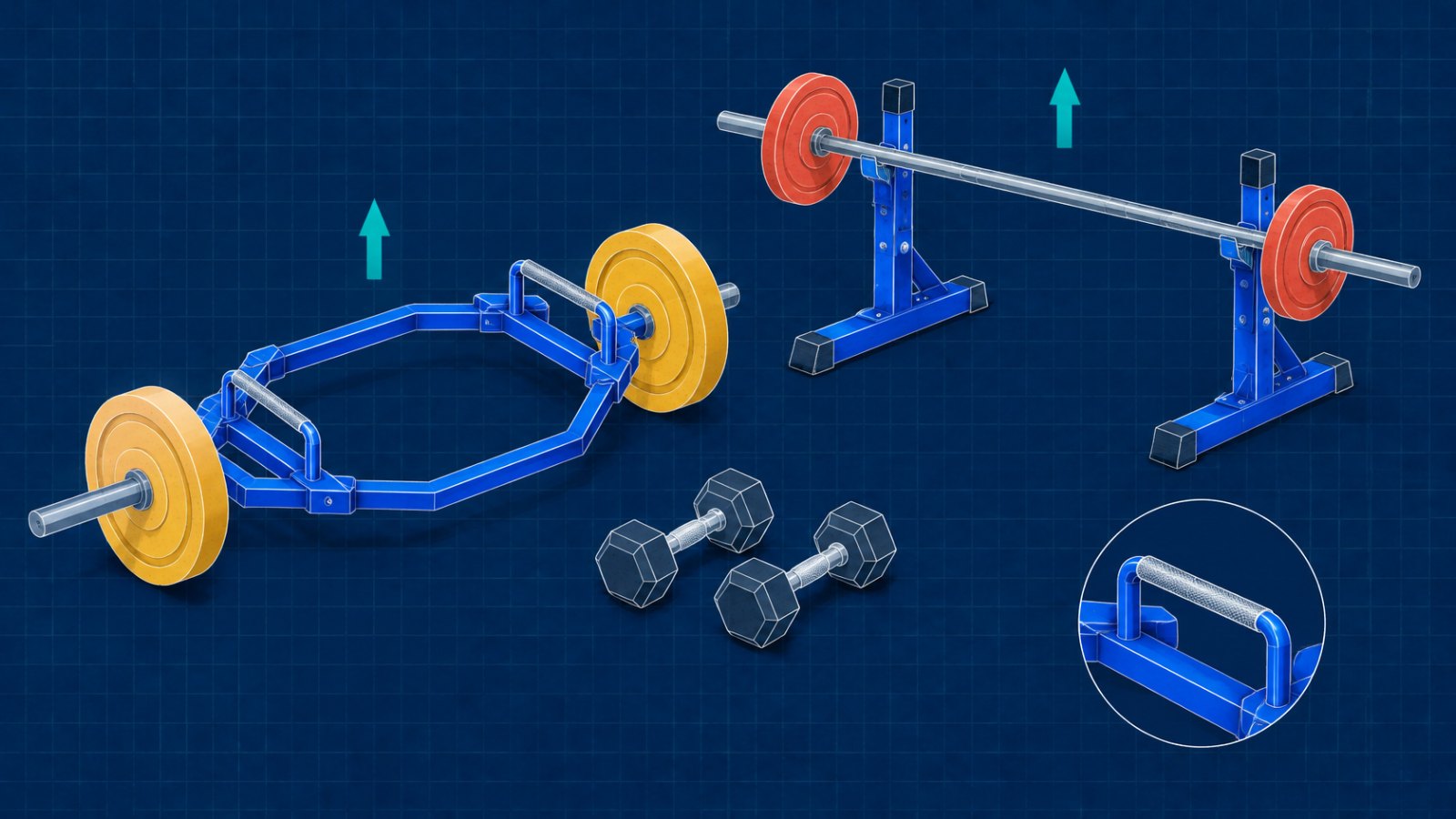
- Trap bar (hex bar). The best-supported way to add load. In 29 trained athletes, trap bar jumps produced more jump height, force and power than barbell jumps with the bar on the shoulders, and a trap bar with 20% of squat 1RM gave the highest power of every condition tested (Swinton et al., 2012). The 10-week trial above also used trap bar jump squats (Oranchuk et al., 2019). Our guide: Specialty Barbells for Home Gyms.
- Dumbbells. Same idea as a trap bar, with the weight at arm’s length. Easy to drop if a landing goes wrong. No study here tested them directly. Our guide: Adjustable Dumbbells for a Home Gym.
- Barbell on your back. It works, but jump power was lower with the load on the shoulders than with no weight at all (Swinton et al., 2012), and landing with a bar on your back is the hardest version to control. Keep it light if you use one. Our guide: How to Choose a Barbell for a Home Gym.
- Weight vest. Keeps your hands free, but weighted jump training had the smallest effect on jump height of the plyometric types compared (Makaruk et al., 2020). Optional, not needed.
- Resistance bands. Bands anchored under a platform add resistance as you rise. Training with bands or chains improved countermovement jumps in a meta-analysis, though the studies varied a lot (Xu et al., 2026). Our guide: Best Resistance Bands for a Home Gym.
- A good landing surface. Rubber gym flooring on a solid floor gives you grip and some give. Avoid slick or uneven surfaces. Our guide: Flooring Under a Power Rack.
Free tools to set it up:
- One Rep Max Calculator: estimate your squat 1RM and see the 20% and 30% loads from its percentage chart.
- Resistance Band Tension Calculator: see how many pounds a band adds at the top of the jump.
- Home Gym Flooring Calculator: how much rubber flooring you need for a jump area.
- How to Measure Your Vertical Jump: a phone app is accurate enough to see whether your jumps are slowing down.
How to program them
This is our take, built from the studies above, not a tested program:
- Sets and reps: 3 to 5 sets of 3 to 6 reps, with full rest between sets. Stop the set when jump height drops.
- Where: early in a leg session while you’re fresh, before heavy squats.
- With heavy squats: keep both. Heavy squats build the strength; jump squats teach you to use it fast. See Squats for Vertical Jump.
- Adding load: don’t add weight until bodyweight reps are fast and your landings are quiet. Then use a trap bar or dumbbells (see above).
- Weaker lifters: if your squat is under about 1.5 times body weight, prioritize heavy squats and keep jump squats at bodyweight.
The Vertical Jump Planner includes squat jumps in its blocks and shifts the plan toward strength if your squat is light for your body weight.
FAQ
Are jump squats good for vertical jump?
Yes. In training studies they raised jump power about as much as heavy squats and Olympic lift variations. They work best alongside heavy squats rather than instead of them.
Should jump squats be weighted?
Not at first. Power was highest with no added weight, and light loads up to about 30% of your squat 1RM came next. Heavier loads slowed the jump down.
What equipment do I need for jump squats?
None to start. To add weight, a trap bar was the best-supported option, and dumbbells work the same way. A rubber floor helps with landings.
Do jump squats build muscle?
The studies here measured power, strength and jump height, not muscle growth. For leg size, heavy squats and other lifting taken close to failure are the better-studied tools.
How many jump squats should I do?
There’s no single tested number. One trial used 7 sets of 6 bodyweight jump squats; our take is 3 to 5 sets of 3 to 6, stopping when height drops.
Are jump squats bad for your knees?
They’re a high-impact exercise. Build up from bodyweight, land softly, and keep the volume moderate. If they hurt, stop and see a clinician.
For the full picture, see How to Jump Higher: What the Research Says and Plyometrics for Vertical Jump.
Sources checked against PubMed on November 10, 2026. This is training information, not medical advice.