
When your legs are wrecked two days after a hard squat session, should you reach for an ice pack or a heating pad? For ordinary post-workout soreness the research gives a clearer answer than most people expect, and it depends on timing more than on the tool. This guide covers what the trials found, whether icing gets in the way of muscle growth, what changes when it is an actual injury, and how to use either one safely. It is general information, not medical advice.
Short answer
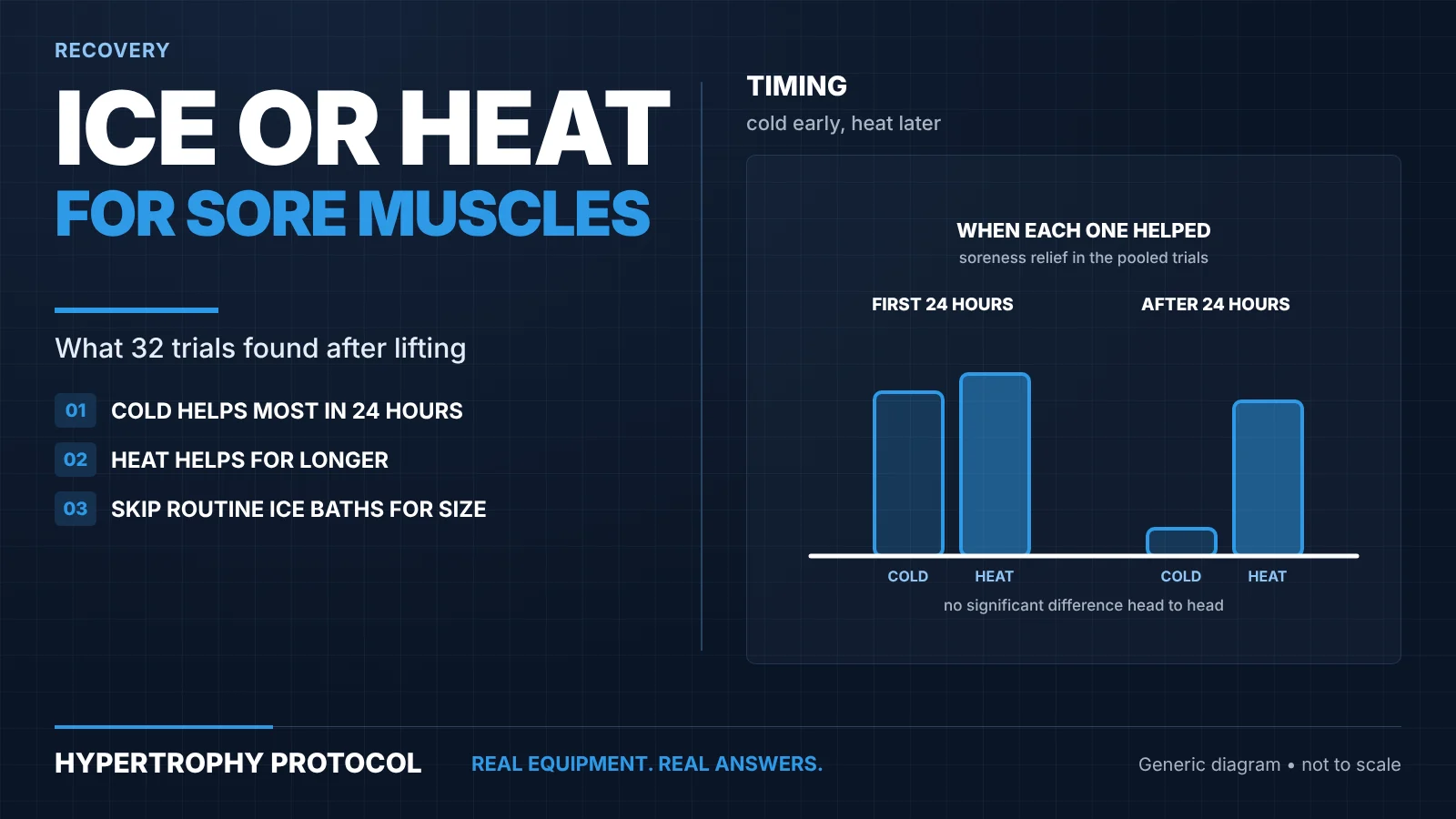
- Ordinary soreness after lifting: both heat and cold ease the pain a little. In a review of 32 trials, cold helped mainly in the first 24 hours, while heat helped both in the first day and after it.
- Which is better: that review found no significant difference between heat and cold, so timing and preference matter more than the choice itself.
- If you lift for size: skip routine ice baths right after training. Regular cold water immersion after lifting led to smaller gains in one 12 week trial.
- A fresh injury is different: sudden sharp pain, swelling or bruising calls for protecting the area and getting it checked if it doesn’t improve.
- Either way: 10 to 20 minutes at a time, with a cloth between the pack and your skin.
Is it soreness or an injury?
Start here, because the answer changes with the cause.
- Normal soreness (DOMS): a dull, achy, tender feeling that shows up a day or so after new, harder or unfamiliar training, usually on both sides, and fades over a few days.
- A possible injury: pain that started suddenly during a set, sits in one specific spot, comes with swelling or bruising, or stops you using the limb normally. That needs a different approach, covered further down.
Most of what follows is about the first kind.
Does heat help sore muscles?
Yes, modestly, and for longer than cold does. A 2021 meta-analysis of 32 randomized trials with 1,098 people found that heat applied after exercise reduced soreness both within the first 24 hours and after 24 hours. Hot packs showed the largest effect of the heat methods.
Two smaller trials point the same way:
- In a 2006 trial on low back soreness, people who wore a low-level heat wrap between 18 and 42 hours after hard back exercise reported 138% more pain relief at the 24 hour mark than people using a cold pack. Each group had only 16 people.
- In a 2011 trial of 120 adults with sore abdominal muscles, a chemical moist heat wrap reduced soreness more than the two other heat wraps tested.
Heat raises blood flow and makes connective tissue more elastic, according to a review of heat and cold therapies, which may be part of why it feels good on stiff muscles. The evidence is still thin: a 2025 umbrella review of 29 systematic reviews rated most of them as low or critically low quality, and graded the evidence for heat therapy as weak even though its effect sizes looked large. Treat heat as a comfort tool with some support, not a fix.
Does ice help sore muscles?
Also modestly, but mostly in the short term. In the same 32 trial meta-analysis, cold applied within an hour after exercise reduced soreness during the first 24 hours, with no clear effect after that. Cold water immersion was the most studied form.
Newer reviews agree on the pattern. A 2026 meta-analysis of 52 studies found a single cold water soak reduced soreness, and no water temperature (about 5, 10 or 15 °C) clearly beat the others. Another 2026 review of 22 trials found it did not change maximal strength over the following days, and jump performance dipped right after the soak before recovering by 24 to 48 hours. The authors rated the soreness benefit as very low certainty.
So which is better for sore muscles, ice or heat?
The meta-analysis that compared them directly found no significant difference between heat and cold. In practice:
- Right after a hard session: cold is the better studied option if you want soreness down that same day.
- The next day or two, when you feel stiff: heat has the edge, since its effect held past the first 24 hours.
- Either way: neither one makes the underlying muscle repair happen meaningfully faster. Sleep, food and easing back into training do that.
If you like both, contrast therapy (alternating hot and cold) also eased soreness in the umbrella review. Our sauna after a workout guide covers that and post-workout heat in more depth.
Will icing sore muscles hurt muscle growth?
Routine cold water immersion right after lifting might. In a 2015 study, 21 active men strength trained twice a week for 12 weeks and spent 10 minutes either in cold water or doing active recovery after each session. Strength and muscle mass increased more in the active recovery group, and only that group grew its type II muscle fibers, by 17%.
That study used full immersion several times a week. A cold pack on one sore spot now and then is a smaller dose, and it has not been tested the same way. If building muscle is your main goal, the practical rule is to keep ice baths away from the hours after lifting and save cold for days when soreness is really getting in the way. We found no study showing that heat after training reduces gains. Our cold exposure and muscle growth guide goes through the timing research in detail.
What about a fresh injury?
The old advice was ice first for any new injury. That has softened. The PEACE and LOVE framework for soft-tissue injuries, published in the British Journal of Sports Medicine, advises protecting the area for one to three days, avoiding anti-inflammatory treatments early on, and then reloading gradually. Its authors write that there is no high-quality evidence on how well ice treats soft-tissue injuries, and that its effect may be mostly pain relief.
Many clinicians still suggest ice for 10 to 20 minutes at a time in the first 24 to 48 hours for pain, then heat after that. If you use ice on a new injury, treat it as pain relief, not treatment. Get it checked if pain is severe, you can’t bear weight or use the limb, or it is not getting better over the next several days.
How to use heat or ice safely
- Time: 10 to 20 minutes per session. Cleveland Clinic calls 20 minutes the maximum for ice, with 10 to 15 often enough.
- Barrier: put a cloth or a few paper towels between an ice pack and your skin, and don’t ice broken skin.
- Spacing: leave at least an hour or two between sessions.
- Stop early if the skin turns very red or pale, or you feel tingling or prickling.
- No cream under a heating pad: pain-relief creams under heat can cause serious skin burns.
- Go shorter or ask first if you have nerve damage or neuropathy, Raynaud’s, or reduced feeling in the area, because you may not notice tissue damage.
Quick decision guide
| Your situation | Better choice | Why |
|---|---|---|
| Sore and stiff one to three days after a new or harder workout | Heat: a warm pack, heat wrap, warm bath or shower | Heat eased soreness both within and beyond the first 24 hours in the pooled trials |
| Within an hour of a brutal session and you want to feel better today | Cold: a cold pack or a short cool soak | Cold helped mainly within the first 24 hours |
| You train for muscle size and were planning an ice bath after every session | Skip routine cold immersion right after lifting | Regular post-lifting cold water immersion blunted gains in a 12 week trial |
| Sudden sharp pain, swelling, bruising or you can’t use the limb normally | Protect it and get it checked if it doesn’t improve | That’s an injury, not normal soreness |
The bottom line
For normal soreness after lifting, use whichever one you like, and lean toward heat once a day has passed. Keep routine ice baths away from your lifting sessions if you are training for size. If the pain started suddenly or comes with swelling or bruising, treat it as an injury and get it looked at if it does not improve.
Frequently asked questions
How long should you apply ice or heat to sore muscles?
We suggest 10 to 20 minutes per session. Cleveland Clinic calls 20 minutes the maximum for ice, with 10 to 15 often enough.
How cold does an ice bath need to be to help soreness?
A 2026 meta-analysis of 52 studies found that a single cold water soak reduced soreness, and no water temperature (about 5, 10 or 15 degrees C) clearly beat the others.
Does using heat after a workout reduce muscle gains?
We found no study showing that heat after training reduces gains. Our caution about muscle growth applies to routine cold water immersion right after lifting.
Can you use a pain relief cream under a heating pad?
No. Pain-relief creams under heat can cause serious skin burns.
Related guides
- Foam Rolling for Sore Muscles: What It Helps and What It Doesn’t
- DOMS: How Long Muscle Soreness Lasts and What Actually Helps
- Overtraining: Signs, Recovery Time and Whether Lifters Really Get It
Sources
- Wang Y, Li S, Zhang Y, et al. Heat and cold therapy reduce pain in patients with delayed onset muscle soreness: a systematic review and meta-analysis of 32 randomized controlled trials. Phys Ther Sport. 2021;48:177-187. doi:10.1016/j.ptsp.2021.01.004
- Wiecha S, Cieśliński I, Wiśniowski P, et al. Physical therapies for delayed-onset muscle soreness: an umbrella and mapping systematic review with meta-meta-analysis. Sports Med. 2025;55(5):1183-1212. doi:10.1007/s40279-025-02187-5
- Mayer JM, Mooney V, Matheson LN, et al. Continuous low-level heat wrap therapy for the prevention and early phase treatment of delayed-onset muscle soreness of the low back: a randomized controlled trial. Arch Phys Med Rehabil. 2006;87(10):1310-1317. doi:10.1016/j.apmr.2006.07.259
- Petrofsky J, Batt J, Bollinger JN, et al. Comparison of different heat modalities for treating delayed-onset muscle soreness in people with diabetes. Diabetes Technol Ther. 2011;13(6):645-655. doi:10.1089/dia.2011.0002
- Jeon Y, Yeo HS. Temperature-dependent effects of post-exercise cold-water immersion on recovery: a systematic review and meta-analysis. BMC Sports Sci Med Rehabil. 2026;18(1). doi:10.1186/s13102-026-01912-5
- Zhu Y, Yang L, Liu T, et al. Temporal dynamics of muscle strength recovery following acute cold-water immersion: a systematic review and meta-analysis. PeerJ. 2026;14:e21537. doi:10.7717/peerj.21537
- Roberts LA, Raastad T, Markworth JF, et al. Post-exercise cold water immersion attenuates acute anabolic signalling and long-term adaptations in muscle to strength training. J Physiol. 2015;593(18):4285-4301. doi:10.1113/JP270570
- Malanga GA, Yan N, Stark J. Mechanisms and efficacy of heat and cold therapies for musculoskeletal injury. Postgrad Med. 2015;127(1):57-65. doi:10.1080/00325481.2015.992719
- Dubois B, Esculier JF. Soft-tissue injuries simply need PEACE and LOVE. Br J Sports Med. 2020;54(2):72-73. doi:10.1136/bjsports-2019-101253
- Cleveland Clinic. How long should you ice an injury? health.clevelandclinic.org
- Cleveland Clinic Newsroom. Heat or ice: which is better for treating minor injuries? June 5, 2026. newsroom.clevelandclinic.org
Last checked November 7, 2026.