
Disclosure: As an Amazon Associate, Hypertrophy Protocol earns from qualifying purchases made through Amazon links on this page, which are marked affiliate.
Disclosure: Hypertrophy Protocol may earn a commission if you buy through some links on this page, at no extra cost to you.
Disclosure: this guide contains a Beyond Power referral link, and Hypertrophy Protocol may receive referral credit if you buy through it.
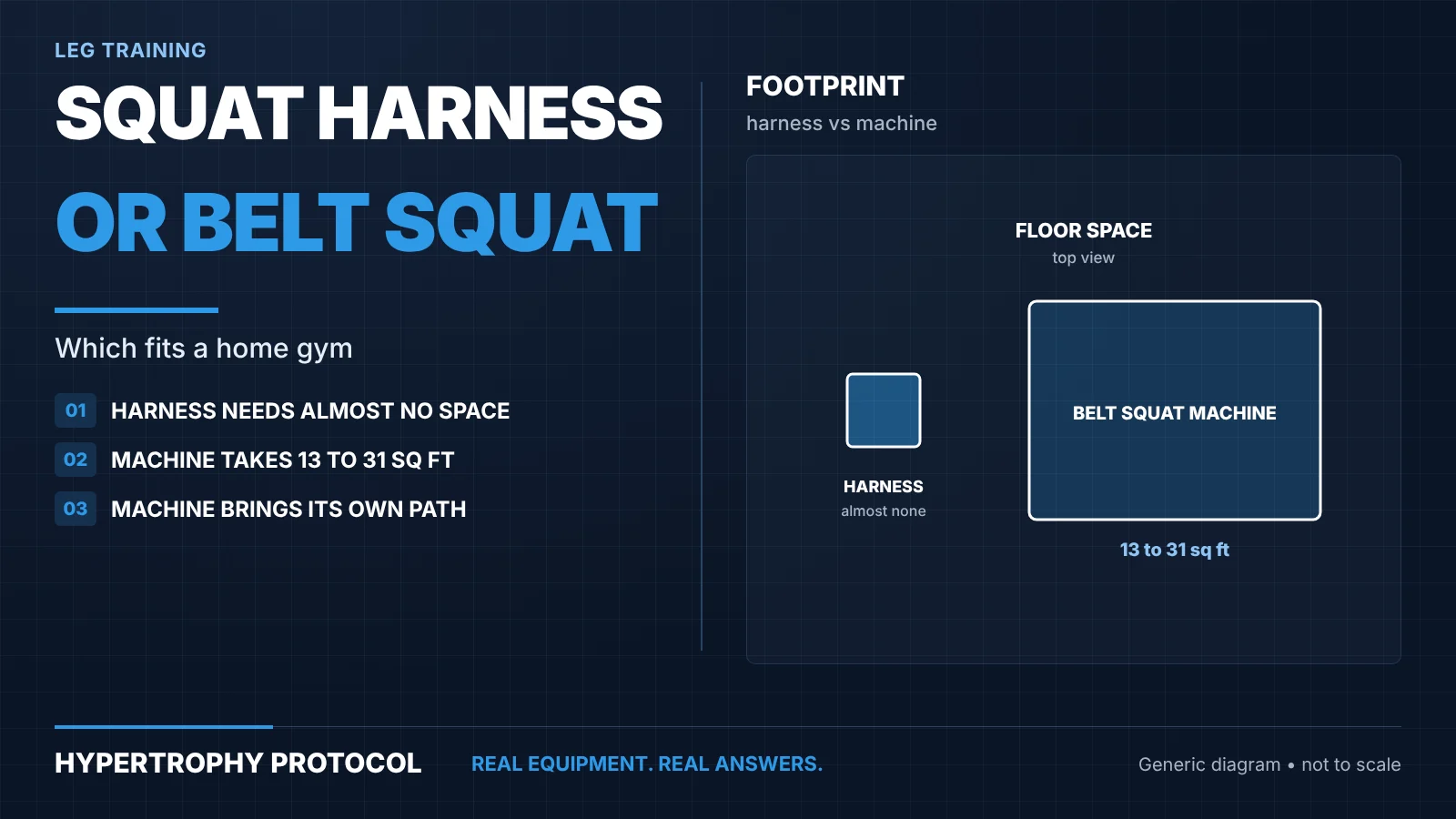
In the squat harness vs belt squat decision for belt squats at home, floor space and load settle most cases. The choice is a squat harness you clip to a cable or plates, or a dedicated belt squat machine. A harness adds almost no footprint but borrows its load and path from whatever you clip it to, while the machines here take roughly 13 to 31 square feet and give you a fixed path, rated to 700 to 1,000 lb where the maker publishes a figure.
If you already own a functional trainer or a strong cable setup, start with the harness. If belt squats will be your main heavy leg lift and you can give up the floor, buy a machine. Every spec and study below was checked on September 28, 2026, on the maker’s own product page or on PubMed.
At a glance
| Option | Best for | Footprint | Rated load | Main catch |
|---|---|---|---|---|
| Squat Harness V4 | Owners of a functional trainer or strong cables | None beyond your load source | Estimated 950 lb | Capped by what your cable or bar delivers |
| Ripped Ramp Deluxe with VOLTRA I dock | VOLTRA I owners | 3.25 sq ft | 1,000 lb ramp; 400 lb with the pulley hack | Pre-order only on Sep 28, 2026 |
| Titan SquatMax-MD | The most compact machine, vertical load | 12.8 sq ft | 1,000 lb belt and loading pin | Rows and deadlifts need the accessory kit |
| Rogue Monster Rhino Belt Squat, Stand Alone | A bolted-down space with room overhead | 22.3 sq ft; 78.5 in tall | Not published | Must be bolted to the floor |
| Bells of Steel Belt Squat Machine 2.0 | A longer wall, extra movements | 28.7 sq ft (18.6 with horns vertical) | 700 lb | Load path not described; full depth not guaranteed |
| Titan Belt Squat Machine | A longer wall, pivoting path | 31.1 sq ft | 1,000 lb | Belt squats only |
Footprints and ratings from the makers’ pages, checked September 28, 2026. Add room to step on and load plates. Confirm before ordering.
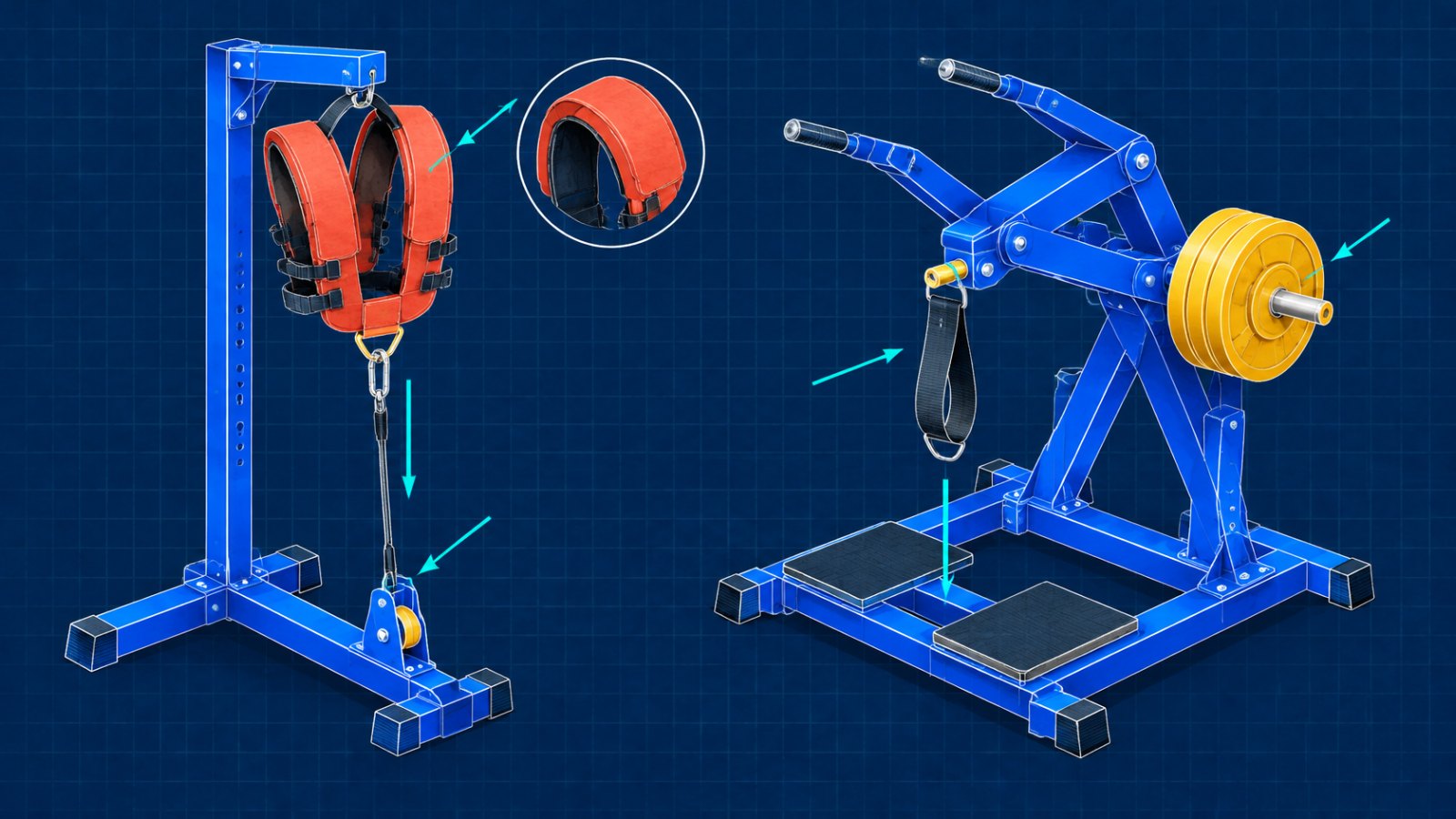
What are you choosing between in a squat harness vs belt squat setup?
Those two recommendations follow from one difference. A harness is an adapter: it gives a cable, a band or a hanging bar somewhere to attach to your body, and it has no weight source of its own. A belt squat machine is the weight source, with a hip belt, a platform and a path built in.
The Squat Harness V4 also sits on your body differently from a hip belt, and the Squat Harness V4 review covers how it loads you and how it fits. This guide stays on the buying decision. The table sets the V4 and its maker’s VOLTRA-ready ramp beside four standalone machines.
| Setup | Load attaches at | Load path | Footprint | Rated load | Loading and start | Other uses | Source |
|---|---|---|---|---|---|---|---|
| Squat Harness V4 | Carabiners on fabric loops at each side | Set by what you clip to | None beyond your load source | Estimated 950 lb (plate-loaded functional trainer); test carefully past 500 lb with free weights | Band hook straps included; loading straps and barbell hook straps sold separately | Cable, band, barbell and hex bar work | Squat Harness |
| Ripped Ramp Deluxe with VOLTRA I dock | Harness on a VOLTRA cable | Cable from a dock in the ramp | 26 x 18 in, 5 in tall (3.25 sq ft) | 1,000 lb ramp; 400 lb max with the O-ring pulley hack (maker’s figure, written when the VOLTRA I’s limit was 200 lb) | Pre-order only on Sep 28, 2026 | Bands, calf raises | Squat Harness |
| Titan SquatMax-MD | Hip belt with carabiner | Vertical: load hangs directly under your hips | 45 x 41 in (12.8 sq ft); 59.5 in tall | 1,000 lb belt and loading pin | Plates on a pin through a center cut-out; band pegs | Hip thrusts, rows, deadlifts (accessory kit) | Titan |
| Rogue Monster Rhino Belt Squat, Stand Alone | Rogue Multi Belt | Plates on a trolley on a 78.5 in tower, raised by a cable | 53 x 60.5 in (22.3 sq ft); must be bolted to the floor | Not published; two 15.75 in weight posts | Trolley rests on the Rhino Horn and lifts off as you stand | Calf raises, rows, shrugs, deadlifts | Rogue |
| Titan Belt Squat Machine | Padded nylon hip belt | Pivoting frame (bushings at pivot points); three weight stopper positions | 83 x 54 in (31.1 sq ft); 38 in tall | 1,000 lb | Two 16.5 in sleeves; four rear posts store plates | Belt squats only | Titan |
| Bells of Steel Belt Squat Machine 2.0 | Belt, chain and carabiners | Not described on the product page; 13 height settings | 51 x 81 in (28.7 sq ft), or 51 x 52.5 in (18.6 sq ft) with the weight horns mounted vertically | 700 lb | Belt, chain, carabiners included; full depth not guaranteed | Calf raises, marches, lunges, RDLs, rows | Bells of Steel (US) |
Two gaps matter. Rogue publishes no load rating for the Rhino, only the length of its weight posts, and Bells of Steel’s product page does not describe the path its load travels. If either detail decides it for you, ask the maker before you order.
How much floor does each option take?
The two routes split furthest on footprint. A harness clipped to a functional trainer or cable column you already own adds nothing to your floor plan, and the VOLTRA-ready ramp is doormat-sized. Every standalone machine here takes a permanent corner.
Floor area from each maker’s published footprint (square feet)
Length times width, converted to square feet. Add room to step on and off, plus space to load plates.
The SquatMax-MD is the most compact machine here, and standing the Bells of Steel weight horns up cuts 28.5 inches off its length. The Rhino is mid-sized on the floor but stands 78.5 inches tall and has to be bolted down, so it needs a fixed spot and a floor you can anchor into.
A harness has one hidden space cost if you load it with a trap bar. A bar hanging below your hips reaches the floor before you reach depth unless you stand on something, which is the same fix Bells of Steel offers for its own machine: stackable blocks, bumper plates or a platform.
Does a vertical hang or a pivot arc change the squat?
Next comes the path your hips follow. The SquatMax-MD hangs the load straight under your hips, the Rhino lifts a trolley up a tower, and Titan’s belt squat machine moves on pivots. With a harness, the path is whatever you clip to, and a cable that leans off vertical pulls you forward as well as down, as the VOLTRA belt squat guide works out with cable-angle math.
| Study | Who | What was compared | Measured result |
|---|---|---|---|
| Joseph et al., 2020 | 10 lifters who trained both lifts (9 men, 1 woman) | Barbell back squat vs a pivoting belt squat machine, 3 sets of 5 at 100% of body weight | Quadriceps EMG did not differ; lumbar erector activity 45.4% lower and gluteus maximus 35.2% lower on the belt squat (integrated EMG) |
| Evans et al., 2019 | 31 adults (16 men, 15 women) | 5RM back squat vs 5RM machine belt squat | Of the four muscles recorded, only gluteus maximus differed, lower on the belt squat (left side 0.69 vs 0.84, normalized EMG) |
| Dufner et al., 2024 | 20 recreationally active adults (8 men, 12 women) | Maximal isometric squat on a flywheel device, full-body harness vs waist belt | Peak force higher in the harness, a small effect (Hedges’ g = 0.23); participants leaned further forward in the over-the-shoulder straps |
On a pivoting machine, the quads worked about as hard as in a back squat while the trunk and glutes did less. The Joseph team tied the glute result to machine design: an earlier study on a machine where the weight slid along a fixed rod showed no glute difference, while the pivoting machines did. That is a lead worth knowing, not a settled rule.
All of this is EMG and force, which are proxies for effort. None of these studies measured muscle growth, and none tested a vest-style harness like the V4 on a cable. The flywheel study used a different harness on a different device and ran one isometric test, so it hints that harness posture differs from a belt squat and little more. For how eight squat loading styles compare more broadly, see the squat machine styles comparison.
How much load can each take, and how easy is it to load?
Capacity is where the machines pull ahead of most harness setups. The V4 itself carries an estimated 950 lb rating, so the harness is rarely the limit. Your ceiling is whatever you clip it to: a VOLTRA I tops out at 230 lb per unit on Firmware 2.0 (up to 250 lb in the separate Project Overdrive Beta), the Deluxe ramp’s pulley hack caps at 400 lb per Squat Harness, and a weight-stack trainer gives you only what reaches the handles.
If your functional trainer runs a 2:1 pulley ratio, each cable delivers half the weight on its stack. Free weights on a harness have a softer ceiling of their own, since Squat Harness advises testing each lift carefully once you pass 500 lb.
The machines are rated from 700 to 1,000 lb where the maker publishes a number. How they load differs more than how much. The Rhino’s plates ride on a trolley that rests on a horn between sets and lifts off as you stand, while the SquatMax-MD takes plates on a loading pin through a cut-out in the center of the platform. Titan’s pivoting machine gives you three stopper positions to set depth, and its rear posts double as plate storage.
Which is faster to set up, and which does more?
Beyond loading, a harness means buckling in, clipping a carabiner to each side, and setting strap or cable length so you reach depth, with the daisy-chain method on the hook straps adding range. If the harness shares a cable station with rows and pulldowns, you rebuild the setup each time you switch.
A machine is always set up, which is most of what its floor space buys you. You belt in, clip on and stand. The height settings on a machine like the Bells of Steel are a fitting step, since the maker’s how-to has you set the attachment point level with your hips.
Versatility runs the other way. The harness works with cables, bands, a barbell and a hex bar, so the same harness serves squats and deadlifts at more than one station. The machines add a few extras each, from rows and shrugs on the Rhino to lunges and RDLs on the Bells of Steel, but Titan’s pivoting machine does belt squats only.
Which should you buy for your home gym?
The choice comes down to what you already own and how central belt squats will be.
If you own a plate-loaded functional trainer or strong dual cables and floor space is tight, buy the harness. You add belt-squat-style leg work for almost no footprint, capped by what your trainer delivers at the handles.
If you train with a VOLTRA I, the harness is the only route that uses it, and the Deluxe ramp gives the cable a fixed dock. Match your working weight to the per-unit ceiling (230 lb on Firmware 2.0, 250 lb on the Overdrive beta) before you commit.
If belt squats will be your main heavy leg movement and you can spare 13 to 31 square feet, buy a machine. The SquatMax-MD is the compact vertical pick, the Rhino suits a bolted-down space with room overhead, and the Titan and Bells of Steel machines fit a longer wall.
If you own none of these, a harness and bands is a low-commitment way to learn whether you like the movement. Treat bands as a trial rather than your long-term load, since tension drops at the bottom of each rep.
Your next step: run your functional trainer or cable setup through the Cable Pulley Ratio Calculator to see what your stack delivers at the harness. If that number sits below your working sets, the harness will cap you, and a machine is the better buy.
Sources checked September 28, 2026. Manufacturers change specs; confirm on the product page before ordering. Research summaries describe the cited studies; individual results vary.
Titan sells the SquatMax-MD through its Amazon store in two versions: freestanding (affiliate) and rack mounted (affiliate), which Titan lists as fitting T-3, X-3 and Titan Series racks. It also sells its plate-loaded Belt Squat Machine (affiliate) there. Listings and options change, so check the size and fit on the product page before you order.
Frequently asked questions
Is a squat harness the same as a belt squat machine?
No. A harness is an adapter that gives a cable, a band or a hanging bar somewhere to attach to your body, and it has no weight source of its own. A belt squat machine is the weight source, with a hip belt, a platform and a path built in.
What is the most compact belt squat machine for a home gym?
Among the machines compared in this guide, the Titan SquatMax-MD is the most compact, at 12.8 square feet based on the maker’s published footprint. Add room to step on and off and to load plates.
Do belt squats work the quads as much as back squats?
In the Joseph 2020 EMG study, quadriceps activity did not differ between a barbell back squat and a pivoting belt squat machine, while lower back and glute activity were lower on the belt squat. EMG is a proxy for effort, and none of the studies this guide cites measured muscle growth.
Does the Rogue Rhino belt squat have to be bolted to the floor?
Yes. Per the maker’s page when checked, the Rogue Monster Rhino Belt Squat, Stand Alone has to be bolted down and stands 78.5 inches tall, so it needs a fixed spot and a floor you can anchor into.