
Disclosure: As an Amazon Associate, Hypertrophy Protocol earns from qualifying purchases made through Amazon links on this page, which are marked affiliate. This article is general information, not medical advice.
Magnesium is one of the most popular sleep supplements, and magnesium glycinate in particular is often sold as a natural sleep aid. The research is less exciting than the marketing. The best recent trial found a small improvement in insomnia symptoms, and a 2026 systematic review concluded the evidence doesn’t support magnesium as a routine insomnia treatment. It’s cheap and generally safe at sensible doses, though, and some people may benefit more than others. This guide covers what the studies show, which form to choose, how much to take and who should be careful.
Short answer
- Does it work? Modestly at best. The largest recent trial found a small improvement in insomnia symptoms (effect size 0.2), and reviews rate the overall evidence as low certainty.
- Who might benefit most: possibly people who get little magnesium from food. They seemed to improve more in the 2025 glycinate trial, but that was an exploratory finding.
- Which form: magnesium glycinate (bisglycinate) is gentle on the stomach and was used in the best recent trial. Citrate is fine but more likely to loosen stools.
- How much: check the label for elemental magnesium. The best recent trial used 250 mg a day. The NIH upper limit is 350 mg a day from supplements and medicines combined.
- Be careful if you have kidney disease or take bisphosphonates, some antibiotics, diuretics or long-term acid reflux medication.
At a glance
| Verdict | Not a proven sleep aid; at best a small benefit, most likely in people who eat little magnesium. |
|---|---|
| Effect size / key numbers | Insomnia scores fell 3.9 points vs 2.3 on placebo (ES 0.2; 155 adults, 4 weeks). |
| Evidence strength | Low to very low: 12 randomised trials with inconsistent results. |
| What to do | If you try it: about 250 mg elemental magnesium a day as glycinate for 3–4 weeks. |
| Main caveat | Stay at or under 350 mg a day from supplements and medicines; check first with kidney disease. |
See the full sections below for sources. General information, not medical advice.
Does magnesium help you sleep?
A little, for some people, and the evidence is weak.
- The 2026 systematic review: Lopresti and colleagues looked at 12 randomised trials of magnesium on its own for sleep in adults. Results were inconsistent across questionnaires, sleep studies and wearables, and the certainty of evidence was low to very low. They concluded magnesium isn’t supported as a routine insomnia treatment but may give modest benefits on some self-reported measures for some adults.
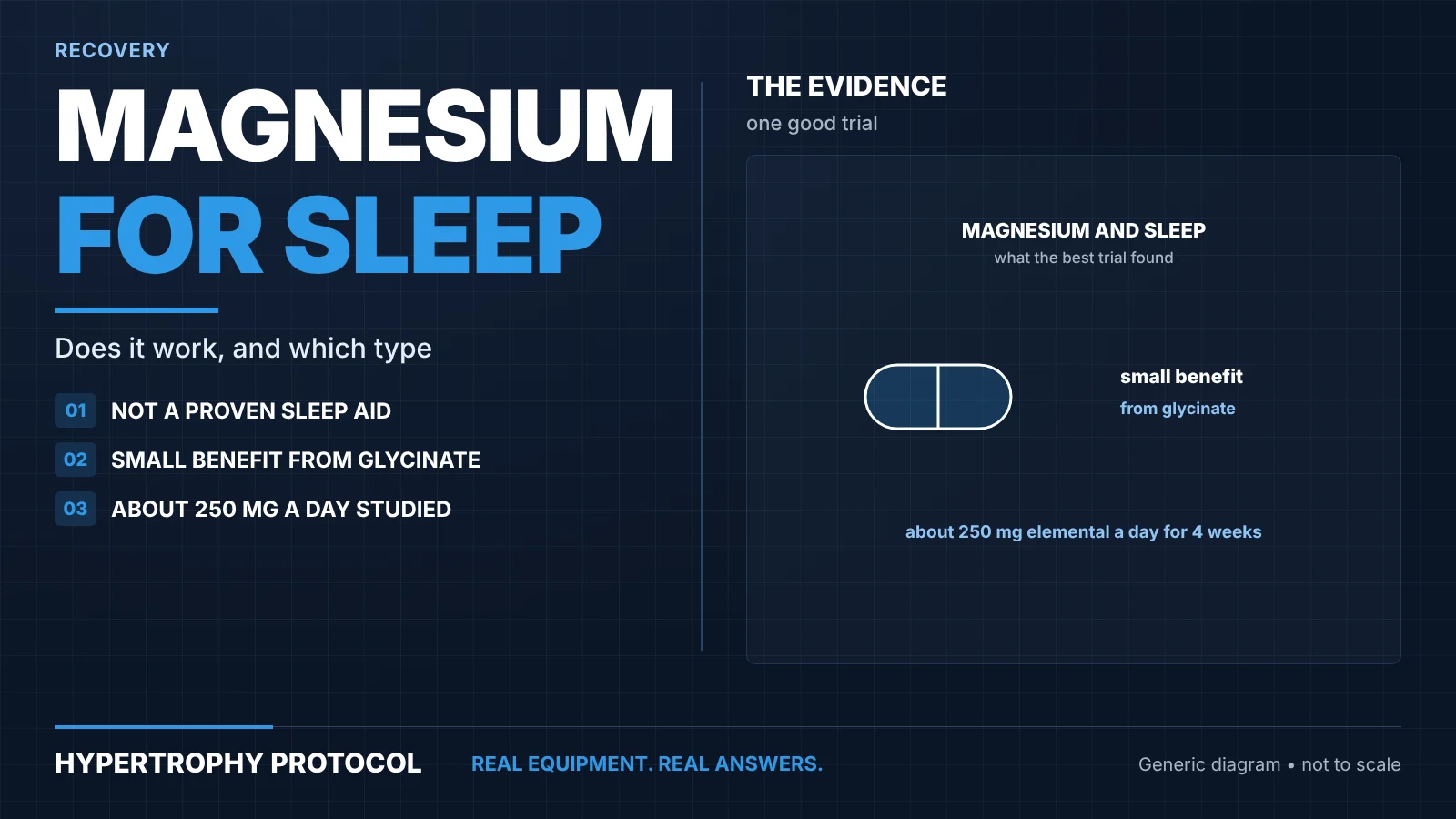
- The best recent trial: in a 2025 study by Schuster and colleagues, 155 adults with poor sleep took magnesium bisglycinate (250 mg of elemental magnesium) or a placebo for four weeks. Insomnia scores fell by 3.9 points with magnesium and 2.3 points with placebo, a small difference (effect size 0.2). People who ate less magnesium at the start appeared to improve more, though that was an exploratory finding.
- Older adults: a 2021 meta-analysis of three small trials in older adults (Mah and Pitre) found people fell asleep about 17 minutes faster with magnesium than placebo. Total sleep time wasn’t significantly different, and the trials were at moderate to high risk of bias.
Notice how big the placebo effect was in the 2025 trial. Most of the improvement people felt would have happened with a sugar pill, which is worth remembering when you read glowing reviews.
Does magnesium help lifters sleep or recover?
There’s no good evidence that it does in people who already get enough. In a 2024 trial by Gallagher and colleagues, trained men took ZMA (zinc, magnesium and vitamin B6) while sleeping only 4 hours a night for two nights. It made no difference to sleep or to bar speed and power in the gym the next morning.
Sweat contains some magnesium, so if you train hard and your diet is low in magnesium-rich foods, a supplement is a reasonable insurance policy. It won’t make up for short sleep, though. For what actually matters for muscle growth, see our guide to sleep and muscle growth. If poor sleep comes with stalled lifts and constant tiredness, our guide to overtraining covers the other signs.
Who is most likely to benefit?
According to the NIH Office of Dietary Supplements, the people most likely to fall short on magnesium are older adults (especially men over 70), people with digestive diseases such as Crohn’s or celiac disease, people with type 2 diabetes and people with long-term heavy alcohol use. If your diet is light on beans, nuts, seeds, whole grains and leafy greens, you may be low too. These are the groups where a supplement is most likely to make a difference.
If you already eat plenty of those foods and sleep poorly, magnesium is unlikely to fix it. Look at sleep timing, caffeine, alcohol, your bedroom and stress first, and see a doctor about insomnia that lasts more than a few weeks.
Magnesium glycinate vs citrate vs other forms
Supplements bind magnesium to another compound, and the form affects how much magnesium you get per pill and how your gut tolerates it. The NIH says aspartate, citrate, lactate and chloride forms are absorbed more easily than some others. Very few trials have compared forms directly for sleep.
| Form | What it’s like | Sleep evidence |
|---|---|---|
| Glycinate / bisglycinate | About 14% magnesium by weight, so capsules are large and you often need two or three. Usually gentle on the stomach. | Small benefit in the 2025 trial. Few trials compare forms, but this is the best-studied option. |
| Citrate | Well absorbed and cheap. More likely to loosen stools, especially at higher doses. | Not well studied for sleep specifically. |
| L-threonate | Marketed for the brain. Low magnesium per gram and expensive. | One 2024 trial reported better sleep scores on an Oura ring; three of its six authors worked for a company that sells the ingredient. |
| Oxide | About 60% magnesium by weight, so pills are small and cheap, but it’s a common laxative. | Used in some older trials. Not a great choice for nightly use. |
| ZMA | Zinc, magnesium and vitamin B6, popular with lifters. | No effect on sleep or performance in trained men (2024). |
How much magnesium to take for sleep
- Read the elemental magnesium on the label, not the weight of the compound. A capsule with 500 mg of magnesium glycinate contains only about 70 mg of magnesium.
- About 250 mg of elemental magnesium a day is the dose with trial support. That’s what the 2025 trial used; it didn’t test other doses or the best time to take it. Evening is a practical choice, and taking it with food can reduce stomach upset.
- Stay at or under 350 mg a day from supplements and medicines combined unless a doctor tells you otherwise. Some antacids and laxatives contain magnesium too. That’s the NIH upper limit for adults, and it doesn’t include magnesium from food. Adults need 310 to 420 mg a day in total, depending on sex and age, and most of that should come from food.
- Give it three or four weeks. If you can’t tell a difference by then, it probably isn’t doing much for you.
Magnesium and restless legs
Magnesium is often suggested for restless legs. A 2024 review (González-Parejo and colleagues) found magnesium improved symptoms and sleep in a small trial, but half of the studies in the review had a high risk of bias. Restless legs are often linked to low iron and other medical causes, so see a doctor rather than self-treating with magnesium.
Side effects and who should be careful
- Digestive upset: diarrhea, nausea and cramps are the most common side effects of high-dose supplements, according to the NIH.
- Kidney disease: healthy kidneys remove excess magnesium. If yours don’t work normally, magnesium can build up, so don’t supplement without your doctor’s approval.
- Medications: the NIH lists interactions with bisphosphonates for osteoporosis and some antibiotics (take them several hours apart from magnesium), certain diuretics, long-term acid reflux and ulcer medications, and very high-dose zinc supplements. Check with your pharmacist.
- Combination sleep products: many contain melatonin or herbs as well, which have their own effects and interactions. Read the full label.
Food first
Good sources of magnesium include pumpkin seeds, almonds and other nuts, beans and lentils, whole grains, spinach and other leafy greens, and fortified cereals. Getting more from food also brings fibre, protein and other nutrients a supplement won’t give you.
Magnesium supplements to consider
Prices were checked on Amazon on October 20, 2026, and change often. We haven’t tested these products; check the elemental magnesium per serving on each label.
| Product | Form | Price | Notes |
|---|---|---|---|
| Nutricost Magnesium Glycinate, 180 capsules (affiliate) | Bisglycinate | About $15 | Budget option. 210 mg of magnesium per three capsules, close to the trial dose. |
| NOW Magnesium Glycinate, 180 tablets (affiliate) | Glycinate | About $20 | Tablets rather than capsules; easy to adjust the dose. |
| Thorne Magnesium Glycinate, 90 capsules (affiliate) | Glycinate | About $26 | Well-known brand with a reputation for quality control. |
| Pure Encapsulations Magnesium (Glycinate), 180 capsules (affiliate) | Glycinate | About $47 | Over 50,000 reviews. Premium price for the same basic ingredient. |
| Nature Made Magnesium Citrate, 60 softgels (affiliate) | Citrate | About $12 | 250 mg per two softgels. Cheapest option; may loosen stools. |
If you compete in a tested sport, choose a product certified by a third-party program such as NSF Certified for Sport, and check the certification for that exact product.
The bottom line
Magnesium isn’t a proven sleep aid. In the best recent trial, glycinate gave a small benefit over placebo, and the people most likely to notice a difference are those who don’t eat much magnesium. If you want to try it, the studied approach is about 250 mg of elemental magnesium a day as glycinate for four weeks. Stay at or under 350 mg a day from supplements and medicines, and stop if you can’t tell a difference. Check with a doctor first if you have kidney disease or take regular medication.
Sources
- Lopresti AL, Smith SJ, Drummond PD. Magnesium supplementation for sleep in adults: a systematic review of randomized controlled trials. J Diet Suppl. 2026;23(5):553-581. doi:10.1080/19390211.2026.2719670
- Schuster J, Cycelskij I, Lopresti A, Hahn A. Magnesium bisglycinate supplementation in healthy adults reporting poor sleep: a randomized, placebo-controlled trial. Nat Sci Sleep. 2025;17:2027-2040. doi:10.2147/NSS.S524348
- Mah J, Pitre T. Oral magnesium supplementation for insomnia in older adults: a systematic review & meta-analysis. BMC Complement Med Ther. 2021;21(1):125. doi:10.1186/s12906-021-03297-z
- Gallagher C, Austin V, Dunlop KA, et al. Effects of supplementing zinc magnesium aspartate on sleep quality and submaximal weightlifting performance, following two consecutive nights of partial sleep deprivation. Nutrients. 2024;16(2):251. doi:10.3390/nu16020251
- Hausenblas HA, Lynch T, Hooper S, Shrestha A, Rosendale D, Gu J. Magnesium-L-threonate improves sleep quality and daytime functioning in adults with self-reported sleep problems: a randomized controlled trial. Sleep Med X. 2024;8:100121. doi:10.1016/j.sleepx.2024.100121
- González-Parejo P, Martín-Núñez J, Cabrera-Martos I, Valenza MC. Effects of dietary supplementation in patients with restless legs syndrome: a systematic review. Nutrients. 2024;16(14):2315. doi:10.3390/nu16142315
- NIH Office of Dietary Supplements. Magnesium fact sheet for consumers. ods.od.nih.gov