
Disclosure: We participate in the Bulletproof Fitness Equipment affiliate program and may earn a commission from qualifying purchases made through links on this page.
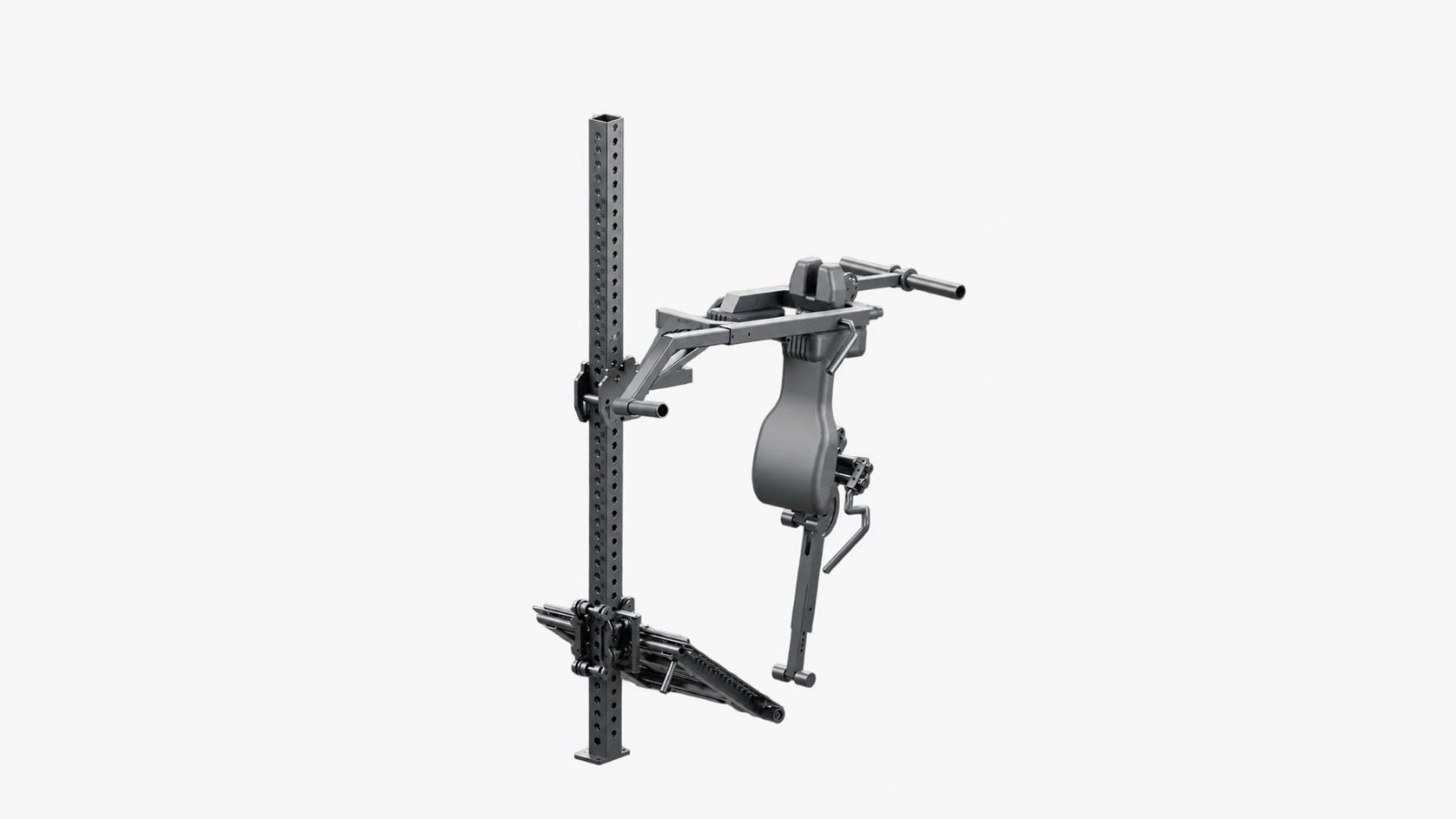
The Bulletproof Squat Arm is a fold-away pendulum squat that mounts to a compatible 3×3 upright instead of standing on its own frame. Bulletproof put it on presale in November 2026. This guide covers what Bulletproof has published about it, how a pendulum squat loads your legs, which muscles it is likely to train, and how it compares with standalone pendulum squat machines.
Specs and prices below come from each maker’s own product page, checked November 22, 2026. Where something is our reading of the design rather than a published spec or a study result, we say so.
See the Squat Arm on Bulletproof’s site
At a glance
- What it is: a pendulum squat arm that mounts to a 3×3 upright and folds flat when you are done.
- Presale price: $1,299 (regular price $1,699). Prices rise in tiers during the presale.
- Mounting: the middle post of a compatible 6-post rack, a Rear Middle Upright added to a 4-post rack, or a wall-mounted Bulletproof upright.
- Listed size: 75.0 in working depth, 20.6 in folded depth, 29.8 in wide, 52.8 in working height (shown at height setting 2 of 5).
- Not published yet: weight capacity, starting resistance, machine weight and a firm ship date.
- Main muscles (likely): quadriceps first, then glutes and adductors. Hamstrings get little.
What the Squat Arm is
Bulletproof describes the Squat Arm as a way to get pendulum squat training “without permanently sacrificing valuable floor space.” It mounts to a compatible 3×3 upright, adjusts to the lifter, and folds away after the workout so the floor can be used for other things.
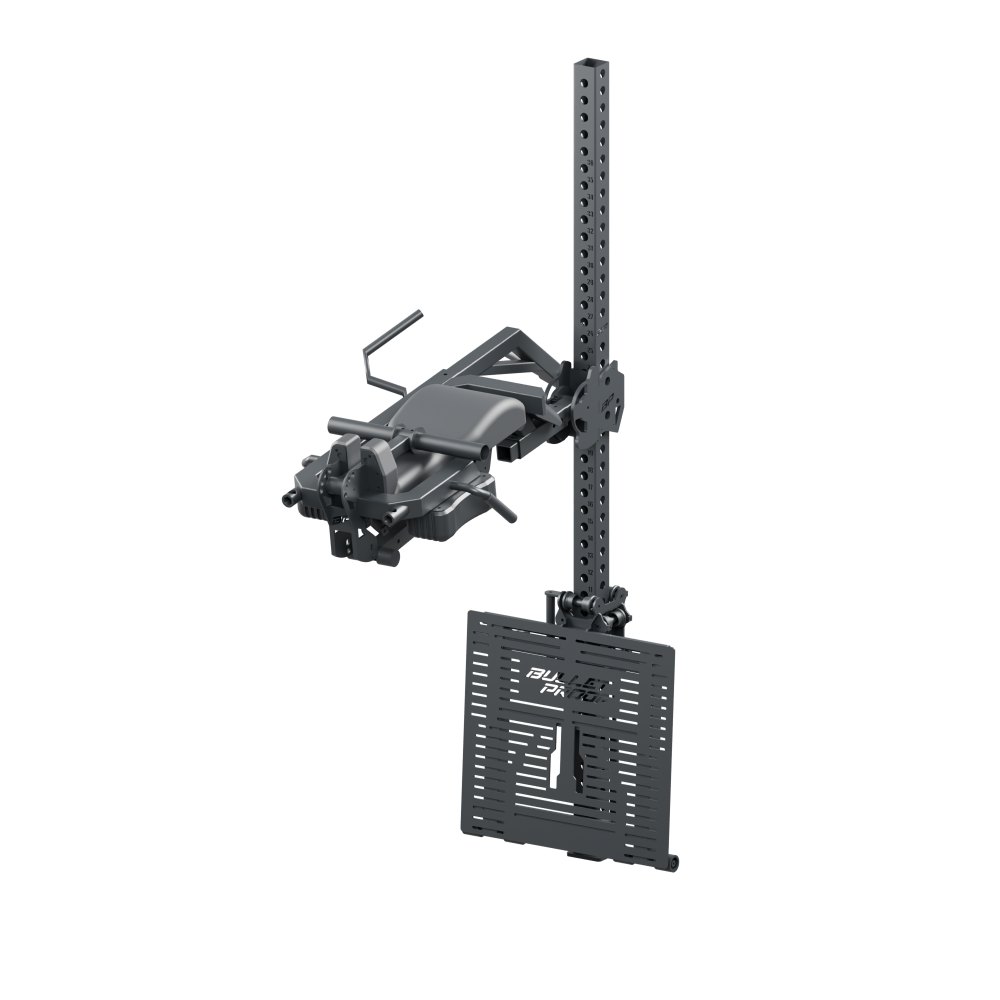
Bulletproof lists these adjustments: arm length, back pad angle, footplate height and angle, weight horn angle, and starting position. The product page’s 3D viewer also shows counterweight plate loading, a safety stop adjustment, a kickstand, folding weight horns and a fold-flat storage mode.
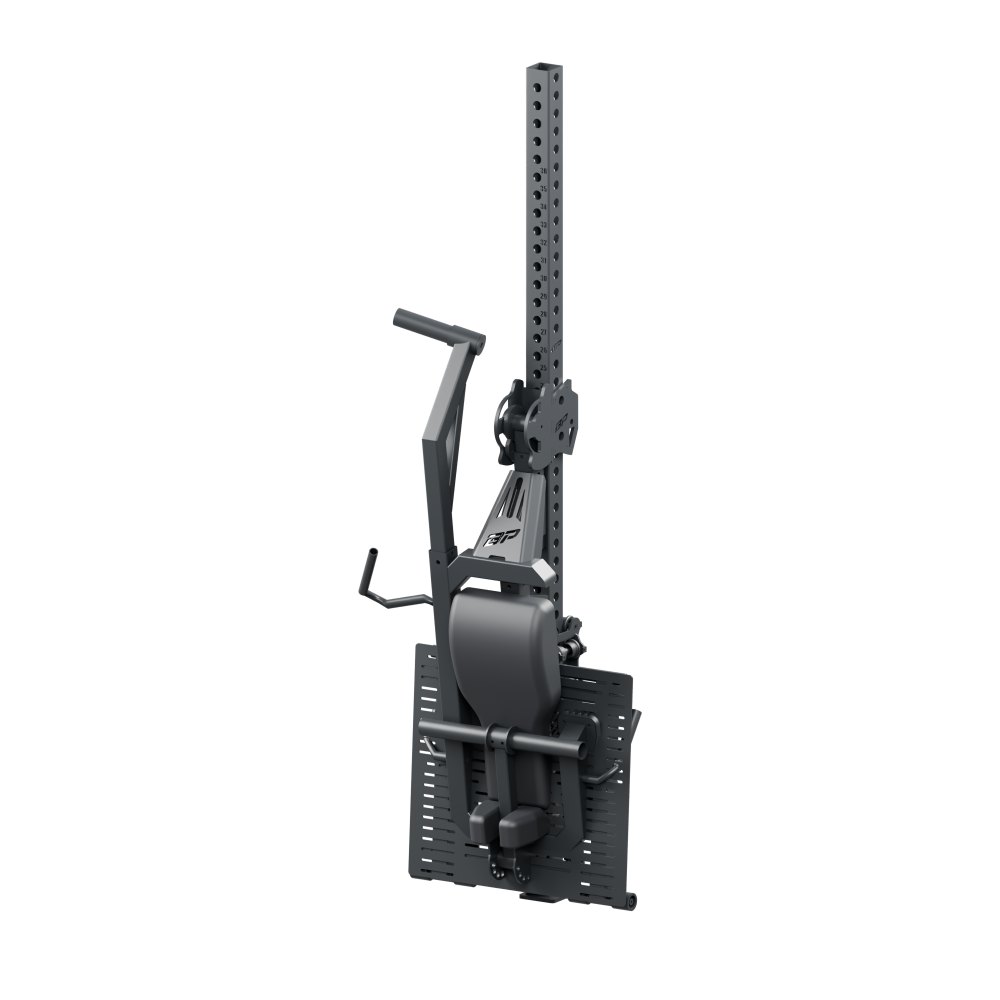
Bulletproof also says the rear handles can be used for Viking presses “in the approved configuration.” It uses “approved” several times (approved settings, approved configuration, approved unloading and storage sequence), so treat any use it does not show as unconfirmed until the manual is out.
Ways to mount it
The Squat Arm attaches to an upright, not directly to a wall. Bulletproof gives three setups:
- 6-post rack: off the side of the middle post on a compatible rack.
- 4-post rack: add the Rear Middle Upright ($329 to $639 across variants). Its options list a rack inside width of 41 to 43 in and 3×3 uprights with 1 in holes.
- No rack: the Wall Upright & Bracket Kit, 72 in, $199 in black or $389 in stainless.
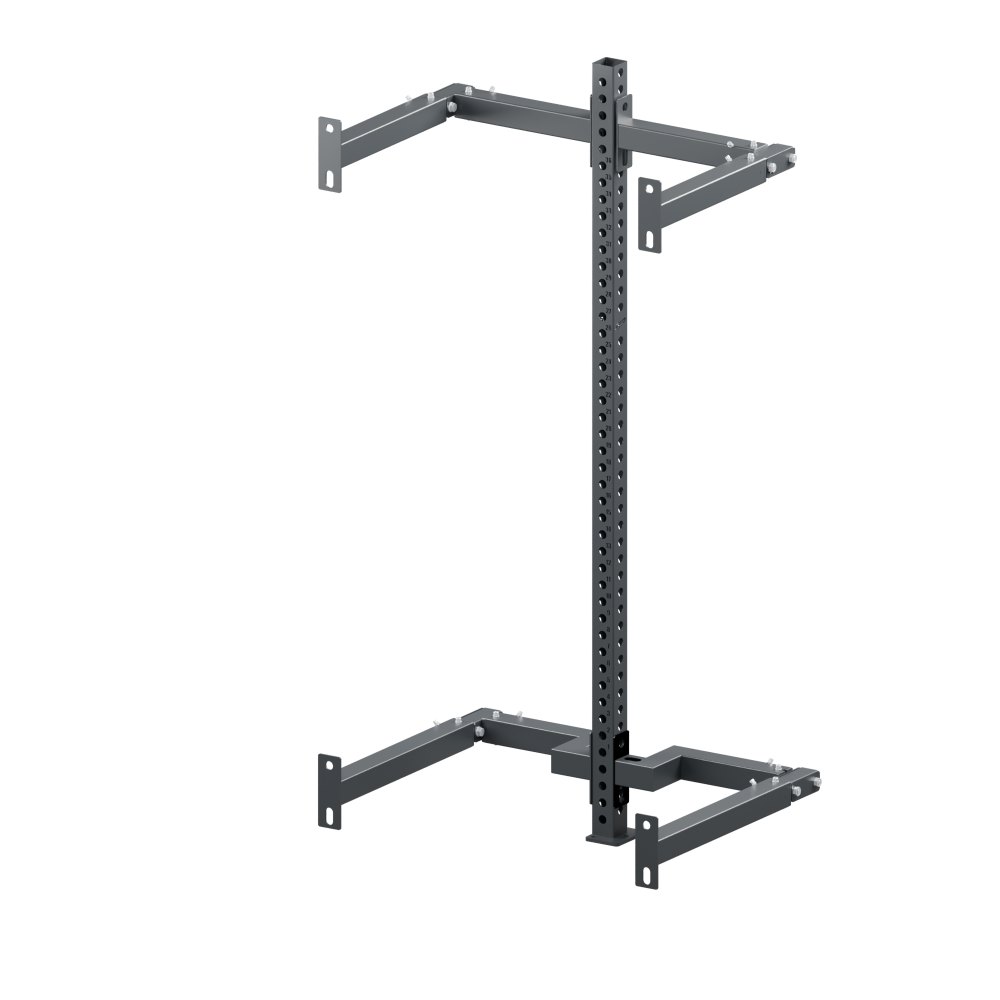
During the presale, Bulletproof takes an extra $100 off when you add the Wall Upright kit and an extra $200 off when you add a Rear Middle Upright. With the cheapest version of each, that comes to $1,398 for the Squat Arm plus wall kit and $1,428 for the Squat Arm plus Rear Middle Upright.
The Squat Arm page itself does not list which hole sizes or rack brands it fits. If your rack uses 5/8 in holes or is not a Bulletproof-listed size, confirm with Bulletproof before ordering.
What Bulletproof has not published yet
- Weight capacity: not listed for the arm or the weight horns.
- Starting resistance: not listed, so you cannot yet compare the empty-arm load with other machines.
- Machine weight: not listed on the product page.
- Ship date: the page shows an estimated shipping window of 2/20/26 to 3/20/26, which is already in the past for a product that went on presale in November 2026. Confirm the year with Bulletproof before relying on it. Bulletproof says ordering by 12/5/26 guarantees the earliest available ship date, and that you can cancel any time before it ships for a full refund.
- Reviews: none yet on the product page.
- Height range: the viewer shows height setting 2 of 5 as suiting about 5’4″. The full range of lifter heights is not listed.
How a pendulum squat loads your legs
We found no study of the Squat Arm, and a PubMed search for “pendulum squat” returned no studies of pendulum squat machines. The points below combine squat research with the geometry of the machine. The geometry parts are our inference, and we label them.
The path: an arc, not a straight line
On a hack squat, the back pad rides a straight, fixed rail. On a pendulum squat, the back pad is fixed to an arm that swings around a pivot, so your shoulders travel along an arc. Inferred from the design: because the pad swings down and forward with you, you can stay fairly upright while your knees travel forward over the footplate. That pattern puts more of the work on the knee than on the hip.
Research supports the idea that knee travel shifts the load between joints. In one study of 7 weight-trained men doing parallel barbell squats with a bodyweight load, letting the knees travel past the toes produced a knee torque of about 150 N·m and a hip torque of about 28 N·m. Blocking the knees from moving forward dropped knee torque to about 117 N·m and raised hip torque to about 303 N·m, with more forward trunk lean (Fry and colleagues, 2003). That was a barbell squat, not a machine. Inferred: foot placement on a pendulum footplate may shift load in a similar way, but this has not been measured.
Depth
Inferred from the design: the supported back makes deep knee bend easier to reach. Depth seems to matter for growth. In a 12-week study of 17 men, deep squats (0 to 120 degrees of knee flexion) produced larger gains in front thigh cross-sectional area (4 to 7 percent) than shallow squats (0 to 60 degrees) (Bloomquist and colleagues, 2013). In a 10-week study of 17 men, full squats grew the adductors and glutes more than half squats, while the knee extensors grew about the same in both groups (Kubo and colleagues, 2019).
The resistance curve
Inferred from basic lever mechanics: on any pivoting arm, the turning effect of a plate depends on its weight times its horizontal distance from the pivot. As the arm swings, that distance changes, so the load you feel changes through the rep. Where a pendulum feels hardest depends on where the weight horns sit relative to the pivot.
Bulletproof lets you change the weight horn angle and the starting position. Our reading is that both will move the point in the rep where the load feels heaviest. Bulletproof has not published a resistance curve, so we cannot say where that point is for any setting.
Inferred: the counterweight plate loading works against the arm’s own weight, and adding counterweight should lower the starting resistance, which helps lighter lifters or high-rep work. Temple of Gainz uses a similar idea on its standalone pendulum and says its loadable counter-balance horns let you “alter the resistance curve.”
Foot position: helpful, but smaller than people claim
Inferred: feet lower and closer under you lets the knees travel forward and loads the quads more. Feet higher and further forward limits knee travel and shifts more work to the hips, glutes and adductors. Keep expectations modest, though. A review of 18 EMG studies on the barbell back squat found that stance width, hip rotation and the front squat did not significantly change muscle activation (Clark and colleagues, 2012). Muscle activity is also not the same as muscle growth.
Muscles the Squat Arm is likely to train
| Muscle | Role in a pendulum squat | What the research shows |
|---|---|---|
| Vastus lateralis, medialis and intermedius (quads) | Main movers. They straighten the knee out of the bottom. | Deep squats grew the front thigh more than shallow squats (Bloomquist 2013). Full and half squats grew the knee extensors similarly (Kubo 2019). |
| Rectus femoris (quad that crosses the hip) | Works, but less than the vastus lateralis and medialis. | Less active than the vasti during squats (Ema 2017). Did not grow in either squat group (Kubo 2019). |
| Gluteus maximus | Extends the hip, most in deep positions. | Grew more with full squats than half squats (Kubo 2019). |
| Adductors | Help extend the hip at depth. | Grew more with full squats than half squats (Kubo 2019). |
| Hamstrings | Inferred: work little. They lengthen at the hip while shortening at the knee. | Did not grow in either squat group (Kubo 2019). |
| Calves | Mostly steady the ankle. | No pendulum squat data. Our inference from the movement. |
These studies used squats (not a pendulum machine) with groups of 14 to 17 men, so they show what deep squatting tends to do, not results measured on this machine.
Exercises on the Squat Arm
Shown by Bulletproof
- Pendulum squat: the main use. Quads first, then glutes and adductors, as covered above.
- Viking press: using the rear handles in the approved configuration. Inferred from the movement: this is an overhead press along an arc, so it trains the shoulders and triceps. Bulletproof has not shown a load range for it.
Variations from the adjustments
- Quad-focused setup: lower footplate position and full depth. Inferred from the knee-travel research above.
- Glute and adductor setup: higher, more forward foot placement and full depth. Inferred, and the difference may be smaller than expected.
- Bottom-range partials: setting the starting position and safety stop to work only the deep part of the rep. In one study of 45 untrained women on the leg extension, training only the more bent part of the knee’s range (100 to 65 degrees) grew some regions of the thigh more than full-range or less-bent partials (Pedrosa and colleagues, 2022). That was a leg extension, and 100 degrees is short of a deep squat’s bottom, so treat this as an idea, not a proven result. Check that the manual allows using the safety stop this way.
Not shown by Bulletproof
Bulletproof’s page shows only the pendulum squat and the Viking press, and it stresses approved settings, so check the manual before trying other exercises such as calf raises or single-leg squats.
Squat Arm vs standalone pendulum squat machines
Prices and specs from each maker’s own product page, checked November 22, 2026.
| Bulletproof Squat Arm | GMWD PS01 | Temple of Gainz V3.1 | Hammer Strength Pendulum-X | |
|---|---|---|---|---|
| Price | $1,299 presale, plus an upright if you need one | $899.99 (regular $1,199.99) | $2,429.99 (regular $2,699.99) | $8,820 |
| Size in use | 75.0 in deep x 29.8 in wide x 52.8 in high (at height setting 2 of 5) | 77 in long x 43 in wide x 62 in high | Not in the page text | 97 in long x 45 in wide x 81 in high |
| Folds away | Yes, to 20.6 in deep | No folding listed | No folding listed | No folding listed |
| Machine weight | Not listed | 287 lb | Not in the page text | 804 lb |
| Weight capacity | Not listed | 250 lb weight loading capacity | Not in the page text | 4 x 45 lb plates per arm |
| Starting resistance | Not listed | Not listed | Not listed | 81 lb per arm |
| Counterweight | Counterweight plate loading | Not listed | Loadable counter-balance horns | Not listed |
| Availability | Presale, ship date unclear | 2 to 7 business days in transit after shipment | Estimated in stock January 2027 | Delivered and installed within 12 to 14 weeks |
Where the Squat Arm makes sense
- You already have a compatible 6-post rack or a 4-post rack that fits the Rear Middle Upright, and floor space is your main limit.
- You want the floor back between sessions, for a car, a bench or other training.
- You are already in the Bulletproof system and want parts that share the same uprights.
Where a standalone machine makes more sense
- Known specs: GMWD and Hammer Strength list capacity and machine weight now. The Squat Arm does not yet.
- Price: the GMWD PS01 is cheaper than the Squat Arm alone, before any upright.
- Timing: GMWD lists 2 to 7 business days in transit after shipment. The Squat Arm is a presale with an unclear ship date.
- No setup each session: a fixed machine is always ready. The Squat Arm has to be unfolded, loaded and then unloaded in Bulletproof’s approved sequence before folding.
- Space while in use: folding only helps between sessions. In use, the Squat Arm needs about the same depth as the GMWD, and it still occupies 20.6 in of depth when folded.
Frequently asked questions
What muscles does a pendulum squat work?
Mostly the quadriceps, then the glutes and adductors, especially at full depth. The rectus femoris and hamstrings get less, based on squat studies, not pendulum machine studies. No study has measured the Squat Arm itself.
What is the difference between a pendulum squat and a hack squat?
A hack squat moves your back along a straight, fixed rail. A pendulum squat swings your back pad around a pivot, so you move in an arc. In our reading, the load changes through the rep depending on where the weight sits relative to the pivot. Our types of squat machines comparison covers both in more detail.
Does the Squat Arm need a rack?
No. It needs a compatible 3×3 upright, which can be the middle post of a 6-post rack, a Rear Middle Upright on a 4-post rack, or Bulletproof’s Wall Upright & Bracket Kit with no rack.
What is the Squat Arm’s weight capacity?
Bulletproof has not published one as of November 22, 2026.
Sources
- Bulletproof Fitness Equipment, Squat Arm, Rear Middle Upright and Wall Upright & Bracket Kit product pages, checked November 22, 2026.
- GMWD Fitness, Pendulum Squat Machine PS01 product page, checked November 22, 2026.
- Temple of Gainz, Plate-Loaded Adjustable Pendulum Squat V3.1 product page, checked November 22, 2026.
- Life Fitness Shop, Hammer Strength Plate Loaded Pendulum-X Squat product page, checked November 22, 2026.
- Bloomquist K, et al. Effect of range of motion in heavy load squatting on muscle and tendon adaptations. Eur J Appl Physiol. 2013. doi:10.1007/s00421-013-2642-7
- Kubo K, et al. Effects of squat training with different depths on lower limb muscle volumes. Eur J Appl Physiol. 2019. doi:10.1007/s00421-019-04181-y
- Fry AC, et al. Effect of knee position on hip and knee torques during the barbell squat. J Strength Cond Res. 2003. doi:10.1519/1533-4287(2003)017<0629:eokpoh>2.0.co;2
- Clark DR, et al. Muscle activation in the loaded free barbell squat: a brief review. J Strength Cond Res. 2012. doi:10.1519/JSC.0b013e31822d533d
- Ema R, et al. Effect of prolonged vibration to synergistic and antagonistic muscles on the rectus femoris activation during multi-joint exercises. Eur J Appl Physiol. 2017. doi:10.1007/s00421-017-3702-1
- Pedrosa GF, et al. Partial range of motion training elicits favorable improvements in muscular adaptations when carried out at long muscle lengths. Eur J Sport Sci. 2022. doi:10.1080/17461391.2021.1927199
Studies were found through PubMed.