
Quick answer
- Push pull legs (PPL) splits training into three days: push (chest, shoulders, triceps), pull (back, biceps, rear delts) and legs.
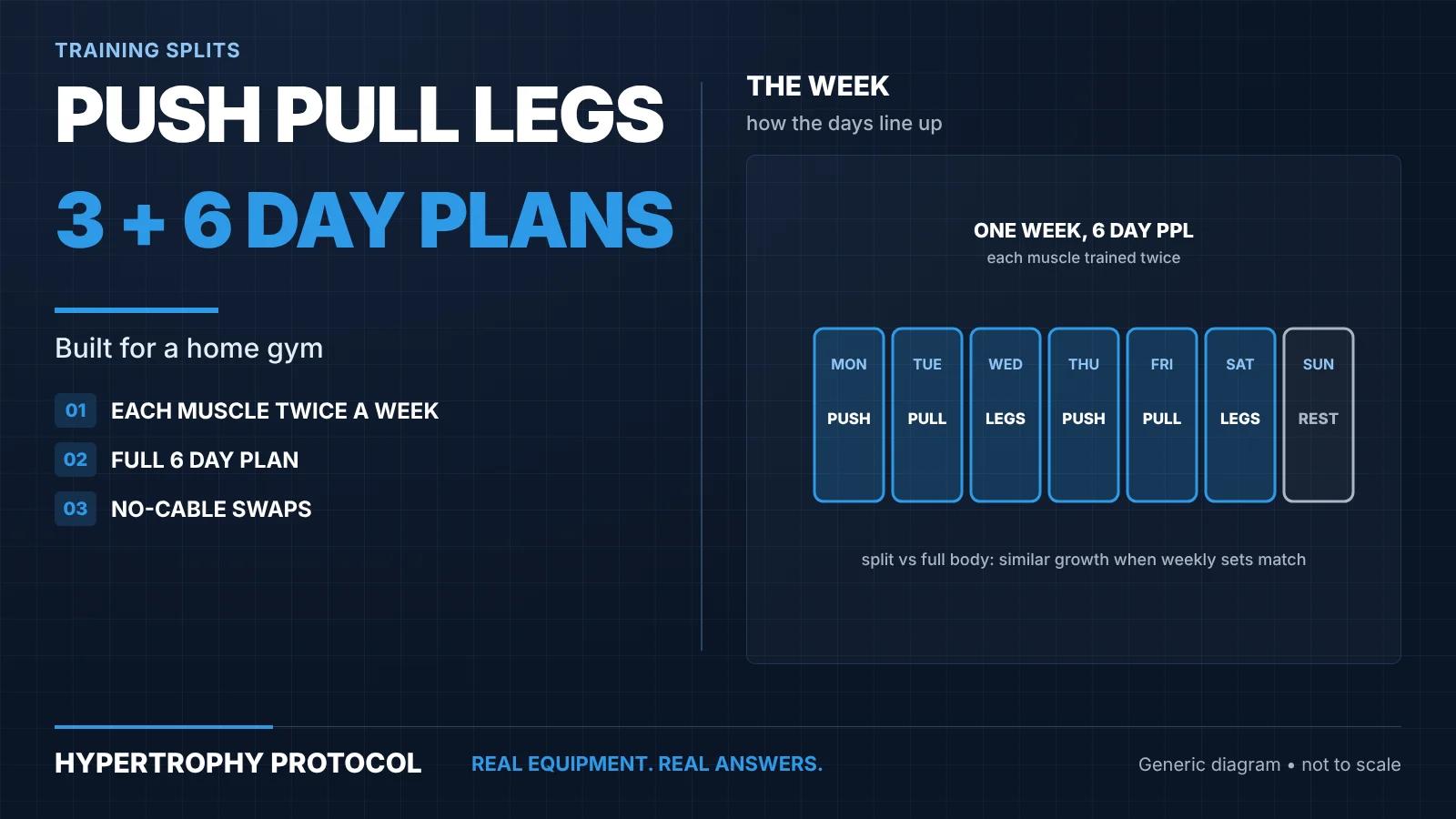
- Run it 6 days a week to train each muscle twice, or 3 days a week if you can fit enough sets into longer sessions.
- Research finds split and full-body routines build similar muscle when weekly sets are equal, so pick the schedule you can stick to.
- A home gym needs a rack, barbell, adjustable bench and dumbbells; a cable station or bands fills the gaps.
Push pull legs is one of the most popular ways to organize lifting for muscle growth, and it works well in a home gym. Below is how the split works, what the research says about it, and a complete 6 day plan using the equipment most home gyms have, with swaps if you don’t own a cable station.
What is a push pull legs split?
Each day trains muscles that work together, so you can hit them hard without overlap wrecking the next session:
| Day | Muscles | Typical lifts |
|---|---|---|
| Push | Chest, front and side delts, triceps | Bench press, overhead press, dips, lateral raises |
| Pull | Lats, upper back, rear delts, biceps | Rows, pull-ups or pulldowns, face pulls, curls |
| Legs | Quads, hamstrings, glutes, calves | Squats, Romanian deadlifts, lunges, leg curls |
Because pushing and pulling muscles rest while the others work, you can train on back to back days without the same muscles being sore and tired each time.
Does the split you choose matter?
Less than most people think. A 2024 meta-analysis pooled 14 studies with 392 people and found split routines and full-body routines produced similar strength and muscle gains when weekly volume was the same (Ramos-Campo et al., 2024). The authors concluded people can pick a routine based on preference.
How often you train each muscle also matters less than how much total work it gets. A 2019 meta-analysis of 25 studies found no meaningful difference in muscle growth between training a muscle more or less often when weekly sets were equal (Schoenfeld et al., 2019). A large 2025 analysis of 67 studies agreed: more weekly sets meant more growth, with diminishing returns, while frequency had little effect on muscle size on its own but did help strength (Pelland et al., 2025).
So the real job of a split is to help you get enough hard sets each week in sessions you can recover from. Training a muscle twice a week makes that easier, which is why an older review recommended at least twice a week for major muscles (Schoenfeld et al., 2016). More sets tends to mean more growth up to a point (Schoenfeld et al., 2017). Use the weekly sets planner to check your totals.
3 day vs 6 day push pull legs
| 3 day PPL | 6 day PPL | |
|---|---|---|
| Schedule | Push, pull, legs, then rest days between | Push, pull, legs, push, pull, legs, rest |
| Each muscle trained | Once a week | Twice a week |
| Session length | Longer, to fit enough sets | Shorter, sets split across two days |
| Best for | Busy weeks, beginners, anyone who wants more rest days | Lifters who enjoy training most days and recover well |
A middle option is a rolling schedule: push, pull, legs, rest, and repeat, regardless of the day of the week. Each muscle gets trained every fourth day, a little under twice a week. If you can only train 3 or 4 days and want each muscle twice a week, a full-body or upper/lower plan fits better. Our hypertrophy training program has both.
6 day push pull legs plan for a home gym
Two versions of each day, so the second session of the week uses different angles. Take most sets within 1 to 3 reps of failure, rest about 2 minutes on big lifts (how long to rest between sets), and add reps or weight when you hit the top of the rep range.
Push A
| Exercise | Sets x reps |
|---|---|
| Barbell bench press | 3 x 6 to 8 |
| Seated dumbbell overhead press | 3 x 8 to 10 |
| Incline dumbbell press | 3 x 8 to 12 |
| Dumbbell lateral raise | 3 x 12 to 15 |
| Overhead cable or band triceps extension | 3 x 10 to 15 |
Pull A
| Exercise | Sets x reps |
|---|---|
| Pull-up or lat pulldown | 3 x 6 to 10 |
| Chest-supported dumbbell row | 3 x 8 to 12 |
| Barbell row | 2 x 6 to 10 |
| Face pull (cable or band) | 3 x 12 to 15 |
| Incline dumbbell curl | 3 x 10 to 12 |
Legs A
| Exercise | Sets x reps |
|---|---|
| Back squat | 3 x 5 to 8 |
| Romanian deadlift | 3 x 8 to 10 |
| Bulgarian split squat | 2 x 8 to 12 each leg |
| Leg curl (machine, band or slider) | 3 x 10 to 15 |
| Standing calf raise | 3 x 10 to 15 |
Push B
| Exercise | Sets x reps |
|---|---|
| Incline barbell bench press | 3 x 6 to 10 |
| Dips (or close-grip bench press) | 3 x 8 to 12 |
| Standing overhead press | 2 x 6 to 8 |
| Cable or dumbbell lateral raise | 3 x 12 to 20 |
| Dumbbell skull crusher | 3 x 10 to 12 |
Pull B
| Exercise | Sets x reps |
|---|---|
| Chin-up or close-grip pulldown | 3 x 6 to 10 |
| One-arm dumbbell row | 3 x 10 to 12 each side |
| Seated cable row or band row | 2 x 10 to 15 |
| Rear delt fly | 3 x 12 to 20 |
| Hammer curl | 3 x 10 to 12 |
Legs B
| Exercise | Sets x reps |
|---|---|
| Front squat or safety bar squat | 3 x 6 to 10 |
| Hip thrust | 3 x 8 to 12 |
| Walking or reverse lunge | 2 x 10 each leg |
| Nordic curl or single-leg Romanian deadlift | 3 x 6 to 10 |
| Seated calf raise | 3 x 12 to 20 |
That works out to about 10 to 16 sets a week for chest, back, quads and hamstrings, and about 6 direct sets for biceps, triceps and side and rear delts, which also get extra work from presses and rows. That is a moderate starting volume: add a set here and there if you recover well, and beginners can start with 2 sets per exercise. For loads, the one rep max calculator turns any set into a percentage chart.
Home gym equipment for PPL
- Power rack, barbell and plates: squats, bench, overhead press, rows. Safeties let you train hard alone.
- Adjustable bench: flat, incline and seated pressing, chest-supported rows. See our adjustable bench guide.
- Dumbbells: most accessory work on all three days. Our adjustable dumbbells guide covers space-saving sets.
- Pull-up bar: usually built into the rack.
- Cable station or bands: face pulls, triceps work, lateral raises with constant tension. See cable attachments for hypertrophy.
No cable? Swap face pulls for band pull-aparts or rear delt flies, cable lateral raises for dumbbell lateral raises, and cable triceps work for dumbbell or band extensions. No leg curl? Use Nordic curls, slider curls or band curls.
Common PPL mistakes
- Overloading the lower back. Heavy barbell rows on pull day plus Romanian deadlifts on leg day can stack up. Chest-supported rows help.
- Skipping rear delts and side delts. Pressing hits the front delts hard; the sides and rears need their own sets.
- Leg days that never end. Keep the heavy lifts first and cap the session at 5 or 6 exercises.
- No rest day. Six days on is a lot. If performance drops for a week or more, take an extra rest day or a lighter week.
For more on building individual sessions, see how to build a hypertrophy workout, and for adding load over time, progressive overload in a small home gym.
Push pull legs FAQ
Is push pull legs good for beginners?
Yes, especially the 3 day version. Many beginners do well with full-body training three times a week too. Either works if you train consistently and add weight or reps over time.
Is push pull legs better than upper/lower?
Not for muscle growth on its own. Research finds similar results when weekly sets match. Upper/lower fits 4 days a week neatly; PPL fits 3 or 6.
Where do abs go in a PPL split?
Add 2 or 3 sets of an ab exercise to the end of any two or three days each week.
How long should a PPL workout take?
About 45 to 75 minutes for the 6 day plan above, depending on rest times. The 3 day version runs longer because each session carries more sets.
What rep range should I use?
Anywhere from about 5 to 30 reps builds muscle if sets are close to failure. Most lifters do best with heavier compound lifts in the 5 to 10 range and accessories in the 10 to 20 range. See the best rep range for hypertrophy.
Studies cited
| Study | What it covered | Main finding |
|---|---|---|
| Ramos-Campo 2024 | 14 studies, 392 people | Split and full-body routines gave similar strength and muscle gains with equal volume |
| Schoenfeld 2019 | 25 studies on frequency | No meaningful difference in growth when weekly volume was equal |
| Pelland 2025 | 67 studies, 2,058 people | More weekly sets meant more growth with diminishing returns; frequency mattered for strength, little for size |
| Schoenfeld 2016 | 10 studies on frequency | Twice a week beat once a week for growth |
| Schoenfeld 2017 | 15 studies on weekly volume | More weekly sets were linked to more muscle growth |