
Some links below are affiliate links, and as an Amazon Associate I earn from qualifying purchases. I may earn a commission at no extra cost to you. It doesn’t change what I recommend. See the affiliate disclosure.
A functional trainer machine is worth buying for a home gym if you want two independent cable columns you can set at any height, and you have the floor space and ceiling height for a frame that is usually 80 to 90 inches tall. Choose on five specs, in this order: pulley ratio, real resistance at the handle, height and footprint, cable travel, and how finely the carriages adjust. Stack size on the box comes last, because on most home units it isn’t the weight you feel.
If you already own a sturdy 3×3 power rack, a rack-mounted cable system can get you most of the same work in less floor space. If you are buying your first rack and want cables too, an all-in-one trainer may cover both. The decision table near the end sorts out which of the three fits you. Every spec below comes from the maker’s own product page, checked October 2026.
For transparency: I don’t own a standalone functional trainer. My cable work runs on two Bulletproof VTS setups, an Innodigym P1 Max with two Rogue solo pulleys, a Rogue TRD pulldown and a Beyond Power VOLTRA I, so the machine specs here are the makers’ numbers, not my measurements.
At a glance: the five specs that matter most, in order
| Spec | What to look for | Why it matters |
|---|---|---|
| Pulley ratio | 2:1 on most home units; a 1:1 lat and row if you pull heavy | It decides what the stack number means |
| Real load at the handle | Stack divided by the ratio, before friction | A 200 lb stack at 2:1 is about 100 lb per handle |
| Height and footprint | Most home frames are 78 to 82 in tall; add assembly clearance, pull-up headroom and a stride in front | It rules out the most machines in basements and garages |
| Cable travel | The listed travel against your longest movement | Too little and wide flys and overhead extensions stop short |
| Carriage adjustment | Number of positions and the lowest and highest pulley height | It sets how closely you can match the cable angle to the muscle |
Stack size on the box comes last. For current machines compared on these specs, see the best functional trainers for a home gym.
What is a functional trainer machine?
A functional trainer is a freestanding frame with two cable columns, one on each side. Each column has its own load, usually a weight stack, and a carriage (also called a trolley) that slides up and down so you can set the pulley anywhere from ankle height to overhead. Most add a pull-up bar across the top.
That layout is the point. Two independent cables let you do flyes, crossovers, single-arm rows and lateral raises from any angle, and you can train one side or both at once. A single cable tower or a lat pulldown station gives you one or two fixed cable paths. A functional trainer gives you a cable at almost any height on both sides.
Does the pulley ratio matter more than the stack weight?
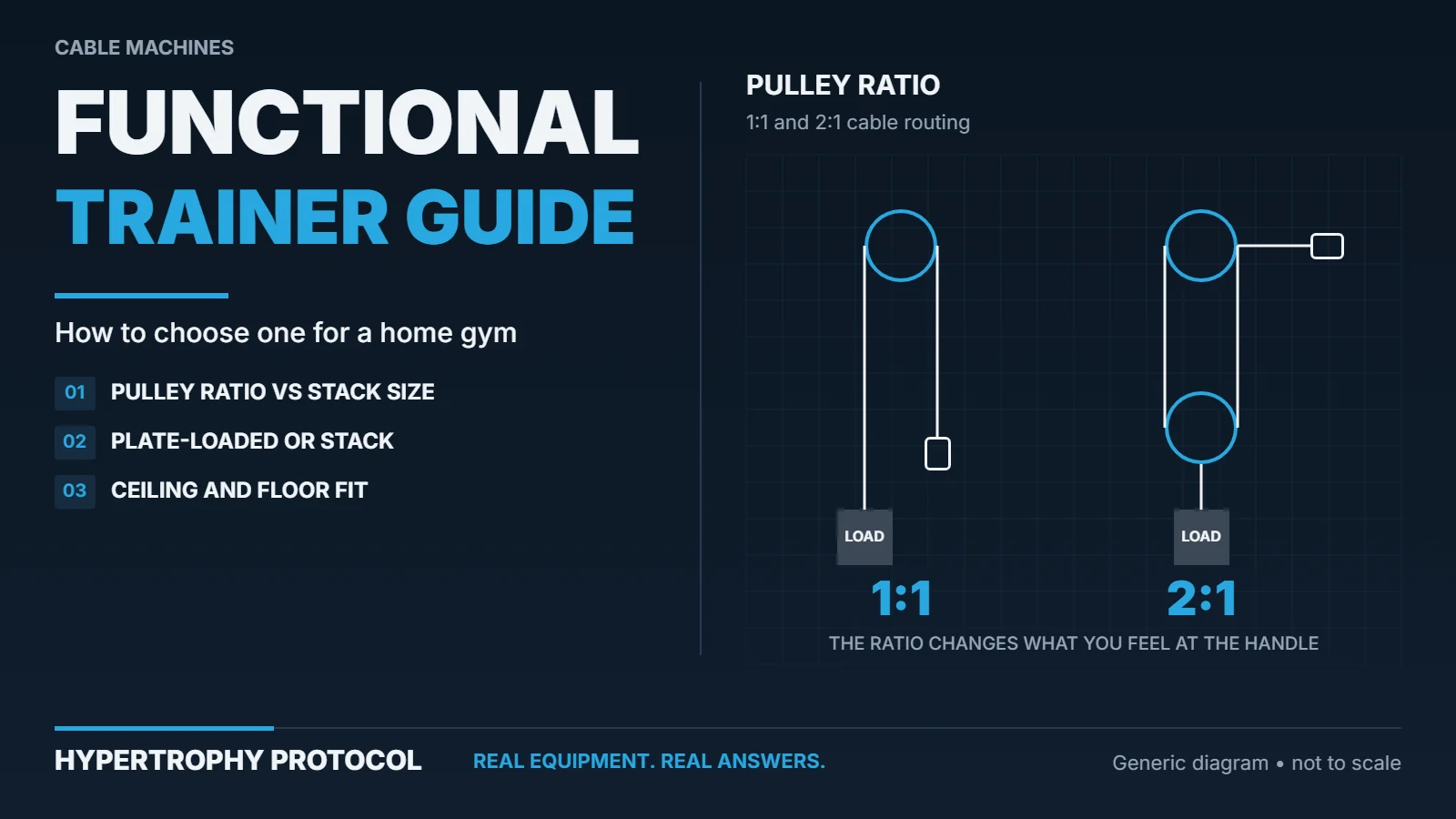
Yes, because the ratio decides what the stack number means. On a 1:1 machine, the handle moves as far as the weight and you feel the full stack, minus a little friction. On a 2:1 machine, the cable runs through a moving pulley on the stack, so the handle travels twice as far as the weight and you feel about half the load.
Most home functional trainers are 2:1. Titan’s 200 lb dual-stack Functional Trainer (also on Amazon, affiliate) is 2:1, as are REP’s Arcadia, Bells of Steel’s Functional Trainer and Rogue’s FT-1. Some designs mix ratios. REP’s Adonis runs its adjustable trolley at 2:1 and its lat pulldown and low row at 1:1.
Why 2:1 is the home default: it doubles cable travel, so a long fly or a high-to-low crossover doesn’t run out of cable, and it halves the increments, so a 10 lb plate step feels like 5 lb. That suits lateral raises, rear delts and single-arm work. The cost is the ceiling on heavy compound pulls. Rows and pulldowns for a strong lifter can outgrow half a stack.
The cable pulley ratios guide covers the mechanics and friction in more depth, and the Cable Pulley Ratio Calculator shows what a given pin setting gives you at the handle on 79 machines from 27 brands.
How much resistance do you actually get at the handle?
Divide the stack by the ratio for a first estimate. At 2:1, a 200 lb stack gives about 100 lb at the handle, a 170 lb stack about 85 lb and a 160 lb stack about 80 lb. Real machines add some friction, so treat these as ideal-pulley numbers.
| Machine | Stack per side (listed) | Ratio | Approx. max at each handle | Smallest step at the handle |
|---|---|---|---|---|
| Titan Functional Trainer | 200 lb, 10 lb increments | 2:1 | About 100 lb (ideal) | About 5 lb (ideal) |
| REP Arcadia | 170 lb (220 lb upgrade), 10 lb increments | 2:1 | 85 lb (110 lb upgraded), per REP | 5 lb, or 2.5 lb with the add-on weight, per REP |
| Bells of Steel Functional Trainer | 160 lb | 2:1 | About 80 lb (ideal) | Increments not listed |
| Rogue FT-1 | 250 lb, 10 lb increments | 2:1 | About 125 lb (ideal) | About 5 lb (ideal) |
Stack and ratio figures from each maker’s product page, checked October 2026. “Ideal” values are stack divided by ratio, checked with Wolfram|Alpha, and ignore friction. Only REP prints its own “feels like” numbers.
Two more numbers matter for light work. The first is the starting resistance, the load you feel with the pin at the top plate. Titan lists 20 lb as its starting resistance without saying whether that is at the stack or the handle. REP’s Arcadia page lists the minimum usable weight per side as 10 lb in its spec table and 20 lb (“feels like 10lbs”) in its FAQ, so check before you count on very light rear-delt work.
The second is the increment. A 5 lb jump on a lateral raise is a big percentage change. REP’s drop-down 5 lb add-on weight, which it says feels like 2.5 lb, is the kind of feature that makes small, steady progress possible on isolation lifts. If a machine lacks one, a pair of small magnetic add-on plates does the same job. For pin add-ons and extenders that aren’t safe on some stacks, see weight stack pin extenders and adapters.
Should you buy plate-loaded or weight stack?
The short version: a weight stack is faster to change and better for supersets and drop sets, while plate-loaded is cheaper, uses plates you already own and usually has more load headroom. The plate-loaded vs weight stack cable machines guide covers resistance feel, cost and space in full, so I won’t repeat it here.
Two points are specific to functional trainers. First, check whether the plate-loaded version has two independent loads or one shared load. Titan’s Plate-Loaded Functional Trainer (also on Amazon, affiliate) lists a 1:2 ratio for a single upright handle (“100 LB feels like 50 LB”, the same thing other makers call 2:1), 1:1 for paired handles, and 1:1 for its lat pulldown and low row, and its page doesn’t say whether the two sides move independently. Ask before you buy if you plan to train both arms at different loads. Second, look for an upgrade path. Bells of Steel sells a plate-loaded-to-weight-stack upgrade kit for its Functional Trainer, so you can start cheaper and add stacks later.
Will a functional trainer fit your ceiling and floor?
Height is the spec that rules out the most machines in a basement or garage. Listed heights from current maker pages range from 78 inches (REP Arcadia with its pull-up bar inverted) to 107.5 inches (Rogue FT-1). Most home models sit between 80 and 82 inches: Titan’s Functional Trainer is 82 in tall, Titan’s plate-loaded unit 81 in, Bells of Steel’s 81 in and the Arcadia 80.8 in.
Three height checks matter more than the frame number:
- Assembly clearance. Rogue lists the FML-6 Twin at 91.5 in tall but 92 in required for assembly. Tall frames often need a little extra room to tilt upright or to fit the top crossmember.
- Pull-up headroom. Your head goes above the bar. Force USA’s FAQ for its 87 in Functional Trainer Rack says you need at least 94 in to do a full chin-up. If the bar is near your ceiling, an inverted or lower bar position helps.
- Overhead cable work. The highest carriage position sets how steep a high-to-low crossover or a high-pulley overhead extension can be. REP lists its Arcadia trolley range as 13 to 68 in.
Footprint is the other half. Titan’s dual-stack unit takes 64 x 44 in of floor, Titan’s plate-loaded unit 61 x 53 in and the Arcadia 55.3 in wide at the front, 24 in at the rear and 35.8 in deep. Then add standing room. You’ll step a stride or more in front of the frame for presses and flyes, so leave clear floor in front of it, not just the base footprint. The Home Gym Room Planner checks a machine’s footprint and height against your room, ceiling and pull-up headroom, and the 10×10 home gym layout guide shows what fits in a small room.
How much cable travel is enough?
Cable travel is how far the handle can move away from the pulley before the stack tops out. Too little and long movements, such as a wide fly, a walk-out overhead extension or a split-stance press, stop short. Not every maker lists it. REP lists 81 in for the Arcadia, 93.4 in for the Arcadia Max and 108 in from the trolley on the Adonis. Rogue lists 68.7 in for the INDY at the 80 in height with the 250 lb stack and 59 in with the 300 lb stack. Titan says its 2:1 cabling gives “increased cable travel” without a number.
On a 2:1 machine the stack moves half as far as your hand, which is why 2:1 units tend to list longer travel. If a page gives no number, ask. It’s a quick email and it decides whether your longest exercise fits.
How many carriage positions do you need?
More positions mean finer control over the cable angle, which matters for matching the line of pull to the muscle. Current counts vary widely: 16 per side on Bells of Steel’s Functional Trainer and Rogue’s FT-1, 20 on Titan’s, 32 on the Arcadia and 36 on the Arcadia Max. The range matters as much as the count. REP gives the Arcadia Max’s trolley range as 12.8 to 77.5 in, and a lower bottom position gives you a lower start for upright rows, curls and kickbacks.
Check the adjustment mechanism too. A pop-pin you can reach with one hand makes switching between a high and a low exercise fast, which matters most when you superset.
Is a built-in pull-up bar worth having?
Usually yes, if you don’t have one elsewhere. Titan, REP’s Arcadia and Bells of Steel’s Functional Trainer include a multi-grip bar. Rogue’s FT-1 doesn’t include one, though its top crossmember takes an optional bar sold separately. Before you count on it, check the pull-up headroom above.
What attachments should come in the box?
Included attachments range from two D-handles to a full set. REP’s Arcadia ships with two steel D-handles with nylon straps. Titan’s dual-stack unit includes a triceps rope, ankle strap, D-handle grips and straps, a long bar, a short bar and a triangle row handle. Bells of Steel’s stack version includes two single D-handles, carabiners and chains.
A thin kit isn’t a reason to skip a good frame, since handles are cheap. For hypertrophy work, the attachments that earn their place are single D-handles, a rope, a lat bar, ankle cuffs and a close-grip row handle. Cable attachments for hypertrophy matches handles to muscles.
Does the frame steel matter on a functional trainer?
Less than on a power rack, because you don’t drop a barbell on a functional trainer, but it still affects stability and how much the frame flexes on a heavy row. Some makers list it and some don’t. Rogue builds the FT-1 from 3×3 in 11-gauge steel, and Bells of Steel lists 14-gauge steel rails. Titan’s dual-stack page says “heavy-duty steel” without a gauge, and REP’s Arcadia page doesn’t state one. Product weight is a reasonable proxy when the gauge isn’t listed: Titan lists its dual-stack unit at 672 lb.
Whatever the gauge, follow the anchoring instructions. Rogue’s FT-1 must be bolted to the floor, and Bells of Steel says its Cable Tower functional trainer must be bolted down. In a coastal garage, finish and hardware matter as much as gauge, and the coastal rust prevention guide covers how to protect cables, pulleys and bolts. For what gauge numbers mean, see 11-gauge vs 14-gauge steel.
Standalone trainer, rack-mounted cables or all-in-one: which should you buy?
Those specs apply to every cable setup, but the bigger choice is the format. A rack-mounted system turns the rack you already own into cable columns. My own setup is two Bulletproof VTS sets, and the guide to turning a rack into a dual functional trainer with Bulletproof shows the parts. An all-in-one trainer combines a rack, a Smith machine and cable stacks in one frame, and what attachments fit all-in-one trainer racks covers the Major Fitness, Mikolo and RitFit frames.
| If this sounds like you | Buy | Why | Main trade-off |
|---|---|---|---|
| You already own a 3×3 rack and train alone | Rack-mounted cable system | Adds two cable columns with no new footprint | Usually plate-loaded; slower weight changes; shares the rack with barbell work |
| You superset cables with barbell lifts, or two people train at once | Standalone functional trainer | Cables stay ready while the rack is in use; pin changes in seconds | Needs its own floor space and 80 in or more of height |
| You mostly do isolation work (lateral raises, flyes, triceps) | Standalone 2:1 weight stack trainer | Light start, small steps, long cable travel | Heavy rows and pulldowns can max out half a stack |
| You row and pull down heavy | A machine with 1:1 lat and row, or plate-loaded 1:1 | Full load reaches the handle | Bigger jumps between plates or pins |
| You have no rack yet and one wall to use | All-in-one trainer | Rack, Smith and cables in one footprint | Cables and barbell share one station; attachment fit varies by brand |
If you’re still choosing a rack, the Power Rack Comparison Tool and the Rack Attachment Fit Checker help decide whether a rack-mounted cable system will fit the rack you have.
Which cable exercises are worth doing for hypertrophy?
A functional trainer’s value is in movements that are awkward with free weights. Here’s a short list, with the training research where it exists. Most cable exercises have no head-to-head growth study, so where the evidence is thin, I say so.
- Overhead cable triceps extension. This one has the strongest data. In 21 adults training 12 weeks on a cable machine, the arm trained overhead grew more triceps than the arm trained with pushdown-style extensions in a neutral position: long head volume rose 28.5% vs 19.6% (Cohen’s d 0.61), and whole triceps volume rose 19.9% vs 13.9%, even though the overhead arm used 34 to 39% lighter loads (Maeo et al., 2023). It’s one study, but it was MRI-measured and ran 12 weeks. If you only do one triceps cable movement, make it the overhead one. Training at long muscle lengths explains why the overhead position may matter.
- Cable lateral raise. Cables aren’t magic here. In 24 trained lifters over eight weeks, cable and dumbbell lateral raises grew the side delts about the same, with muscle thickness up 3.3 to 4.6% (Larsen et al., 2025). Use the cable if you like its different resistance curve or its small load jumps, not because it grows more muscle.
- Lat pulldown (half-kneeling single-arm or with a bar). No training study has compared pulldown grip widths for growth. In 15 men, lat activity was similar across narrow, medium and wide grips, and the 6RM was slightly lower with the wide grip (77.3 kg vs about 80 kg) (Andersen et al., 2014). That’s EMG and strength, not growth, so pick the grip that feels best on your shoulders.
- Seated or standing cable row. No cable-specific growth data. A 1:1 path or a high stack helps here, since rows load heavier than most cable work.
- Cable fly and crossover. No growth study against dumbbell flyes. The draw is constant tension at the stretched position and easy angle changes for upper, middle and lower chest.
- Face pull and reverse fly. Good rear-delt options with light starting loads. No head-to-head growth data.
- Cable curl, including behind-the-body. Lets you load the biceps with the arm behind you. No direct growth comparison with dumbbell curls.
- Cable pull-through and kickback. Hip-extension work for the glutes when you can’t load a hinge heavily. Evidence for these specifically is thin.
The common thread in the research is that the cable itself isn’t the growth factor. Effort, load progression and range of motion are. Machines vs free weights for muscle growth covers the broader comparison, and progressive overload in a small home gym covers how to keep adding load when the steps are coarse.
What’s the quick checklist before you order?
- Ratio: 2:1 for isolation work and long travel; look for 1:1 options if heavy rows and pulldowns are the priority.
- Handle load: divide the stack by the ratio, then compare it with your current row and pulldown weights.
- Light end: starting resistance and smallest step, for lateral raises and rear delts.
- Height: frame height, assembly clearance and pull-up headroom against your ceiling.
- Floor: base footprint plus a stride of standing room in front.
- Cable travel and carriage range: enough for your longest movement and your lowest and highest pulley settings.
- Anchoring: whether the maker requires bolting down, and whether your floor allows it.
Once you have a shortlist, the best functional trainers for a home gym compares current models on those specs.
FAQ
Is a functional trainer worth it for building muscle at home?
Yes, if you’ll use it for movements free weights do poorly, such as overhead triceps extensions, flyes, single-arm rows and lateral raises with small load steps. If you mostly press and squat with a barbell, a rack-mounted cable system on the rack you own is cheaper and saves floor space.
What does 2:1 mean on a functional trainer?
The handle moves twice as far as the weight stack, and you feel about half the stack weight, before friction. A 200 lb stack at 2:1 gives about 100 lb at the handle.
How tall a ceiling do I need for a functional trainer?
Most home models listed in this guide are 78 to 82 inches tall, but leave room for assembly and pull-ups. Force USA, for example, says a full chin-up on its 87-inch Functional Trainer Rack needs at least 94 inches. Run your room through the Home Gym Room Planner before ordering.
Is a plate-loaded functional trainer a good idea?
It’s a good budget choice if you already own plates and don’t change weights mid-superset. Check whether the two sides load independently and what the cable ratio is for each station.
Related guides
- Cable Pulley Ratios Explained: 1:1 vs 2:1 Systems
- Cable Pulley Ratio Calculator
- Plate-Loaded vs Weight Stack Cable Machines
- Turn Your Rack Into a Dual Functional Trainer With Bulletproof
- What Attachments Fit All-in-One Trainer Racks?
- Cable Attachments for Hypertrophy
- Home Gym Room Planner
- All free tools
Specs checked October 2026 on each maker’s product page. Manufacturers change specs; confirm on the product page before ordering.